
Choosing your first guitar isn’t about picking acoustic *or* electric; it’s about building a foundational skillset that will serve both.
- Most teachers recommend acoustic first to build a “rhythmic foundation” and clean technique, which can drastically reduce the chance of quitting.
- Your physical comfort—how the instrument’s body shape fits your physique—is a more critical starting point than the genre of music you like.
Recommendation: Start by identifying your long-term goals, then choose the instrument that best builds the fundamental skills required to get there.
That feeling is universal for every aspiring guitarist: standing in a music store, caught between two worlds. In one hand is the raw, resonant honesty of an acoustic guitar, the instrument of campfires and coffeehouses. In the other, the sleek, iconic power of an electric, promising searing solos and stage-shaking riffs. The common advice is to “pick the one your heroes play” or to follow the simple logic that acoustic is for folk and electric is for rock. While there is truth to this, it overlooks a more fundamental question.
What if the choice wasn’t a final destination, but the first strategic step in a lifelong musical journey? The real question isn’t “acoustic or electric?” but rather, “Which instrument will best build the rhythmic and physical foundation for the musician I want to become?” This decision is less about picking a team and more about choosing the right training ground. Approaching it with a long-term strategy ensures that you are not closing doors but opening them, building skills that will make you a versatile and confident musician, regardless of which instrument you eventually favor.
This guide will walk you through that strategic decision. We will explore why so many instructors point to the acoustic as the ideal starting point, how your own physique should influence your choice of guitar shape, and how the skills you build on one instrument directly translate to the other. We will even cover how to bridge the technical gap with equipment and properly care for your instrument like a professional.
Summary: Your Path from First Chord to Future Versatility
- Why Do 80% of Teachers Recommend Starting on Acoustic Guitar?
- How to Adapt Your Acoustic Strumming Hand for Electric Solos?
- Dreadnought or Parlor: Which Body Shape Fits Your Physique?
- The “Noodling” Trap: Why Soloing Won’t Get You Gigs?
- How to Configure a Pedalboard That Works for Both Electric and Acoustic?
- Why Does Moving the Accent Turn a Soleá into a Bulería?
- Why Does Dry Air Make Your Action Drop and Strings Buzz?
- How to Prevent Your Acoustic Guitar from Cracking in Winter?
Why Do 80% of Teachers Recommend Starting on Acoustic Guitar?
The recommendation to start with an acoustic guitar isn’t about tradition or making things unnecessarily difficult. It’s a strategic move to combat a harsh reality: 90% of first-time guitar learners give up within the first year. An acoustic guitar provides the ideal environment to build the core skills that make playing rewarding, which in turn keeps you motivated. It forces you to become a self-contained musical unit, developing a strong sense of rhythm and clean technique from day one.
Unlike an electric guitar, where amplification and effects can hide sloppy playing, an acoustic is brutally honest. Every buzz, muted string, and inconsistent strum is audible. This direct feedback is invaluable. It trains your hands to form chords cleanly and your strumming to be intentional and dynamic. This process builds a solid rhythmic foundation, the single most important skill for any musician. You learn to provide your own bass, chords, and percussion simultaneously, developing an unshakeable inner clock.
The key benefits of this approach are foundational:
- Natural Finger Strength: The higher string tension on an acoustic builds callus and finger dexterity more effectively, making the eventual transition to an electric feel effortless.
- Clean Fretting Habits: Without the crutch of distortion, you learn to press down on the strings with the right pressure and placement to produce a clear, pure tone.
- Holistic Song Structure: You are the entire band. This forces you to learn how a song is constructed from intro to outro, not just the flashy lead parts.
- Dynamic Control: The direct resonance of the guitar’s body teaches you to control volume and emotion through your touch alone, a skill that translates beautifully to electric playing.
Starting on an acoustic isn’t about choosing a genre; it’s about investing in a skillset that will make you a better musician, no matter what kind of guitar you play in the future.
How to Adapt Your Acoustic Strumming Hand for Electric Solos?
The transition from the broad, rhythmic motions of acoustic strumming to the precise, articulate picking required for electric solos is one of the biggest technical hurdles for a developing guitarist. The hand that once acted as a powerful engine for chords must now become a surgical tool for individual notes. This is a change in mechanics, not just a change in instrument.
Acoustic strumming involves a loose wrist and a sweeping motion from the elbow, designed to strike multiple strings at once. In contrast, electric lead playing demands economy of motion. Most of the movement comes from the wrist and the subtle flex of the thumb and index finger holding the pick. The goal is to isolate single strings with accuracy and speed, often while using the palm of the same hand to mute other strings and control unwanted noise—a technique known as palm muting.
This image illustrates the subtle but critical shift in hand posture and pick grip required to move from one style to the other.
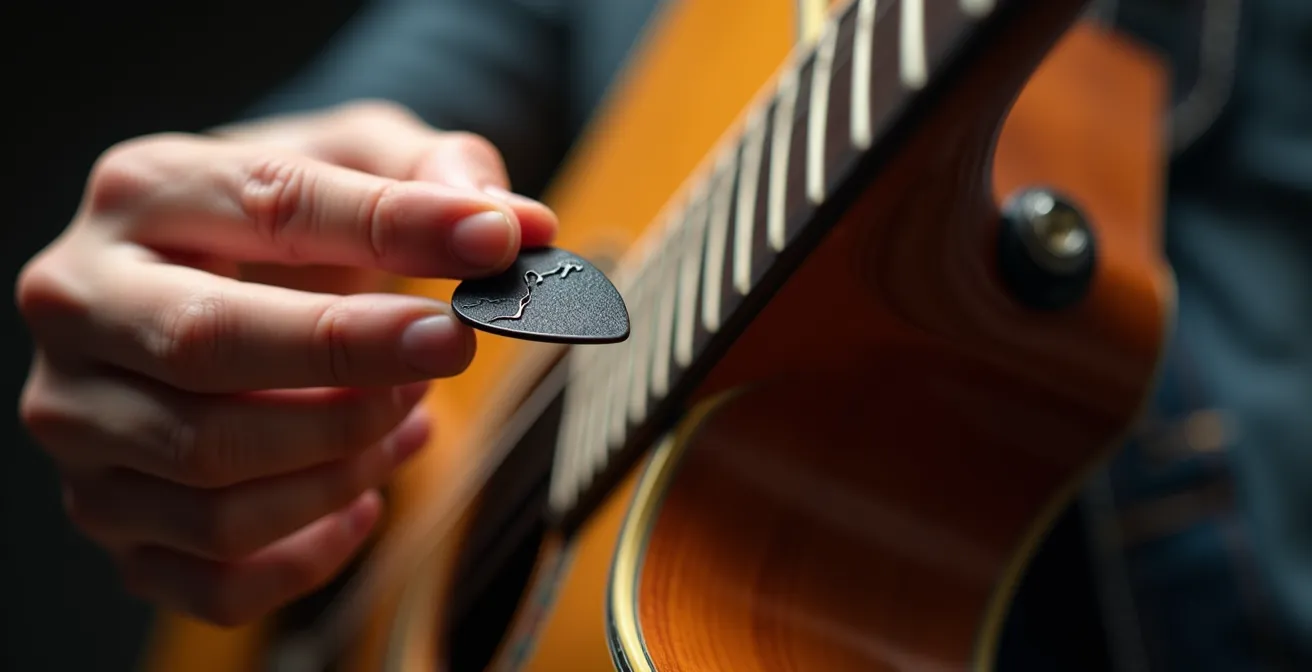
As you can see, the anchor points change. While strumming, the hand may float freely. For soloing, players often anchor their palm or pinky finger on the bridge or body of the guitar to create a stable platform for precise picking. The skills are not mutually exclusive; they are two sides of the same coin. The dynamic control you learned on the acoustic—playing loud and soft—translates directly into the expressive nuance of an electric solo. The powerful down-strum of a chorus becomes the aggressive attack on a single note in a rock solo.
Dreadnought or Parlor: Which Body Shape Fits Your Physique?
Before you even consider tone or genre, the most important factor in choosing your first acoustic is comfort. If an instrument is physically uncomfortable to hold, you simply won’t play it as often. The guitar should feel like an extension of your body, not an obstacle to overcome. This relationship between your body and the instrument’s shape is what we can call the physical interface, and it’s a critical, often overlooked, part of the selection process.
Acoustic guitars come in a wide range of body sizes, from small “parlor” guitars to large “dreadnoughts” and “jumbos.” While electric guitars are generally heavier, acoustics are bulkier. According to Fender Musical Instruments, the average weight of an electric guitar is 6 to 12 lbs, while acoustics are lighter at 2 to 6 lbs, but their larger bodies can be cumbersome for smaller players. A tall player with long arms might feel cramped on a small parlor guitar, while a shorter player might struggle to get their arm around a deep-bodied dreadnought, leading to shoulder pain and poor posture.
The following table provides a general guide to help you match a body shape to your physical frame and playing style. Use it as a starting point to understand how shape influences both comfort and sound.
| Body Shape | Best For | Sound Character | Electric Equivalent Feel |
|---|---|---|---|
| Dreadnought | Taller players, powerful strumming | Booming bass, high volume | Les Paul, Semi-hollow |
| Parlor | Smaller frames, fingerstyle | Focused mids, intimate tone | Stratocaster, Telecaster |
| Concert/000 | Versatile players | Balanced frequency response | SG, PRS |
Ultimately, the best way to know is to go to a store and hold them. Sit down. Stand up. Does the guitar rest comfortably on your leg? Can your strumming arm reach over the body without straining your shoulder? Choosing the right physical interface is your first major step towards a long and enjoyable relationship with your instrument.
The “Noodling” Trap: Why Soloing Won’t Get You Gigs?
Many beginners, drawn to the electric guitar, dream of playing lightning-fast solos. They spend hours learning scales and licks, a practice often called “noodling.” While technically impressive, this focus on lead playing at the expense of rhythm is a common trap. As professional guitar instructor Jeff B. notes, “The most in-demand skill in any band is solid rhythm, the very foundation built on an acoustic.” A band can survive with a simple soloist, but it cannot function without a tight rhythm section.
Your role as a guitarist in a group setting is, 90% of the time, to provide the harmonic and rhythmic backbone of the song. You are part of a team, and your job is to make the whole band sound good. A player who only knows how to solo is like a soccer player who only knows how to take penalty kicks—impressive in isolation, but useless for the majority of the game. The ability to lock in with a drummer, to complement a bass line, and to create a solid bed for a vocalist is what makes you a valuable and hireable musician.
Case Study: The Rhythmic Mastery of Rodrigo y Gabriela
An analysis of professional equipment trends reveals that even virtuoso players prioritize rhythm. The duo Rodrigo y Gabriela, famous for their fiery, flamenco-infused performances, blend acoustic and electric sounds. Gabriela Quintero, the rhythmic engine of the pair, uses a minimal setup focused entirely on enhancing her percussive, complex acoustic strumming. Her role proves that rhythmic command can be just as captivating—and more musically essential—than a flurry of lead notes. This rhythm-first approach is what gives their music its immense power and has earned them global acclaim, demonstrating that rhythmic mastery opens more professional doors than solo virtuosity alone.
The rhythmic foundation you build—whether on an acoustic or a clean-toned electric—is your ticket to playing with others. It teaches you to listen, to feel the groove, and to understand your role in a larger musical conversation. So, learn your scales, but never at the expense of your rhythm.
How to Configure a Pedalboard That Works for Both Electric and Acoustic?
For the guitarist who refuses to choose, the modern solution is a hybrid setup that accommodates both acoustic and electric instruments. This is no longer a niche practice; artists from bluegrass innovator Billy Strings to metal bands have incorporated acoustic sounds into their live shows. The key is a thoughtfully designed pedalboard—a strategic signal chain architecture—that can process both signals effectively, often at the same time.
The core challenge is that acoustic and electric guitars have different needs. An acoustic pickup needs clean pre-amplification and subtle EQ to sound natural, while an electric guitar signal is designed to be shaped by overdrive, modulation, and other effects. A simple A/B/Y pedal can split your signal into two separate paths, one for each instrument. However, more elegant solutions now exist in a single box.
The All-in-One Solution: Line 6 HX Stomp
Modern multi-effects units like the Line 6 HX Stomp are capable of processing and routing both signals simultaneously. By loading “Acoustic Impulse Responses” (IRs)—digital snapshots of high-end acoustic tones—you can make a standard pickup sound like a professionally miked instrument. You can then create separate presets for your acoustic and electric, each with its own chain of effects (like compression, reverb, or delay) and send them to different outputs, one to a PA system and one to a guitar amp. This provides a compact, powerful, and professional-grade hybrid rig.
Building a board that serves both masters requires careful planning. The following checklist outlines the essential utility pedals that form the foundation of a versatile dual-use setup.
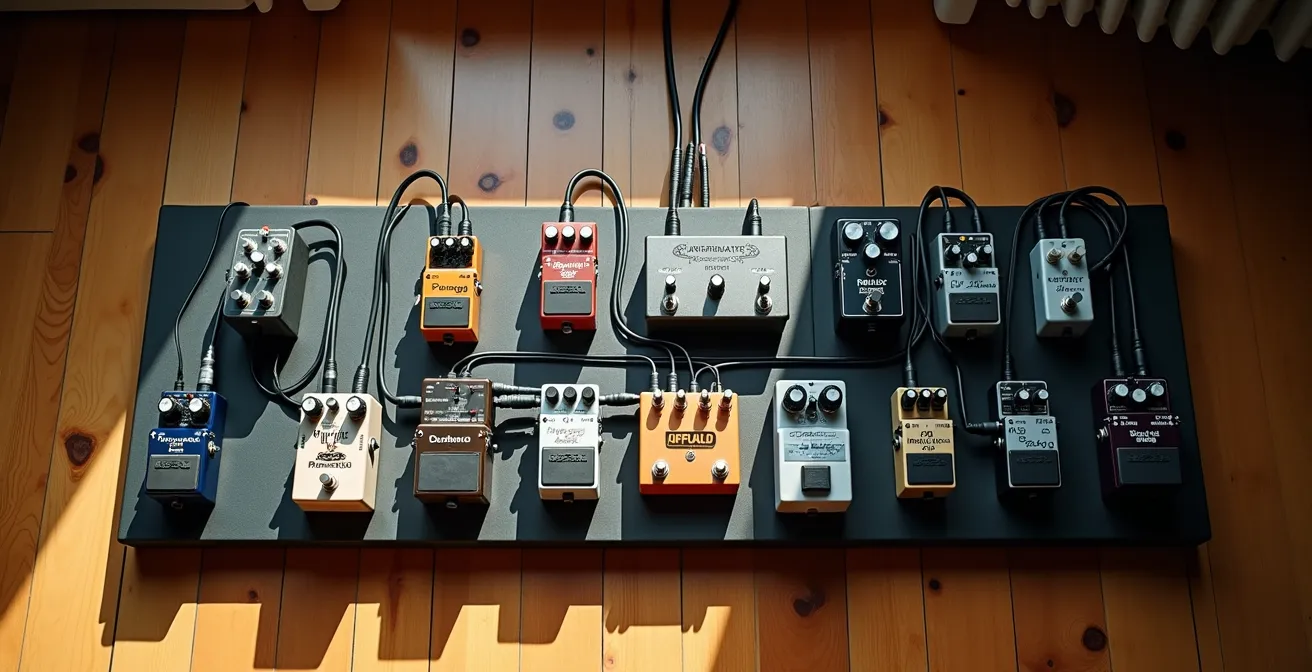
Your Action Plan: Building a Hybrid Pedalboard
- Start with a high-quality compressor: Use it to manage the sharp attack of an acoustic and add sustain to an electric, creating a more consistent dynamic range for both.
- Add a graphic EQ pedal: This is your problem-solver. Use it to cut feedback-prone frequencies on your acoustic or to sculpt the midrange of your electric tone.
- Include a clean boost: Perfect for lifting your volume for a solo or a featured acoustic part without adding unwanted distortion or color to your sound.
- Consider an IR loader: This is the ultimate “bridge” pedal. It can make your acoustic pickup sound incredibly natural and can also be used to emulate different speaker cabinets for your electric.
- Use an A/B/Y pedal for signal routing: This is the traffic cop of your board, allowing you to switch between instruments or even blend them together, sending each to its dedicated processing chain or amp.
–
Why Does Moving the Accent Turn a Soleá into a Bulería?
On the surface, this question about two specific Flamenco rhythms seems advanced and obscure. However, it holds the ultimate lesson about the power of a rhythmic foundation. A Soleá and a Bulería are both based on the same 12-beat cycle. The only thing that separates them is the placement of the strong accents. By shifting where you place the emphasis—from beat 12 in a Soleá to beat 3 in a Bulería, for example—the entire feel, emotion, and energy of the music transforms. This is rhythmic control at its most profound level.
This is a skill honed through deep listening and physical practice, an intuition most naturally developed on a responsive acoustic instrument where the player *is* the entire rhythm section. It’s about understanding that rhythm is more than just keeping time; it’s about shaping time. This sensibility is what allows a player to develop a truly unique voice, or tonal signature, that goes far beyond the notes they play.
As virtuoso guitarist Rodrigo Sánchez of Rodrigo y Gabriela explains, this rhythmic depth is the true source of a player’s identity:
The player’s unique rhythmic sensibility, honed on an acoustic instrument, is the key to developing a signature voice on electric, far more than just learning scales.
– Rodrigo Sánchez, Premier Guitar Rig Rundown Interview
Learning to manipulate accents is like learning the difference between a statement and a question in speech. It adds inflection, emotion, and meaning. This skill, once internalized, can be applied to any genre. It’s what makes a reggae rhythm swing, a funk groove pop, and a rock riff punch. The ability to feel and place accents is what separates a mechanical player from a musical one, and it is the ultimate payoff from building that solid rhythmic foundation from the very beginning.
Why Does Dry Air Make Your Action Drop and Strings Buzz?
Owning a quality guitar, especially an acoustic, comes with a responsibility that goes beyond practicing. You become the steward of a living, breathing object made of wood. Understanding the concept of environmental stability is non-negotiable for protecting your investment and ensuring your instrument plays its best. The single greatest threat to a wooden guitar is a lack of humidity.
Guitars are built in environments with controlled humidity, typically between 45-55%. When the surrounding air becomes too dry (common in winter or in desert climates), the wood begins to lose its own moisture and shrink. This process has several predictable and damaging effects. The top of the acoustic guitar, which is a thin sheet of wood under tension, will begin to sink. As the top drops, it pulls the bridge and strings down with it, lowering the “action” (the height of the strings off the fretboard). When the action gets too low, the strings start to rattle against the frets, creating an annoying buzz.
Simultaneously, the fretboard itself, also made of wood, will shrink in width. Since the metal frets do not shrink, their ends will begin to poke out from the sides of the neck, feeling sharp to the touch. According to guitar care experts, this is the first and most obvious warning sign, as dehydration begins at 35% humidity, with sharp fret ends appearing. Even solid-body electric guitars are vulnerable, as their wooden necks and fretboards can suffer the same fate.
Ignoring these signs can lead to far more severe damage, including cracks in the guitar’s body and a warped neck. Understanding the physics of humidity is the first step in preventing these costly and often irreversible problems.
Key Takeaways
- Starting on acoustic builds a “rhythmic foundation” that helps combat the 90% quit rate among new players.
- Physical comfort, achieved by matching the guitar’s body shape to your physique, is more crucial than genre when starting out.
- Rhythmic mastery, not soloing, is the most valuable and hireable skill for any musician looking to play in a band.
How to Prevent Your Acoustic Guitar from Cracking in Winter?
Now that you understand why dry air is the enemy, protecting your guitar becomes a simple matter of proactive care. Preventing dehydration is infinitely easier and cheaper than repairing a cracked or warped instrument. The most common cause of catastrophic damage to an acoustic guitar is letting it fall below 35% relative humidity for extended periods. Your goal is to create a stable micro-environment for your instrument, especially during the dry winter months when indoor heating leaches moisture from the air.
The most effective strategy is to store your guitar in its hard case when you are not playing it. A case acts as a small, controllable chamber, isolating the guitar from the drastic humidity swings of the larger room. This allows you to manage its environment with minimal effort. You should also allow the guitar to acclimate to temperature changes slowly. If you bring a cold guitar inside, leave it in the case for several hours to warm up gradually before opening it to avoid sudden expansion that can cause finish cracks.
To maintain proper humidity inside the case, follow this simple protocol:
- Use a two-way humidification system: Products like the D’Addario Humidipak are designed to automatically maintain a stable 45-50% relative humidity by either releasing or absorbing moisture as needed. They are foolproof and highly effective.
- Monitor with a digital hygrometer: Don’t guess. Place a small, inexpensive digital hygrometer inside the case with your guitar. This gives you an accurate, at-a-glance reading of the humidity level.
- Be consistent, even with long-term storage: Out of sight should not mean out of mind. If you are storing a guitar for the season, check the hygrometer and humidification system monthly to ensure they are still working.
This simple maintenance routine is the mark of a serious musician. It ensures your instrument is always stable, playable, and protected, ready for you whenever inspiration strikes.
By shifting your perspective from a simple “acoustic vs. electric” debate to a strategic plan for building foundational skills, you are setting yourself up for success. You can now walk into that music store not with confusion, but with a clear purpose: to find the instrument that is the right first step for your unique musical future. Start your journey today by finding the guitar that feels like a partner in your long-term growth.
Frequently Asked Questions About Guitar Care and Choice
What humidity range should I maintain for my guitar?
Guitars should be kept within a comfortable range of 45-55 percent relative humidity to prevent cracking and other structural issues.
How does dry air affect both acoustic and electric guitars?
Even solid-body electrics need humidity control as they have wooden necks and fingerboards. A telltale sign of dryness on any guitar is when fret ends start poking out from the sides of the neck as the fingerboard shrinks.
Can humidity changes affect guitar intonation?
Yes, drastically. The combination of a dropping top on an acoustic and a rising neck angle can make a guitar seem like it has a badly made neck. However, the problem often originates with the body’s dehydration and can be corrected with a truss rod adjustment and proper humidification.