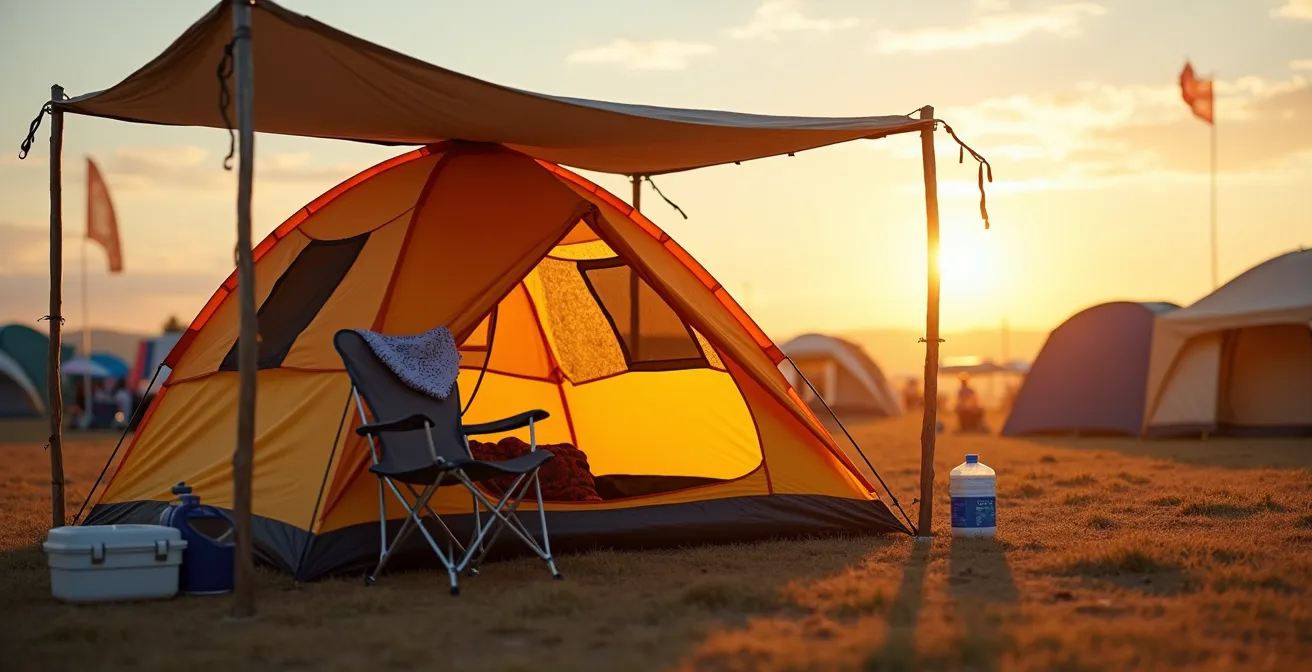
Surviving a sweltering festival isn’t about cooling your tent; it’s about strategically managing your body’s core systems like a seasoned operative.
- Dehydration is caused by electrolyte loss, not just a lack of water. Active hydration is key.
- Pacing your energy from day one—what we call “energy budgeting”—is the single most important factor for weekend-long enjoyment.
Recommendation: Shift your focus from fighting the external environment (the hot tent) to proactively supporting your internal one (your body) with electrolytes, strategic rest, and smart gear choices.
The moment of truth for any festival camper arrives not during a headliner’s set, but at 7 a.m. on Saturday morning. The sun hits the nylon, and within minutes, your tent transforms into a sauna. You wake up gasping, sticky, and exhausted. The common advice feels laughably inadequate: “find a shady spot” (they were all taken by Thursday), “use a battery-powered fan” (it just circulates hot air), or the classic, “drink more water.”
If you’re terrified of heatstroke and exhaustion ruining your weekend, it’s time to change the strategy. After years on the festival circuit, I can tell you the secret isn’t about fighting the tent. The tent will always win. The real enemy is a systemic failure of your body’s resources: hydration, energy, and security. The rookie treats a festival like a sprint; the veteran treats it like a multi-day survival mission.
This guide isn’t about flimsy hacks. It’s a field manual for managing your core systems. We’ll dismantle the myths around hydration, teach you how to budget your energy, secure your gear without a single lock, and choose equipment that works with you, not against you. Your mission is to not just survive, but to thrive from the first act to the final encore. Forget cooling the tent—it’s time to fortify the operator.
This article will provide a complete operational plan, breaking down the essential survival tactics you need to master. We’ll cover everything from the science of hydration to the art of disappearing your valuables in plain sight.
Summary: Your Festival Survival Field Manual
- Why Is Drinking Water Not Enough to Prevent Dehydration While Dancing?
- How to Secure Your Valuables in a Tent Without a Lock?
- Hiking Boots or Sneakers: Which Will Save Your Feet in the Mud?
- The “Friday Night” Mistake: Why Going Too Hard Early Ruins the Weekend?
- Where to Set a Meeting Point When There Is No Cell Signal?
- How to Attend a Festival Zero-Waste Without Ruining the Fun?
- Beyond the Main Stage: How to Avoid Crowds and Find Real Festival Magic?
- How to Assess the Environmental Impact of Your Festival Weekend?
Why Is Drinking Water Not Enough to Prevent Dehydration While Dancing?
Here’s the first critical piece of intelligence: dehydration isn’t just a lack of water; it’s a lack of electrolytes. When you’re dancing for hours under the sun, you’re sweating out vital minerals like sodium, potassium, and magnesium. Chugging plain water can dilute the electrolytes you have left, sometimes making the problem worse. This is why you can feel weak, dizzy, and nauseous despite drinking gallons. It’s a state of systemic failure, not just thirst.
The impact is severe. During intense activity, studies show that even a 2% drop in hydration can noticeably affect energy and performance. This is the first domino to fall, leading to poor decisions, exhaustion, and a ruined weekend. The solution is to move from passive hydration (drinking when thirsty) to systemic hydration: a proactive strategy that replenishes both water and electrolytes.
Your new protocol involves a multi-pronged approach. Before you even head to a stage, you need to pre-hydrate. About two hours before intense dancing, aim to drink around 700ml of an electrolyte beverage. Look for drinks or powders that contain about 200 mg of salt per 470 ml and 6-8% carbohydrates for energy. During the day, maintain a routine. Don’t wait for thirst. Aim to consume a set amount of fluid each hour, alternating between water and your electrolyte mix. This strategy ensures your body’s systems remain online, functional, and ready for the mission ahead.
How to Secure Your Valuables in a Tent Without a Lock?
A flimsy tent zipper is an open invitation, not a deterrent. Any lock you put on it screams, “Valuables inside!” to opportunistic thieves. In a festival environment, conventional security is useless. You must adopt a new doctrine: security through obscurity. The goal isn’t to make your tent impenetrable, but to make your valuables invisible and inconvenient to find. A thief is looking for a quick score, not a scavenger hunt.
The most effective method is a two-part strategy known as the “Decoy and Deep Hide.” First, you create an obvious decoy. This could be an old backpack or a tote bag left in a visible spot. Fill it with non-essentials: a cheap t-shirt, an empty phone case, maybe a few coins. This gives a potential thief something to grab quickly, satisfying their goal and encouraging them to move on. It’s a low-cost sacrifice to protect high-value assets.

Simultaneously, you “deep hide” your real valuables. Think like a spy. Where is the last place someone would look? Your car keys, wallet, and phone should be hidden in separate, inconvenient locations. Roll your cash and keys inside a dirty sock at the bottom of your laundry bag. Tuck your spare credit card inside a slit in your sleeping bag’s insulation. The more unassuming and annoying the location, the better. The key is to make the effort of finding your items far outweigh the potential reward.
Field Strategy: The “Decoy & Deep Hide” Method
As outlined in the ultimate guide to festival camping, the core principle is to never pack anything you can’t afford to lose. For the essentials you must bring, the strategy is simple. A decoy bag with low-value items provides a quick, satisfying target for thieves. Meanwhile, your actual valuables—phone, keys, wallet—are hidden deep within your gear in the most inconvenient places possible: inside muddy boots, rolled into a sleeping bag, or taped to the bottom of your camping chair. This approach exploits the thief’s need for speed and minimizes your risk.
Hiking Boots or Sneakers: Which Will Save Your Feet in the Mud?
Your feet are your transport. If they fail, your mission is over. Choosing footwear based on fashion or ideal weather is a rookie mistake that can lead to blisters, soaked socks, and days of pain. The choice between hiking boots and sneakers isn’t about style; it’s a tactical decision based on terrain and weather intelligence. Each has a distinct role in your operational gear.
Sneakers are for dry, predictable conditions only. They offer breathability and comfort but are useless at the first sign of rain, turning into heavy, mud-caked sponges. Hiking boots or trail runners offer superior grip and ankle support on uneven ground, which is standard at most festival sites. However, the most critical factor is water resistance. A single downpour can turn a field into a mud pit, and in that environment, only one type of footwear truly ensures survival: wellies or rain boots. They are your ultimate defense against mud and water, but they come with their own challenges, like heat and potential for blisters if not worn with thick socks.
The following table breaks down your options, allowing you to make an informed choice based on the festival forecast. Breaking in any new footwear before the event is non-negotiable.
| Footwear Type | Pros | Cons | Best For |
|---|---|---|---|
| Wellies/Rain Boots | Waterproof, mud-proof | Can cause blisters without thick socks, hot in dry weather | Heavy rain/mud predicted |
| Trail Runners | Lightweight, good grip, water-resistant options, comfortable for long days | Not fully waterproof | Mixed conditions |
| High-Top Boots | Ankle support, sturdy, some water resistance | Heavy, can be hot | Uneven terrain |
| Trainers/Sneakers | Comfortable, breathable, lightweight | Poor in mud, no water resistance | Dry conditions only |
Ultimately, a veteran’s strategy is often to bring two pairs: a comfortable, breathable pair like trail runners for the sunny days, and a pair of wellies on standby in the car or tent. This allows you to adapt to changing conditions and keep your primary asset—your mobility—intact.
The “Friday Night” Mistake: Why Going Too Hard Early Ruins the Weekend?
The gates open, the energy is electric, and the temptation to dive headfirst into the chaos is immense. This is the “Friday Night Mistake,” and it’s the most common reason why festival-goers burn out before the Sunday headliner even takes the stage. Your energy is not an infinite resource; it is a finite budget that must be managed across the entire weekend. Blowing your entire “energy budget” on the first night is a strategic blunder.
The physiological cost is immense. Hours of dancing, walking between stages, and exposure to the elements can lead to a 30 percent reduction in energy levels due to dehydration and muscle fatigue. Going all out on Friday means you start Saturday with a significant deficit. You’re not just tired; your body’s ability to regulate temperature, fight off illness, and make good decisions is compromised. This is how you end up with heatstroke, a nasty cold, or missing your favorite band because you passed out in your tent.

The veteran’s approach is one of energy budgeting. Know your limits. If you’ve been dancing for hours, take a break. Find a patch of shade, sit down, and rehydrate. A strategic 30-minute nap in the afternoon isn’t a sign of weakness; it’s a tactical recharge that can buy you an extra four hours of energy for the night. Treat rest as an integral part of the festival experience, not something that happens when you collapse. Pacing yourself isn’t about having less fun—it’s about ensuring you have the energy to have fun for the entire duration.
Where to Set a Meeting Point When There Is No Cell Signal?
At some point, your phone will die, or the network will become so congested that it’s useless. “I’ll text you” is not a plan; it’s a prayer. When you get separated from your group—and you will—having a pre-established, foolproof, analog communication plan is the only thing that will bring you back together. Relying on technology in a low-tech environment is a recipe for solo wandering and missed experiences.
The most effective strategy is the Clock Face & Landmark System. Before you separate, your group must agree on one, and only one, primary landmark. This landmark must be:
- Large and Unique: A giant art installation, the main sound tower, or a specific, named food stall. Avoid generic things like “the bar.”
- Accessible 24/7: It can’t be in an area that closes overnight.
- Highly Visible: You should be able to spot it from a distance. Using a flag or pennon to mark your own campsite can also help with general orientation.
Once the landmark is chosen, you use it as a giant clock face. If you’re facing the landmark, “12 o’clock” is directly behind it, “6 o’clock” is where you’re standing, and “3 o’clock” is to your right. Agreeing to “meet at the giant disco ball at 3 o’clock” is infinitely more precise than “meet by the disco ball.” Combine this with a “Time + 15” protocol: establish a primary meeting time (e.g., 9:00 PM) and a fail-safe backup time 15 minutes later in case someone is running late. If someone doesn’t show by 9:15, you know they aren’t coming, and you can move on without waiting indefinitely.
How to Attend a Festival Zero-Waste Without Ruining the Fun?
Surviving a festival isn’t just about your own physical well-being; it’s about ensuring the collective environment survives as well. The idea of “zero-waste” can seem daunting, conjuring images of sacrifice and inconvenience. But in reality, a low-impact approach is about smart, proactive planning, not about ruining your fun. It’s another system to manage, and it starts long before you pack your car.
The majority of festival waste comes from two sources: single-use food and drink packaging, and cheap, disposable camping gear. You can drastically reduce your footprint by tackling these head-on. The most powerful action you can take is to “decant” everything before you leave home. Remove new gear from its cardboard and plastic wrapping. Transfer snacks from bulky bags into reusable containers or beeswax wraps. Pour toiletries from large bottles into small, reusable travel containers. This not only cuts down on trash you have to carry out, but it also makes your gear more compact and organized.
Bringing your own reusable water bottle, coffee cup, and plate/cutlery set is non-negotiable. Most vendors are happy to use them, and some even offer a discount. This simple kit eliminates a mountain of single-use plastic over a weekend. By integrating these habits, you shift from being a passive consumer to an active, responsible participant in the festival ecosystem.
Your Pre-Festival Decanting Plan
- Review Intel: Check the festival website for their specific rules on allowed items, recycling facilities, and campsite size.
- Decant Supplies: Transfer all snacks, cereals, and dry goods from their original packaging into reusable silicone bags or containers.
- Minimize Toiletries: Decant shampoo, soap, and sunscreen into small, reusable travel bottles instead of bringing full-size products.
- Strip New Gear: Remove all cardboard boxes, plastic wrap, and tags from any new equipment before you pack it.
- Prepare for Triage: Pack a dedicated bag for your own trash and another for recyclables to make disposal clean and easy.
Beyond the Main Stage: How to Avoid Crowds and Find Real Festival Magic?
A festival is a temporary city, and just like any city, its true character isn’t always found on the main boulevards. Chasing only the big-name headliners means spending most of your time fighting massive crowds, waiting in long lines, and draining your energy budget. Experiential survival means learning to avoid these high-traffic traps and seeking out the authentic, unique moments that make a festival truly memorable.
Your festival map is a treasure map, not just a schedule. Look for the smaller, quirkier stages tucked away in the woods or at the edge of the grounds. This is often where you’ll discover your new favorite band playing an intimate set for a few dozen people. Explore the art installations at different times of day—a sculpture can feel completely different at sunrise than it does when lit up at midnight. Make time for the workshops, the comedy tents, and the pop-up performances. These are the low-energy, high-reward experiences that replenish your spirit.
This approach is also a powerful tool for energy management. Instead of battling your way into a dense sea of people for a main stage act, you can relax on a blanket with a clear view of a smaller stage. You’re conserving physical energy while having a more personal and often more powerful experience. The real magic of a festival lies in its spontaneity and hidden corners. A veteran doesn’t just attend the festival; they explore it.
Key Takeaways
- Systemic Hydration Is Key: Your body needs electrolytes, not just water. A proactive hydration plan is essential for maintaining energy.
- Budget Your Energy: Treat your energy as a finite resource. Pacing yourself from the first day is crucial for weekend-long endurance.
- Plan for Analog Failure: Technology will fail. A pre-agreed landmark and time-based meeting system is the only reliable way to find your friends.
How to Assess the Environmental Impact of Your Festival Weekend?
Once the last note has faded and the crowds depart, what remains is your collective footprint. Assessing your impact is the final, crucial step in the festival mission. It’s a debrief that separates a mere attendee from a responsible citizen of the festival community. The most visible impact is trash, but the most damaging is often the gear that gets left behind. The sight of a field littered with abandoned tents is a heartbreaking failure of personal responsibility.
Your impact assessment is simple: did you leave your campsite cleaner than you found it? This is the golden rule. It means packing out every single thing you packed in. This includes bottle caps, cigarette butts, and broken tent poles. A true veteran takes pride in their campsite discipline. But it goes one step further: if you have space, pick up a few extra pieces of trash left by less considerate campers. This small act of service helps preserve the venue and ensures the festival can return year after year.
The most significant environmental statement you can make is to invest in durable, reusable gear and commit to taking it home, no matter how tired you are. Leaving a cheap, broken tent behind is not an option.
Most people naturally pack their tent up after the festival and take it with them. However, some festival-goers leave their tent there at the campsite, even though they shouldn’t. This is massively disrespectful to those who have to clean up afterwards and is a waste of a perfectly good tent.
– Winfields Outdoors, Camping At Music Festivals: A Beginner’s Guide
This final act of packing up properly, of leaving no trace, is what completes the mission. It’s the ultimate sign of a seasoned pro who understands that a great festival experience is a privilege, not just a right, and depends on the respect we show for the space and the people who maintain it.
You now have the intelligence and the strategy. Your next step is to acquire the right gear and, more importantly, adopt this survivalist mindset. Begin planning your mission today to ensure your next festival is your best one yet.