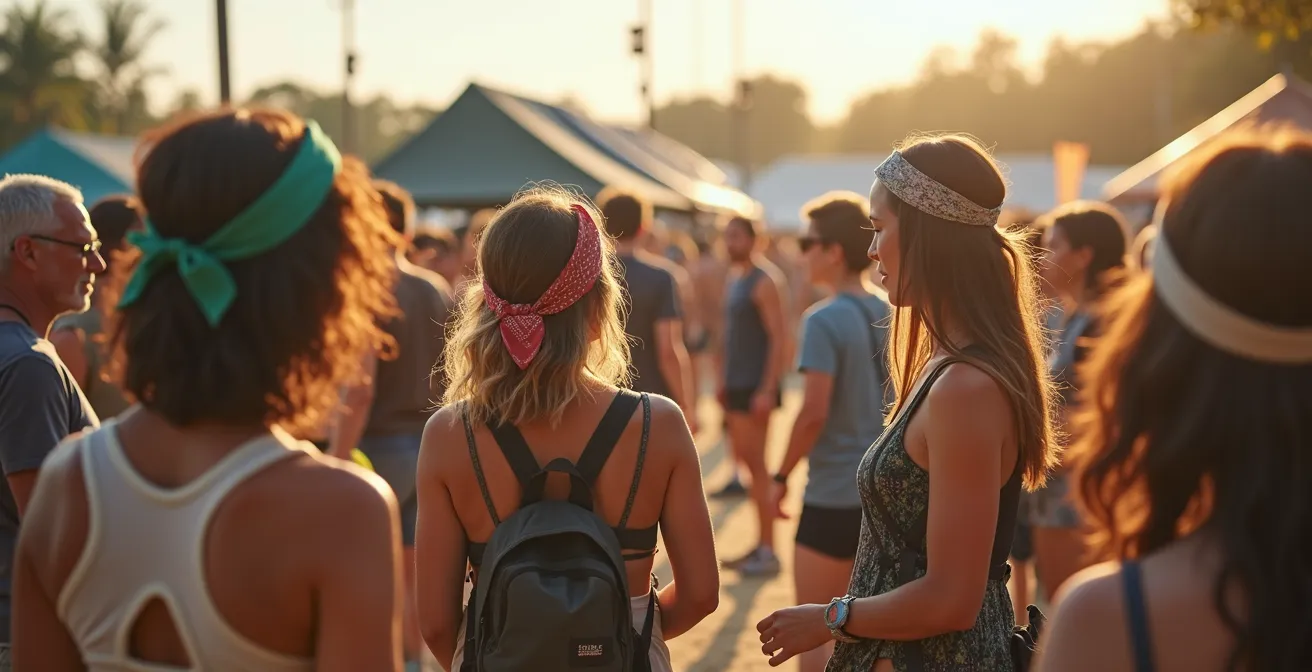
Your true festival footprint extends far beyond the trash you generate; it’s a complex blend of environmental, economic, and cultural consequences.
- The rise of “glamping” and luxury amenities creates a culture of systemic consumption that undermines sustainability efforts.
- Mega-festivals often cause “economic leakage,” where profits benefit global promoters more than local communities, leading to gentrification.
Recommendation: Adopt a “Total Impact Assessment” mindset. Scrutinize not just your own waste, but where your money goes, what kind of consumption the event encourages, and the festival’s real commitment to its host community.
The post-festival blues often come with a familiar pang of guilt. You see the overflowing bins, the fields littered with abandoned tents, and the sheer scale of consumption, and you wonder if your presence did more harm than good. You diligently used your reusable water bottle and sorted your recycling, but the feeling that it was a drop in a very polluted ocean is hard to shake. This guilt is valid, but it’s often misdirected at individual actions when the root causes are systemic.
The common advice—pack light, carpool, leave no trace—is essential but incomplete. It places the burden of sustainability squarely on the shoulders of the attendee while ignoring how the modern festival industry is often designed for maximum consumption. The real challenge is to move beyond personal waste management and start conducting a Total Impact Assessment of your participation. This means looking critically at the entire ecosystem of an event: its environmental practices, its economic model, and its cultural footprint.
But what if the key to a greener festival experience wasn’t just about refusing a plastic straw, but about understanding the hidden environmental cost of “glamping”? What if it involved questioning who really profits from your expensive ticket and whether the “diverse” lineup is a genuine celebration or a performative gesture? This guide is designed for the eco-conscious attendee who is ready to ask these bigger questions. We’ll provide a framework to analyze your true impact and become a more conscious participant, not just a consumer.
In the following sections, we will deconstruct the modern festival experience. We’ll examine the hidden environmental and cultural costs of luxury camping, provide a realistic guide to zero-waste attendance, and explore the complex economic and social dynamics that shape these mega-events, right down to how to get a good night’s sleep in a hot tent.
Summary: How to Assess the Environmental Impact of Your Festival Weekend?
- Why Does High-End Camping Hinder the Counter-Cultural Spirit of Festivals?
- How to Attend a Festival Zero-Waste Without Ruining the Fun?
- Local Businesses or Global Promoters: Who Really Profits from Festivals?
- The “Coachella Effect”: Why Festival Locations Become Unaffordable for Locals?
- When Does a Lineup Cross the Line From Diverse to Performative?
- Why Does Seeing Someone Like You on Stage Increase Music Participation?
- How to Secure Your Valuables in a Tent Without a Lock?
- How to Sleep Comfortably at a Festival When It’s 30 Degrees in Your Tent?
Why Does High-End Camping Hinder the Counter-Cultural Spirit of Festivals?
The original spirit of music festivals was rooted in community, shared experience, and a rejection of consumerism. Basic camping was the great equalizer. Today, the rise of “glamping” and high-end camping options introduces a stratified, consumption-driven model that directly contradicts this ethos. These luxury experiences—with air-conditioned yurts, private showers, and concierge services—create a significant, often hidden, environmental burden. It’s not just about comfort; it’s about systemic consumption built into the festival’s infrastructure.
This shift has a measurable impact. While a standard festival attendee produces a significant amount of waste, luxury camping dramatically inflates that figure. The energy required to power private air conditioning units, the water for personal bathrooms, and the single-use products included in “welcome kits” all contribute. In fact, sustainability reports highlight a stark difference; AGF’s 2024 Festival Sustainability Insights reveal that camping festivals can generate over 1.4kg of waste per person per day, compared to just 0.5kg at non-camping events. Much of this increase is driven by the resource-intensive nature of elevated camping experiences.
Beyond the physical waste, glamping erodes the counter-cultural soul of festivals. It creates a velvet-rope mentality, separating attendees into tiers of comfort and access. This fosters an environment of passive consumption rather than active participation, where the experience is purchased, not co-created. It normalizes a level of resource use that is fundamentally unsustainable at scale, moving festivals further away from their roots as gatherings of shared values and closer to becoming temporary luxury resorts.
How to Attend a Festival Zero-Waste Without Ruining the Fun?
The term “zero-waste” can sound intimidating, evoking images of deprivation and inconvenience that seem at odds with the carefree spirit of a festival. However, aiming for zero-waste is not about achieving perfection; it’s about making intentional choices to dramatically reduce your footprint. The key is preparation and shifting your mindset from disposable convenience to durable resourcefulness. It’s about ensuring the fun isn’t fueled by a mountain of single-use plastic.
This process starts long before you pack your bag. It involves a pre-festival audit of your needs, focusing on reusable systems rather than disposable items. This includes everything from your food and drink containers to your toiletries. The goal is to pack items that will return home with you, ready for the next adventure. The good news is that these efforts are part of a growing trend. A Greener Future’s latest report shows that an encouraging 49% average site recycling rate was achieved at festivals in 2024, a significant jump from 38% in 2022, proving that collective action works.
To make this practical, focus on a few high-impact areas: bring a complete reusable meal kit (bottle, cutlery, container), opt for solid toiletries (shampoo bars, bar soap) to eliminate plastic packaging, and plan your meals to use bulk ingredients. The visual below highlights some of these essential, non-disposable items that form the foundation of a zero-waste kit.

As the image illustrates, a sustainable kit is about quality and reusability. A sturdy water bottle, bamboo cutlery, and cloth napkins are not just eco-friendly; they often provide a better experience than flimsy, disposable alternatives. By investing in a durable setup, you not only reduce waste but also elevate your festival comfort.
Your Zero-Waste Festival Action Plan
- Gear Audit: A week before, source or borrow reusable camping gear (tents, chairs) instead of buying cheap, disposable versions.
- Meal Prep: Create a meal plan using bulk ingredients packed in reusable containers to avoid single-serving packaging.
- Kit Assembly: Pack a dedicated, non-disposable kit including a water bottle, cutlery set, plates/bowls, and cloth napkins.
- Packaging Choices: When buying supplies, choose products with zero or circular packaging, like shampoo bars, bar soap, and items in glass or metal.
- Exit Strategy: Prepare a “return kit” with designated bags for sorting any recyclables, compostables, and landfill waste you might accumulate.
Local Businesses or Global Promoters: Who Really Profits from Festivals?
When a mega-festival comes to town, it’s often touted as a major economic boon for the local area. While there’s no doubt that some local businesses—hotels, restaurants, and shops—see a temporary surge in revenue, a critical analysis often reveals a pattern of economic leakage. This occurs when the vast majority of profits generated by the event do not stay within the local community. Instead, they flow outwards to the large, often multinational, corporations that act as global promoters.
These large promoters control the most lucrative revenue streams: ticket sales, high-level sponsorships, and official merchandise. They often bring in their own vendors and staff, bypassing local businesses for key services. The result is that while the local community shoulders the burden of increased traffic, noise, waste, and strain on public services, it may only see a fraction of the immense profits. Your ticket money may be funding a corporate headquarters in another country rather than supporting the town hosting you.
This economic imbalance can have profound and lasting effects on a region, a phenomenon often tied to what is known as the “Coachella Effect.” It’s a stark example of how festival economics can reshape a community’s financial landscape.
Case Study: The Coachella Valley Economic Engine
The economic impact in festival hotspots like the Coachella Valley is a double-edged sword. According to an analysis of Realtor.com data, the massive influx of visitors creates a highly profitable market for short-term rentals (STRs). This has driven a trend where, as highlighted in a report by Luxe Homes Austin, local house prices in some festival cities have nearly doubled in under a decade. While this benefits property owners who can capitalize on rentals, it creates an affordability crisis for permanent residents.
This dynamic is confirmed by local experts who see the impact firsthand. As real estate professional Stephen Burchard notes, the situation creates a difficult trade-off for the community:
A homeowner is able to rent out a home due to loose city ordinance restrictions, then some are taking advantage of it. However, if they live here full time, then they need to find housing and that can be a challenge. The Valley sells out for Coachella, STRs, and hotels.
– Stephen Burchard, Stephen Burchard Real Estate
The “Coachella Effect”: Why Festival Locations Become Unaffordable for Locals?
The “Coachella Effect” is a term that encapsulates the cultural and economic gentrification that can occur when a small or rural area becomes the permanent home of a mega-festival. It begins with the economic shifts discussed previously but quickly spirals into a deeper social issue. As an area becomes a trendy, desirable destination for tourists and investors, property values and the cost of living skyrocket, pushing out long-term, often lower-income, residents.
The visual contrast is often stark. Temporary cities of tents and stages spring up, dwarfing the surrounding residential communities that must live with the consequences year-round. The aerial view below captures this dynamic, showing the massive festival grounds juxtaposed with the fabric of the local town.

This image isn’t just a landscape; it’s a map of economic pressure. The festival’s presence transforms the housing market from one based on residential need to one driven by tourism and investment speculation. Homes that were once affordable for local workers are converted into lucrative short-term rentals or sold to outside investors, creating a severe housing shortage. This pressure is immense; research from the Lincoln Institute reveals that a staggering 55% of Coachella Valley households are “rent-burdened,” meaning they spend an unsustainable portion of their income on housing.
As an attendee, your presence contributes to this demand. While you are not directly responsible for housing policy, being a conscious participant means recognizing this impact. It involves choosing to support local businesses that are owned by residents, questioning whether your accommodation choice contributes to the housing shortage, and understanding that the “cool” and “authentic” location you’re visiting is a living community facing real pressures.
When Does a Lineup Cross the Line From Diverse to Performative?
In recent years, festival promoters have faced increasing pressure to create more diverse and inclusive lineups. In response, many have started to feature more artists from underrepresented backgrounds, genres, and identities. While this is a positive step, it raises a crucial question for the conscious attendee: is this diversity genuine or performative? The line is crossed when representation becomes a marketing tool rather than a genuine act of cultural curation.
Performative diversity often manifests as tokenism. This can look like booking a single hip-hop headliner in a historically rock-dominated festival, or placing artists of color in early, poorly attended time slots while prime-time remains homogenous. It’s about ticking a box to appease public criticism without making a meaningful shift in the festival’s power structure or cultural identity. The lineup poster may look diverse, but the lived experience for both the artists and the audience tells a different story.
Genuine diversity, on the other hand, is about deep and authentic integration. It means giving artists from various genres and backgrounds prominent billing and stage placement. It involves curating a lineup that feels cohesive and intentional, where different sounds and cultures are in conversation with one another, not just placed side-by-side. A truly diverse festival invests in building relationships with different music scenes and communities year-round, rather than just cherry-picking a few names to meet a quota. As an attendee, you can spot the difference by looking beyond the headliners. Is there diversity throughout the undercard? Are niche genres given respectable stages and time slots?
Why Does Seeing Someone Like You on Stage Increase Music Participation?
The importance of a genuinely diverse lineup goes far beyond optics; it has a profound psychological impact on the audience and can directly influence future music participation. The phenomenon is rooted in the concepts of role modeling and social proof. When an aspiring musician sees someone on stage who shares their background, identity, or musical heritage, it sends a powerful message: “This space is for you, too. Your voice is valid here.”
This representation acts as a form of permission-giving. For a young woman seeing an all-female punk band, a person of color seeing a celebrated electronic producer, or a queer artist seeing a headliner who is open about their identity, the effect is transformative. It breaks down invisible barriers and challenges the unspoken norms of who gets to be a star. It makes the abstract dream of a music career feel tangible and achievable. This is not just about inspiration; it’s about building the pipeline for the next generation of artists.
Conversely, a lack of representation can have a chilling effect. If lineups year after year are dominated by a narrow demographic, it reinforces the idea that the industry is a closed club. This can discourage talented individuals from pursuing music, believing there is no path for them. Therefore, a festival’s lineup is not just a reflection of current tastes; it is an active force in shaping the future of music. By championing a wide array of voices, festivals can cultivate a richer, more vibrant, and more resilient musical ecosystem for everyone.
How to Secure Your Valuables in a Tent Without a Lock?
While we focus on large-scale systemic issues, personal safety and security remain a fundamental part of the festival experience. A tent, by its nature, is not a secure fortress. However, worrying about your valuables can detract from the joy and community spirit of the event. The most effective security strategy in a campground is not based on locks, which can be easily cut, but on a combination of clever concealment and social deterrence.
Your greatest security asset is the community around you. Opportunistic thieves thrive on anonymity. By breaking that anonymity, you create a powerful deterrent. Upon arrival, take the time to introduce yourself to your campsite neighbors. Learn their names and create a small, informal network. This simple act transforms a collection of strangers into a neighborhood watch, where people are more likely to notice and question someone unfamiliar poking around your tent.
Beyond social strategies, smart concealment is your next best defense. Most thieves are looking for a quick, easy score. They will check the most obvious places first: pockets of bags, pillowcases, and items left near the tent door. Your goal is to make finding your valuables time-consuming and inconvenient. Think like a thief in reverse and use decoys and misdirection to your advantage. Here are some community-tested strategies:
- Build a Network: Introduce yourself to neighboring campers immediately upon arrival to build a trust network and watch out for each other.
- Use Decoy Containers: Store cash or cards in an empty, clean sunscreen bottle or an old mint tin. Keep electronics in a bag of dirty laundry.
- Center Your Valuables: Position your most important items in the very center of your tent, buried under sleeping bags or clothes, far from the tent walls and door.
- Leave a Dummy Wallet: Keep a “dummy wallet” with a small amount of cash and some expired cards visible. A thief might grab it and leave, satisfied with their small find.
- Mark Your Gear: Use a UV pen to mark your electronics and other valuable gear with your name or a unique symbol. It won’t prevent theft, but it can help in recovery if the items are found.
Key Takeaways
- A true assessment of your festival impact must go beyond personal waste and include the event’s economic and cultural footprint.
- Luxury “glamping” options often carry a disproportionately high environmental cost and can undermine the communal ethos of festivals.
- The “Coachella Effect” demonstrates how mega-festivals can lead to local gentrification and housing unaffordability, even while bringing in revenue.
How to Sleep Comfortably at a Festival When It’s 30 Degrees in Your Tent?
After a long day of dancing, a good night’s sleep is not a luxury; it’s essential for having the energy to enjoy the entire weekend. Yet, one of the biggest challenges of festival camping is the “greenhouse effect” inside a tent. As soon as the sun rises, a tent can transform into an oven, making comfortable sleep impossible. Staying cool is a matter of strategic tent placement, ventilation, and choosing the right materials to have against your skin.
First, position your tent wisely. If possible, find a spot that will get morning shade from a tree or a larger structure. Even a few hours of protection from the direct morning sun can make a huge difference. Second, maximize ventilation. Open all the vents and mesh windows on your tent before you go to sleep to encourage airflow. If your tent has a rainfly, consider removing it on clear nights or propping it up to allow more air to circulate.
Finally, what you wear and sleep on matters immensely. Your choice of fabric can be the deciding factor between a sweaty, restless night and a comfortable rest. Materials with excellent moisture-wicking and breathability properties will draw sweat away from your body and allow heat to escape. While synthetic materials are often cheap, they can trap heat and feel clammy. Natural fibers, though sometimes more expensive, offer superior performance in hot conditions. As this performance comparison of cooling fabrics shows, investing in the right material is investing in your well-being.
| Fabric Type | Moisture Wicking | Temperature Regulation | Sustainability Score | Cost Range |
|---|---|---|---|---|
| Merino Wool | Excellent | Natural thermoregulation | High (biodegradable) | $$$ |
| Linen | Good | Highly breathable | High (low water use) | $$ |
| Tencel/Lyocell | Excellent | Cool to touch | High (eucalyptus-based) | $$ |
| Synthetic Polyester | Moderate | Traps heat | Low (petroleum-based) | $ |
Combining these strategies—smart placement, good ventilation, and the right fabrics—can transform your tent from a sauna into a sanctuary, ensuring you’re rested and ready for whatever the festival has in store.
Now, armed with a framework for a Total Impact Assessment, you can approach your next festival not as a passive consumer, but as a critical and conscious participant. Use this knowledge to make more informed choices, support events that align with your values, and truly enjoy the experience, knowing you’ve considered your full footprint.