Your public persona is not an authentic extension of you; it is a strategic character built to protect your sanity and monetize your art.
- Authenticity is a product to be manufactured and sold, not a raw state of being to be naively exposed.
- Treat your social media as a mythological narrative and your fan interactions as controlled “ritualized access” to build mystique.
Recommendation: Stop trying to be “real” and start architecting “The Character.” This is the only way to survive the game and get paid.
You’re talented, you’ve made the art, and now you’re told you need to be a brand. The pressure is immense: be a 24/7 content creator, an open book on social media, a friend to thousands of strangers. The common advice is a siren song luring you onto the rocks of burnout: “Just be authentic.” They tell you to post consistently, share your vulnerabilities, and engage with every comment. This is not just bad advice; it’s dangerous. It blurs the line between your private self and your public commodity until there’s nothing left of you for you.
Let’s be clear: in this industry, naive authenticity is a liability. It leads to exhaustion, creative paralysis, and public meltdowns. The artists who last are not the ones who are the most “real”; they are the ones who are the most strategic. They understand that a public persona is a tool, not a confession. It’s a meticulously crafted character designed to serve the art, engage a specific audience, and most importantly, build a protective wall—a sanity firewall—around the person who has to live a life when the stage lights go down.
Forget what you’ve been told. We’re not here to “find your brand.” We’re here to build your armor. This guide will deconstruct the machinery of a sustainable artistic persona, piece by cynical piece. We will explore how to manufacture mystique, leverage controversy, architect a visual mythology, and ultimately, get paid for your work without selling your soul—or at least, by selling a carefully constructed version of it.
This article provides a complete roadmap for building and managing a public persona that serves your career, not destroys your life. The following sections break down the core strategies, from narrative creation to long-term sustainability.
Summary: A Strategic Playbook for Your Public Persona
- Why Do PR Scandals Often Increase an Artist’s Fan Engagement?
- How to Align Your Instagram Grid to Tell a Single Mythological Story?
- Talent or Charisma: Which Factor Actually Sustains a 20-Year Career?
- The “Accessible” Trap: Why Replying to Every DM Can Destroy Your Mystique?
- When to Kill Your Old Persona to Launch a New Album Cycle?
- Viral Hit or Slow Burn: Which Builds a More Sustainable Fanbase?
- Why Is the Lobby Bar More Important Than the Stage at a Showcase?
- How to Generate Real Income from Streaming With Less Than 1 Million Streams?
Why Do PR Scandals Often Increase an Artist’s Fan Engagement?
Let’s get one thing straight: a PR “scandal” is not a crisis. It’s a filter. In a world of lukewarm takes and desperate people-pleasing, a moment of controversy does something invaluable: it forces people to pick a side. This isn’t about being liked by everyone; it’s about being loved fiercely by a dedicated few. When you polarize, you don’t just gain attention; you forge an army. The casual listeners might drift away, but your core base digs in, their identity becoming intertwined with defending yours. Their support is no longer just about the music; it’s a tribal affiliation.
The mechanism is purely psychological. As PR expert Chad Teixeira explains, this polarization hardens loyalty among core supporters. The fan relationship, for a true artist, is never transactional; it’s emotional. Fans project their own values, struggles, and aspirations onto “The Character” you’ve built. When that character is attacked, they feel personally attacked. Defending you becomes an act of defending themselves. This dynamic transforms passive listeners into active, engaged, and highly vocal evangelists. They buy more merch, stream more music, and fight your battles in comment sections. A scandal, managed correctly, is a fanbase-strengthening exercise.
Of course, this is not an excuse for genuinely destructive behavior. The “scandal” must be a conflict of values, not a moral failing. It’s about taking a stand, having a sharp edge, or simply being misunderstood by the mainstream. The goal is to create a narrative of “us versus them,” where “us” are the ones who “get it.” This creates an in-group dynamic that is far more powerful and sustainable than the fleeting approval of the masses. Your controversy becomes a badge of honor for your fans, a testament to their superior taste and loyalty.
How to Align Your Instagram Grid to Tell a Single Mythological Story?
Your Instagram is not a photo album. It is a script, a canvas, a mythological tapestry. Every post is a scene, every caption a line of dialogue. The emerging artist’s biggest mistake is treating it like a diary, posting random, “authentic” moments. This creates noise, not a narrative. A strategic artist treats their grid as a visual narrative arc, planned in chapters of 9 to 12 posts. Each chapter has a beginning, a middle, and a climax, all serving the current era of “The Character.” Think of it as a silent film where the story is told through mood, color, and symbolism.
To achieve this, you must establish recurring visual symbols that act as iconographic anchors. This could be a specific color palette that reflects the mood of your upcoming album, a recurring object (a wilting flower, a cracked mirror), or a specific gesture. These elements create a secret language with your audience, making them feel like insiders when they spot the pattern. This is also where you can play with image-caption dissonance. The photo might show the glamorous, public-facing Character, while the caption offers a cryptic, poetic glimpse into their “inner thoughts.” This creates a sense of depth and complexity, inviting fans to speculate and engage on a deeper level.
This is not about being fake; it is about being a director. You are directing the audience’s perception, guiding them through the story you want to tell. Every visual element must be deliberate and aligned with the persona you are cultivating for the current artistic cycle.

As you can see in this conceptual layout, the grid is not a collection of random snapshots but a cohesive visual journey. The progression from dark, moody tones to lighter, more hopeful ones tells a story without a single word. This level of control is what separates a fleeting influencer from an enduring artist. It’s the difference between showing your life and building a legend.
Talent or Charisma: Which Factor Actually Sustains a 20-Year Career?
Let’s end this tired debate. Talent is the price of entry. It gets you in the room. Charisma—or more accurately, a masterfully managed persona—is what keeps you in the game for two decades. Talent produces the work, but the persona creates the world around that work, giving people a reason to care year after year. An artist with immense talent but no persona is a brilliant artisan who will likely be celebrated posthumously. An artist with moderate talent but a captivating persona can build an empire. The ideal, of course, is both, but their importance shifts dramatically over a career’s lifecycle.
In the beginning, charisma is king. It has to be. You have no track record, no body of work to stand on. Your persona—your look, your worldview, your “story”—is what captures attention and convinces people to press play. As your career progresses, the balance must shift. Your talent needs to shine through to prove the initial hype was warranted. You need to deliver consistently great work. In the later stages, your body of work becomes your legacy, and the persona evolves to support transitions, reinventions, and maintain relevance beyond the initial spark.
The strategic management of this balance is the secret to longevity. This is not an opinion; it’s a well-observed pattern in the industry, as outlined in this analysis of career sustainability factors.
| Career Stage | Talent Impact | Charisma Impact | Optimal Ratio |
|---|---|---|---|
| Years 1-5 | Creates initial work | Captures attention | 30% Talent / 70% Charisma |
| Years 5-10 | Proves consistency | Maintains engagement | 50% Talent / 50% Charisma |
| Years 10-15 | Establishes legacy | Evolves persona | 60% Talent / 40% Charisma |
| Years 15-20+ | Defines career | Supports transitions | 70% Talent / 30% Charisma |
Look at those numbers. They tell a story of strategic evolution. A 20-year career is not an accident; it is an architectural achievement. It requires knowing when to lean on the allure of “The Character” and when to let the weight of the work speak for itself. Neglecting one for the other is the fastest way to become either a flash in the pan or a forgotten genius.
The “Accessible” Trap: Why Replying to Every DM Can Destroy Your Mystique?
The myth of the “accessible artist” is the most dangerous platitude in modern music. You are told to “engage your fans,” reply to every comment, and answer every DM. This is a trap. It is not scalable, it is exhausting, and it is the single fastest way to annihilate the one currency that truly matters in this business: mystique. Familiarity breeds contempt. The more you give, the more is demanded, and the less valuable each interaction becomes. You are an artist, not a customer service representative.
True power lies in strategic inaccessibility. It’s about creating a perceived distance that makes any access feel like a privilege, not a right. When you are everywhere, you are nowhere special. When you are scarce, your presence is an event. This doesn’t mean building a fortress and never speaking. It means curating the interaction. It’s the difference between a leaky faucet and a sacred spring. You control the flow. Your time, your thoughts, and your attention are the most valuable products you have. Don’t give them away for free in the DMs.
The goal is to create “ritualized access,” not constant availability. This gives fans the feeling of connection they crave without draining you or cheapening your brand. It’s about creating structured, meaningful moments of interaction that reinforce your persona rather than dilute it.
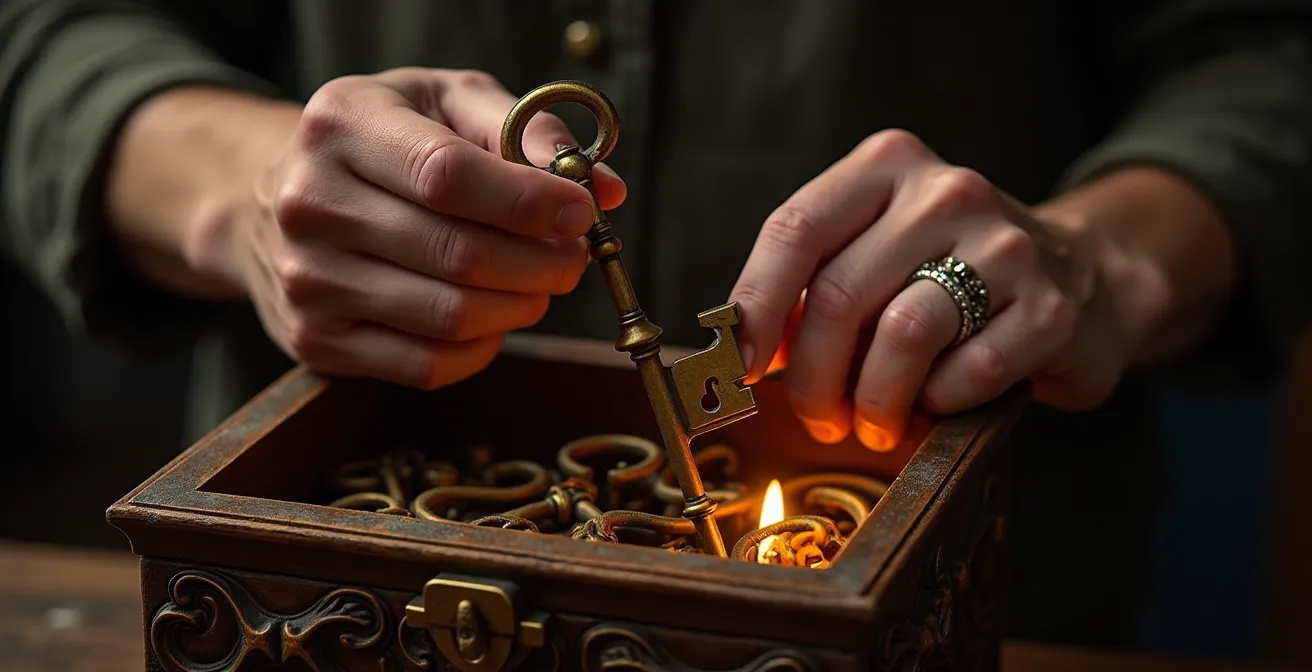
Think of your private self as the treasure inside this box. The key is the access you grant. Handing out copies of the key to everyone devalues both the key and the treasure. But offering a glimpse, a controlled unlocking at a moment of your choosing, creates desire, speculation, and immense value. This is the art of maintaining mystery in an age of oversharing.
Your Action Plan: Creating Ritualized Access to Maintain Mystique
- Schedule monthly “oracle” Q&A sessions where you only provide cryptic, thoughtful responses, reinforcing the persona’s wisdom or wit.
- Commit to replying to only one fan DM publicly per week, but make that reply exceptionally meaningful, personal, and content-rich.
- Create structured “access moments” through meticulously planned live streams at specific, recurring times, turning them into can’t-miss events.
- Hire or consult with a social media strategist to analyze engagement patterns and identify the optimal, most impactful moments for you to appear.
- Establish and ruthlessly maintain strict privacy boundaries, especially during sensitive personal moments, teaching your audience what is and is not for public consumption.
When to Kill Your Old Persona to Launch a New Album Cycle?
A persona is not a life sentence. It’s a costume. And when the role is over, you must have the courage to take it off and burn it. The most successful long-term artists are masters of reinvention. They understand that a persona that works for a confessional folk album will be an anchor weighing down a synth-pop era. Holding onto a stale persona is a sign of fear, and the audience can smell fear. They will get bored before you do.
The “when” is critical. You don’t kill a persona on a whim. You kill it when it no longer serves the art you are creating. The signal is a feeling of friction, of inauthenticity—not in the naive public sense, but a private, artistic incongruence. When it feels like you’re playing a character that is no longer yours, that’s your cue. The music changes, so the myth must change with it. This is a strategic “death and rebirth” that must be timed to coincide with a new album cycle, creating a clean break and a powerful new narrative.
Look at the masters. As Lance Marwood of V13.net advises, “Your persona isn’t a one-and-done. Check in with yourself. If it feels stale, tweak it.” The process is a symbolic execution. The old visual themes are purged from social media. The old fashion style is retired. The old way of speaking is silenced. This creates a vacuum, a sense of anticipation for what comes next. It’s a marketing event in itself.
Case Study: The Constant Reinventions of Miley Cyrus
Miley Cyrus is the modern blueprint for persona assassination and rebirth. She has flawlessly executed multiple reinventions, each perfectly timed to a new musical direction. She systematically dismantled her Disney-friendly “Hannah Montana” persona to usher in a provocative, edgy “Bangerz” era. When that ran its course, she pivoted to an experimental, psychedelic phase with “Dead Petz,” then shed that skin for a return to her country-folk roots with “Younger Now,” and most recently, a full-blown, rock-inspired reinvention for “Plastic Hearts.” Each “death” was a calculated PR move that generated massive speculation and ensured the world was watching when the new character was finally revealed.
Each shift was a risk, but the alternative—stagnation—was a guaranteed failure. Your career is a series of chapters. Have the guts to end one to start the next.
Viral Hit or Slow Burn: Which Builds a More Sustainable Fanbase?
Going viral is like a sugar rush. It’s an intense, exhilarating spike of attention, but it’s followed by an inevitable crash. A viral hit brings you millions of “tourists”—people who are there for the trend, the meme, the fleeting moment. They are not your fans. They are a shallow, disloyal audience with a microscopic attention span. A slow-burn, on the other hand, is like building a foundation of stone. It’s a gradual process of accumulating “citizens”—people who are invested in you, your story, and your entire body of work.
The metrics don’t lie. The tourist from a viral hit might stream your one song a few times, but they will not buy a t-shirt, a vinyl record, or a concert ticket. The citizen from a slow-burn relationship will do all of that and more. They feel a sense of discovery and ownership over your career because they were there “before it was cool.” Their loyalty is not tied to a trend; it’s tied to you, “The Character.” This is the fundamental difference between a career and a moment.
A viral hit is not a strategy; it’s a lottery ticket. A slow burn is a deliberate, long-term investment in building real, tangible value. The following data, based on industry observations, starkly illustrates the difference in fanbase quality. This is why we chase citizens, not tourists.
| Metric | Viral Hit | Slow Burn |
|---|---|---|
| Initial Reach | Massive (millions) | Limited (thousands) |
| Audience Depth | Shallow engagement | Deep emotional connection |
| Fan Loyalty | Trend-based attachment | Artist-based attachment |
| Revenue Per Fan | Low ($5-10/year) | High ($50-100/year) |
| Long-term Retention | 10-20% after 1 year | 60-80% after 1 year |
Look at the Revenue Per Fan and Long-term Retention. That is the entire ballgame. One viral hit might get you a meeting with a label, but a dedicated fanbase of slow-burn citizens will pay your bills for a decade. The choice is clear.
Why Is the Lobby Bar More Important Than the Stage at a Showcase?
You’ve been grinding for months to perfect a 20-minute showcase set. You think the performance is the final exam. You are wrong. The performance is the easy part; it’s the prerequisite. Everyone at an industry showcase is talented. The music is a known quantity. The real test, the one that actually gets you signed or funded, happens off-stage. It happens in the sticky, crowded, too-loud lobby bar before and after you play.
Industry professionals—A&R reps, publishers, agents—are not there to be entertained. They are there to make an investment. They are betting on a person, not just a song. On stage, you’re a performer. In the lobby, they get to see if you’re a professional. They are evaluating your “off-stage persona.” Are you poised? Are you articulate? Can you hold a conversation? Do you seem like someone they can spend the next five years in a tour bus with? Do you radiate confidence or reek of desperation?
This is where “The Character” you’ve built does the heavy lifting. It’s your armor in a high-stakes social environment. An industry insider’s perspective is invaluable here, and they are ruthlessly efficient in their judgment.
The performance on stage is expected; it’s a known quantity. The real test for industry professionals is the ‘off-stage persona’ in the lobby.
– Industry insider perspective, Lost Boy Entertainment
Your goal in the lobby is not to pitch, but to create a gravitational field. You position yourself centrally, you speak with intention, and you let people come to you. You focus on building genuine connections, not just handing out business cards. This is where the mystique you’ve cultivated pays off. People will be curious about the artist who seems calm and in control amidst the chaos. The stage proves your talent; the lobby proves you are a viable business partner.
Key Takeaways
- Your persona is a strategic tool, not an authentic reflection. Use it to build a “sanity firewall.”
- Mystique is a currency. Cultivate it through “strategic inaccessibility,” not constant online engagement.
- Focus on building a “slow burn” fanbase of loyal citizens who generate high revenue per fan, not chasing viral “tourists.”
How to Generate Real Income from Streaming With Less Than 1 Million Streams?
You’ve been sold a lie. The lie is that success is measured in millions of streams and that you need to be a global superstar to make a living from your music. This is a narrative designed by major labels and streaming platforms to keep you on a content treadmill, chasing fractional pennies while they get rich. The reality is, streaming platforms are not your revenue source; they are your marketing funnel. They are the top of a pyramid, and you are leaving a fortune on the table if you’re not building the rest of the structure.
The math is simple and brutal. Getting a million streams on Spotify will net you, on average, about $3,000-$4,000. It’s a pathetic return for your art. Now, consider an alternative model. Instead of trying to get a million strangers to listen once, what if you could get 1,000 true fans to give you $100 a year? That’s a $100,000 annual income. This isn’t a fantasy; it’s the core principle of a sustainable creative career.
The proven ‘1,000 True Fans’ model shows that 1,000 true fans spending $100 per year can generate a six-figure income. These are the “citizens” we talked about, the ones cultivated through a slow-burn strategy. They don’t just stream; they want to support you directly. Your job is to give them compelling, exclusive ways to do so. Your music on streaming platforms is the free sample that gets them in the door. The real business happens on your own turf.
This means creating a value ladder. Use your song lyrics as a password to unlock exclusive content on your website. Sell the song stems to your most dedicated producer fans. Create a paid, private Discord or Patreon community where you share behind-the-scenes content, alternate acoustic recordings, and early access. This is where you convert the emotional connection you’ve built into direct, reliable income. Stop chasing millions of streams and start building a direct relationship with the 1,000 people who will actually fund your career.
Start today. Stop counting streams and start building your pyramid. Architect your value ladder, identify your first 100 “true fans,” and create an exclusive offering for them. This is how you take back control and build a career on your own terms.