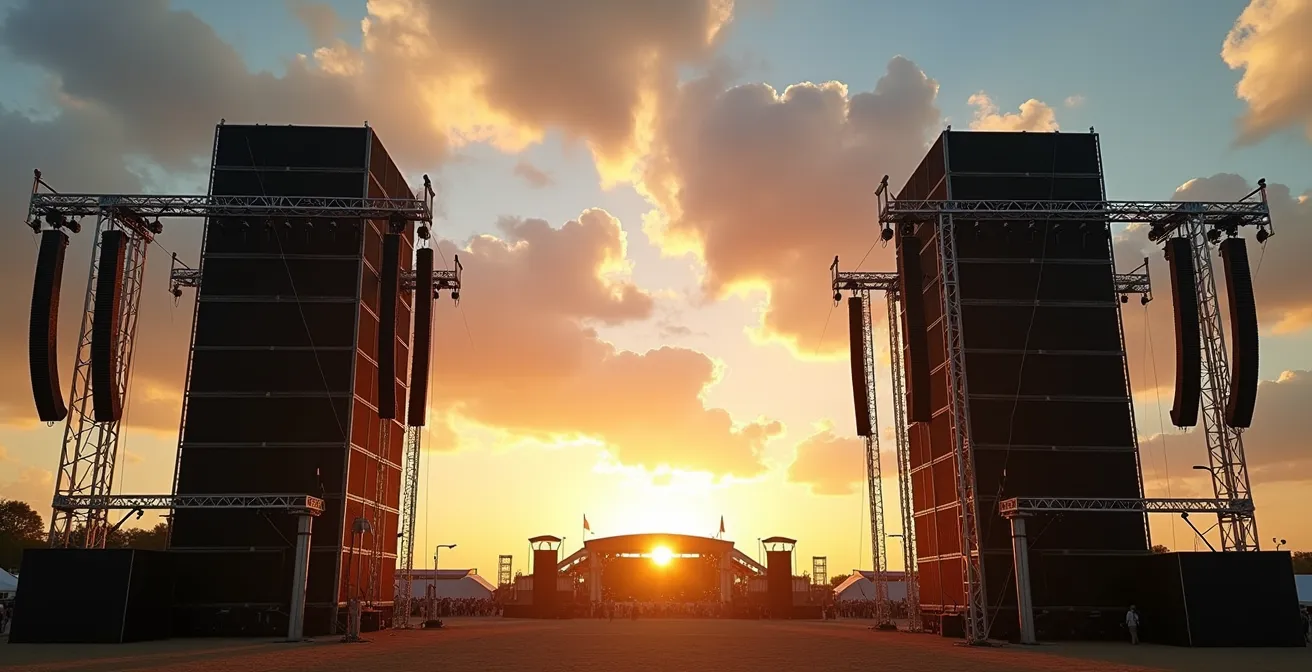
Moving a crowd isn’t about brute-force volume; it’s the science of controlled low-frequency energy.
- True physical impact comes from infrasonic frequencies (below 30Hz), which require immense, well-managed power.
- Strategic speaker stacking (like cardioid arrays) is crucial to focus bass on the audience and prevent sonic chaos.
Recommendation: Focus on system integrity and efficiency—from crossovers to amp headroom—to create a powerful, clean, and sustainable vibe.
There’s a moment at every great show that we, as operators and enthusiasts, chase. It’s not just hearing the music; it’s when the kick drum hits and you feel it in your bones, when the sub-bass rolls through the crowd like a wave, and for a second, everyone breathes in unison. This is the physicality of sound. Many believe achieving this is a simple matter of getting the biggest speakers and the most powerful amps. They talk about raw wattage and sheer volume as the ultimate goal.
But that’s a rookie mistake. That approach leads to a wall of noise, not a wave of energy. It creates sonic mud, not a shared physical experience. The real secret, the one that separates legendary sound systems from expensive PA stacks, lies in a much deeper understanding of physics and intention. The key isn’t brute force; it’s about the precise control of energy, especially in the frequencies you feel more than you hear.
This is where engineering becomes an art form. It’s about shaping sound waves with acoustic geometry, protecting the integrity of the signal from source to driver, and understanding the profound psychological impact of low-frequency information. This guide moves beyond the platitudes. We’re going to explore the science of power allocation for deep bass, the strategy behind speaker stacking, the crucial role of crossovers, the subtle art of managing headroom, and the philosophy of creating a truly communal experience through sound.
This article details the engineering principles and practical choices that allow a sound system to do more than just make noise—it explains how to make it a physical force. Below is a summary of the key areas we will explore to master this craft.
Summary: How to Engineer a Sound System with Physical Impact
- Why Do You Need So Much Power Just for the Sub-30Hz Frequencies?
- How to Stack Speaker Boxes to Avoid Phase Cancellation Outdoors?
- Active or Passive: Which Crossover Protects Your Drivers Better?
- The “Red Line” Mistake: Why Pushing Your Amps Too Hard Destroys the Vibe?
- Where to Position the Control Tower for the Best Crowd Experience?
- How to Configure a Pedalboard That Works for Both Electric and Acoustic?
- Why Do You Feel Sub-Bass in Your Chest and Not Just Your Ears?
- How to Assess the Environmental Impact of Your Festival Weekend?
Why Do You Need So Much Power Just for the Sub-30Hz Frequencies?
The quest for that chest-rattling bass isn’t just about loudness; it’s about moving a massive amount of air very slowly. Frequencies below 30Hz, often called infrasound, operate at the very edge of human hearing but are central to the physical sensation of bass. Our ears are far less sensitive to these frequencies, which means you need an exponentially greater amount of acoustic energy for them to be perceived at the same level as midrange sounds. This is the core reason why your subwoofers demand the lion’s share of your power budget.
It’s not uncommon for a professional rig to dedicate thousands of watts just to the sub-bass. Discussions among professional audio engineers often suggest that 1500W RMS is a typical requirement for powered subwoofers to produce meaningful output below 40Hz. This power isn’t for sheer volume; it’s for driver control. The amplifier must be able to push the large woofer cone forward and then pull it back with absolute precision to reproduce these long wavelengths cleanly. Insufficient power results in sluggish, distorted bass that feels muddy instead of tight and impactful.
This challenge has driven incredible innovation in efficiency, proving that smart engineering can outperform brute force. We’re aiming for controlled, articulate low-end that moves the crowd, not just shakes the ground meaninglessly.
Case Study: Dave Rat’s SuperSub Design for Coachella
Audio innovator Dave Rat tackled this power-versus-size problem head-on when designing the SuperSub for festivals like Coachella. His design aimed to maximize low-frequency output while minimizing truck space, a critical logistic for touring. As detailed by Powersoft, the manufacturer of the transducer technology used, a single SuperSub could produce the output of two or three conventional double 18″ subwoofers while saving nearly 50% on transport space. This was achieved through a revolutionary motor design and cabinet tuning, proving that raw power is only effective when paired with superior engineering.
Ultimately, investing in heavy-duty amplification for the sub-30Hz range is investing in the core physical experience you want to deliver. It’s the foundation upon which the entire vibe is built.
How to Stack Speaker Boxes to Avoid Phase Cancellation Outdoors?
Once you have the power, you face an even greater challenge: directing it. Outdoors, with no walls to contain the sound, controlling low frequencies is an exercise in acoustic geometry. Simply placing stacks of subs on the left and right of the stage is the fastest way to create a sonic mess. As sound waves radiate from each stack, they interact. In some spots, they combine and get louder (constructive interference), but in others, they cancel each other out (destructive interference or phase cancellation), creating “power alleys” and dead zones in the audience.
This is where strategic arraying becomes an operator’s most powerful tool. The goal is to create a single, coherent wave of bass that covers the crowd evenly. This is achieved through specific physical arrangements and the use of digital signal processing (DSP) to introduce micro-delays to certain speakers. A common and highly effective method is the cardioid subwoofer array. By placing one sub facing backward and reversing its polarity, its rearward sound wave cancels out the rearward wave from the forward-facing subs, drastically reducing on-stage bass mud and focusing energy on the crowd.
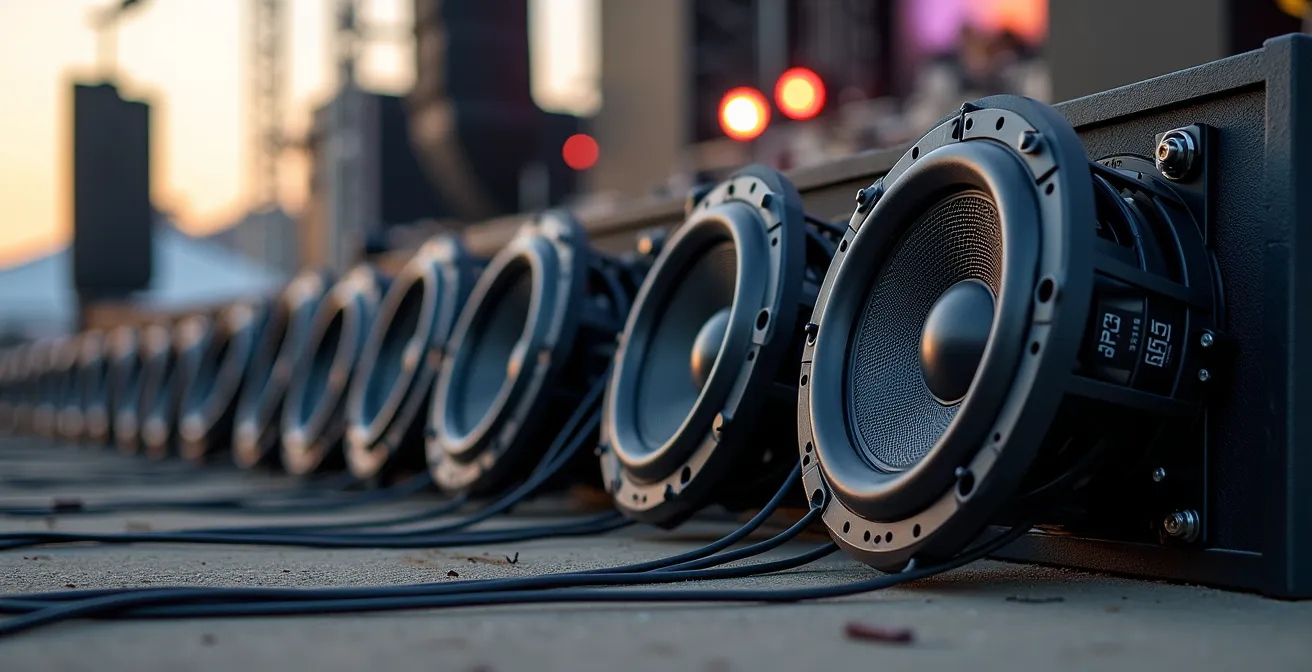
This technique is just one of many. Advanced configurations like end-fire, gradient, and vortex arrays offer even more precise control over the bass coverage pattern. Choosing the right one depends on the venue’s shape, the desired coverage area, and the amount of control needed. It’s a science of millimeters and milliseconds that transforms a collection of individual speakers into a unified, powerful instrument.
As detailed in a profile by industry publication FOH Online, Dave Rat developed the Vortex and V-Fire methods in 2009. These were groundbreaking techniques for arranging and delaying conventional subwoofers to steer low-frequency coverage horizontally, allowing engineers to precisely aim the bass at the audience while keeping the stage clean.
The following table, based on data from audio measurement experts, compares the most common configurations an operator might choose.
| Configuration | Rear Rejection | Coverage Pattern | Setup Complexity |
|---|---|---|---|
| Standard Left/Right | None | Omnidirectional | Simple |
| Cardioid (Front/Back) | 15-20 dB | Heart-shaped | Moderate |
| End-Fire Array | 10-15 dB | Forward-focused | Complex |
| Vortex Configuration | 20+ dB | Steerable | Very Complex |
Mastering these stacking techniques is non-negotiable for any serious outdoor event. It’s the difference between a muddy, inconsistent experience and a powerful, physical connection with every single person in the crowd.
Active or Passive: Which Crossover Protects Your Drivers Better?
A sound system is an ecosystem where every component must work in harmony. The crossover is the brain of this system, acting as a traffic cop for audio frequencies. Its job is to split the full-range audio signal and send the right frequencies to the right speakers: low frequencies to subwoofers, mids to mid-drivers, and highs to tweeters. A poorly configured crossover will not only sound terrible but will actively destroy your expensive drivers by sending them frequencies they weren’t designed to handle.
The debate between active and passive crossovers is a long-standing one. Passive crossovers are built into the speaker cabinet and use simple capacitors and inductors. They are simple and require no external power, but they are inefficient (wasting amplifier power as heat) and inflexible. Active crossovers, on the other hand, are separate electronic units (or integrated into a DSP) that filter the signal *before* it gets to the amplifiers. This allows each amplifier to be dedicated to a specific frequency range, resulting in far greater efficiency, control, and protection.
For any large-scale system designed for physical impact, an active crossover is the only professional choice. It allows for precise control over crossover points, slopes, and levels. Most importantly, it enables the use of limiters—a safety mechanism that prevents damaging signals from ever reaching the amplifiers and drivers. This level of protection is impossible with a passive system. While it’s true that the typical DSP processing in active systems can introduce 8-12 milliseconds of delay, this is easily managed with system alignment tools and is a small price to pay for the immense protection and control offered.
Action Plan: Basic Active Crossover Protection Setup
- Initial Settings: Set your subwoofer’s level control to about 50% of its maximum volume and ensure the phase switch is at 0 degrees.
- Bass Management Configuration: In your processor or receiver, set all speakers to ‘Small’ and start with a crossover frequency of 80Hz, a standard recommended by THX.
- Avoid Double Processing: If your subwoofer has its own internal crossover, use the ‘LFE In’ or ‘Bypass’ input on the sub to let your main system processor handle all crossover duties.
- Level Matching: Use your AV receiver’s internal test tones and an SPL meter to adjust the subwoofer’s output level until it matches the other speakers. Fine-tune from there by ear.
- Phase Alignment Check: While listening to a bass-heavy track from your main listening position, have a friend flip the sub’s phase switch (0/180 degrees). The correct setting is the one that produces the loudest, most solid bass.
Think of your active crossover not just as a filter, but as a comprehensive management and protection system for your most valuable assets. It’s what allows you to push the system to its limits safely, night after night.
The “Red Line” Mistake: Why Pushing Your Amps Too Hard Destroys the Vibe?
In the world of sound systems, there’s a tempting but destructive habit: pushing the amplifiers into the “red.” The little red lights on an amp’s meter aren’t a challenge; they’re a warning that you’re running out of headroom and entering the danger zone of clipping. When an amplifier clips, it can no longer reproduce the clean, round sine wave of the audio signal. Instead, it chops off the top and bottom, creating a harsh, distorted square wave.
This does two terrible things. First, it sounds awful. The warmth and punch of the music are replaced by a brittle, aggressive distortion that is physically fatiguing to listen to. It destroys the vibe instantly. Second, and more critically, it destroys your gear. A square wave sends a continuous stream of direct current (DC) to your speaker’s voice coil, causing it to overheat and eventually burn out. It’s particularly lethal for high-frequency drivers (tweeters), which can be fried in seconds by a clipped signal.
The pressure to be “loud” is immense, especially in genres like EDM where, historically, tracks were mixed to extreme levels to stand out. This culture of pushing levels, sometimes north of -6 LUFS, has conditioned many to believe that louder is always better. But a professional operator knows that perceived loudness and dynamic impact come from a clean signal with plenty of headroom, not a compressed, clipped one. Keeping your meters in the green and occasionally tickling the yellow is the sign of a confident engineer who has built a system with enough headroom to handle dynamic peaks without breaking a sweat.
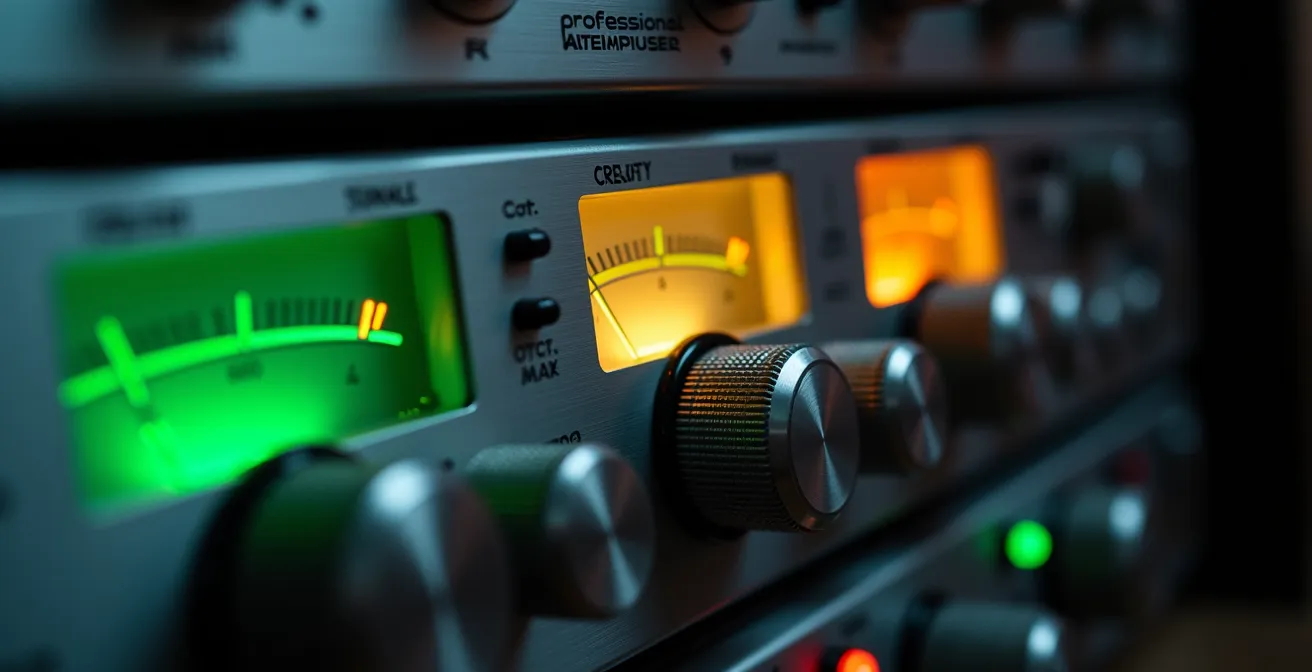
The red line isn’t a goal; it’s a failure state. A truly powerful system is one that can be immensely loud and physical while operating comfortably within its limits. That’s the mark of a pro.
Where to Position the Control Tower for the Best Crowd Experience?
The Front of House (FOH) mix position—the control tower—is the nerve center of the entire audio experience. It’s where the engineer listens, judges, and makes real-time adjustments to create the perfect mix for the audience. Its placement is one of the most critical decisions in setting up for a show, and it’s a decision fraught with compromise. Position it too close, and the mix won’t translate to the back of the venue. Too far back, and the engineer loses the immediacy and impact felt by the front rows.
The industry standard is to place the FOH tower roughly two-thirds of the way back from the stage into the main audience area. This spot is generally considered to represent the “average” listener’s experience, providing a good balance of direct sound from the PA and the reverberant energy of the venue. However, a great engineer knows this is just a starting point. The true art lies in ensuring the mix translates everywhere.
This is where modern technology like tablet-based remote control becomes invaluable. During soundcheck, the engineer can leave the console and walk the entire venue, from the front barrier to the side-fills to the back bar, listening for inconsistencies. They can identify dead zones caused by phase issues or areas where high frequencies are being blocked, and then make adjustments to the system’s DSP—adjusting delays, levels, and equalization for different speaker zones—to create the most consistent experience possible for everyone.
This philosophy is perfectly captured by established audio engineering best practices, which frame the task with a sense of duty to the entire audience:
The FOH position is a carefully chosen compromise to represent the ‘average’ experience. The true art is ensuring the sound translates well everywhere, from the front barrier to the back bar.
– Audio engineering best practices
Ultimately, the FOH tower isn’t just a platform for a mixing desk; it’s an observation post. Its ideal location is the one that gives the engineer the most accurate information to make decisions that serve the entire communal experience.
How to Configure a Pedalboard That Works for Both Electric and Acoustic?
While we’re talking about massive festival rigs, the philosophy behind a musician’s humble pedalboard offers a powerful analogy for our own work. A guitarist meticulously arranges their pedals—compressor, overdrive, delay, reverb—to create a specific signal chain that shapes their tone. Each component has a purpose, and the order matters. This same principle of a deliberate, curated signal path applies directly to large-scale sound systems, just with a different set of tools.
Instead of a pedalboard, our “board” is a mixing console and a rack of processors. But the goal is the same: to preserve the integrity of the source while shaping it for maximum impact. The debate between a “purist” signal path (like a DJ using a simple rotary mixer for its warmth) and a complex, flexible path (like a live sound engineer using a digital console with endless routing) exists in our world, too. Do we prioritize the analog character of a few key components, or the surgical control of a fully digital workflow?
The most advanced sound systems often do both, splitting the signal to treat different elements in unique ways. This isn’t just about EQing the kick drum differently from the vocals; it’s a fundamental architectural choice. A groundbreaking example of this philosophy is Dave Rat’s “Double Hung PA” system, used extensively with the Red Hot Chili Peppers. Instead of one PA, he flew two separate, side-by-side systems. As described in his public documentation, one system reproduced only vocals, kick, and snare—the core, punchy elements—while the other handled everything else like guitars, bass, and cymbals. This radical approach drastically increased clarity by preventing the dense wash of guitars from smearing the attack of the vocals and drums, a phenomenon known as intermodulation distortion.
Whether it’s a pedalboard or a stadium PA, the lesson is the same: a great sound is born from a series of deliberate choices about how the audio signal travels and is processed. Your system’s architecture is as important as the components themselves.
Why Do You Feel Sub-Bass in Your Chest and Not Just Your Ears?
This is the central magic we are chasing. The reason a great sound system feels physical is because it’s engaging your entire body, not just your ears. The human ear is fantastic at perceiving frequencies from around 20Hz to 20,000Hz, but the feeling of being enveloped by sound comes from frequencies at and below that lower threshold. This is the realm of infrasound, where the sound waves are so long that they are felt as pressure and vibration.
When a large subwoofer pushes a 25Hz wave, it’s creating a pressure wave over 45 feet long. You don’t “hear” this with your ears in the traditional sense; you perceive it through mechanoreception. The nerve endings in your skin, muscles, and especially your chest cavity resonate with this pressure. It’s the same physical principle as feeling the rumble of a nearby train. This whole-body stimulation has a profound, almost primal, effect on the listener.
It’s not just a subjective feeling; it’s a quantifiable phenomenon. A scientific study on bass frequencies and dancing behavior at a live electronic music concert found that intermittently adding very low-frequency sound (below the hearing threshold) caused people to dance 11.8% more. The participants couldn’t hear the extra bass, but their bodies could feel it, and it compelled them to move. This is physical proof that the communal vibe we strive for is directly tied to this tactile dimension of sound. Film producers have known this for years; Gaspar Noé famously used 27Hz tones in his film ‘Irreversible’ to create a deep sense of unease, explaining, “You can’t hear it, but it makes you shake.”
Building a system that physically moves a crowd means intentionally engineering for this full-body experience. You’re not just a sound engineer; you’re a conductor of physical energy.
Key Takeaways
- True physical impact is driven by controlled energy in the sub-30Hz range, which requires immense, well-managed power, not just generic volume.
- Acoustic geometry is non-negotiable; strategic speaker arrays (like cardioid) are essential for focusing bass on the crowd and ensuring signal integrity.
- An efficient sound system, built on principles of headroom, proper crossovers, and modern amplification, is not only more powerful and clear but also inherently more sustainable.
How to Assess the Environmental Impact of Your Festival Weekend?
As builders of these massive sound systems, we have a responsibility that extends beyond the dance floor. The same engineering principles that create a powerful, physical experience also dictate our environmental footprint. A poorly designed system is not only sonically inferior; it’s also incredibly wasteful. Assessing our impact means looking at two key areas: power consumption and noise pollution.
An inefficient system wastes colossal amounts of electricity, turning it into heat instead of sound. The choice of amplification is crucial here. Modern Class-D amplifiers are vastly more efficient than older Class-A/B designs, drawing less power from the grid (or generators) for the same acoustic output. Likewise, using highly efficient speaker designs, such as horn-loaded cabinets, maximizes the sound pressure level (SPL) you get for every watt you put in. This “SPL per watt” ratio is a key metric of a sustainable and well-engineered system.
Controlling noise pollution is the other side of the coin. Our goal is to contain the energy within the festival grounds. This is where the acoustic geometry we discussed earlier plays a dual role. A cardioid subwoofer array, for instance, doesn’t just clean up the stage sound; it dramatically reduces the amount of low-frequency energy bleeding out into the surrounding environment, respecting the festival’s neighbors. Thoughtful system design, like using delay towers to provide coverage for the back of a large crowd instead of just turning up the main PA, also helps contain the sound and improve the experience for everyone.
Pioneering venues like Amnesia Ibiza have shown that world-class sound and sustainability can go hand-in-hand, rebuilding their legendary system with a focus on high-efficiency, low-distortion technologies that deliver powerful sound while minimizing ear fatigue and environmental impact. It’s about being smart and deliberate, creating a powerful experience through precision, not just volume.
By focusing on efficiency, we create a system that is not only more powerful and clearer but also kinder to our planet and our communities. That is the mark of true pride in our craft. Now, take this knowledge and start designing not just a sound system, but an experience. The crowd is waiting.