
Escaping repetitive music recommendations isn’t about finding a better app; it’s about fundamentally changing your relationship with music discovery. Contrary to the idea that technology holds all the answers, the key is to shift from being a passive consumer to an active curator. This guide moves beyond simple tricks to instill a conscious, intentional listening practice, treating your music library not as a data-driven feed, but as a personal archive built with passion and curiosity.
There’s a familiar, frustrating feeling for any modern music lover: you open your streaming app, ready for something new, only to be served the same 50 songs you’ve had on rotation for months. You feel trapped in an “algorithmic feedback loop,” a digital echo chamber that reflects your past tastes with unnerving accuracy but rarely challenges them. This experience, often called algorithm fatigue, leaves you feeling disconnected from the vast, vibrant world of music that exists just beyond the platform’s clean interface.
The common advice is often to switch platforms, tinker with settings, or try another AI-driven discovery tool. But these are temporary fixes for a deeper issue. They still place technology, rather than your own curiosity, in the driver’s seat. What if the real solution isn’t to find a better algorithm, but to become the curator yourself? What if we treated music discovery not as a passive stream to be consumed, but as an active craft to be honed?
This article is your manifesto for reclaiming control. We won’t just list alternatives; we’ll build a new framework for listening. By embracing an archivist’s mindset, you can cultivate a sonic palette that is uniquely yours—eclectic, personal, and deeply meaningful. We will explore how to diagnose the algorithmic trap, develop active search methods, understand the irreplaceable value of human curation, and ultimately learn to trace the very lineage of the music you love.
This guide provides a structured path to transform your listening habits. Below is a summary of the key skills you will develop to move from a passive listener to an active, passionate music curator.
Summary: Building Your Personal Music Curation Practice
- Why Does Spotify Always Play the Same 50 Songs?
- How to Find Underground Artists Before They Go Viral?
- Human Curators vs AI Playlists: Which One Discover Better Gems?
- The Hidden Danger of Musical Echo Chambers for Your Artistic Growth
- When to Schedule Deep Listening Sessions for Maximum Retention?
- Why Do Musicians Who Listen to Only One Genre Sound Generic?
- Why Is Distinguishing Between House and Techno Crucial for DJs?
- How to Trace the Lineage of Your Favorite Genre Back to its Roots?
Why Does Spotify Always Play the Same 50 Songs?
The feeling that your streaming service is a broken record isn’t just in your head; it’s a direct consequence of how recommendation algorithms are designed. These systems thrive on predictability. Their primary goal is to keep you listening, and the safest bet is to serve you something you already like—or something statistically similar. This creates an algorithmic feedback loop: you listen to a track, the algorithm registers your “engagement,” and it serves you more of the same, reinforcing its initial assumption about your taste. Over time, this narrows your sonic world instead of expanding it.
The problem is compounded by a fragmented media landscape. While it feels like everyone is on one or two major platforms, a recent Bain & Company study reveals that nearly 20 different sources now rank among the top ways fans discover new music. An algorithm confined to one platform simply cannot account for the rich, diverse signals coming from independent radio, live shows, or niche communities. It operates with incomplete data, defaulting to the lowest common denominator: popular tracks and artists adjacent to your existing history.
To break free, you must consciously disrupt the data stream the algorithm feeds on. This means taking active steps to introduce variety and unpredictability into your listening. Forcing the system to “re-learn” your preferences is the first step toward reclaiming your discovery journey. It’s about seizing control from the automated system and making intentional discovery a core part of your listening habit.
Breaking this cycle requires more than just wishing for better recommendations. It involves taking specific, deliberate actions within your streaming apps to signal a desire for novelty. Start by turning off autoplay features to regain control over what plays next and periodically clearing your listening history to reset the algorithm’s assumptions about your taste. This small act of defiance is the beginning of true curation.
How to Find Underground Artists Before They Go Viral?
Finding an artist before they hit the mainstream is one of the most rewarding aspects of music curation. It’s a moment of pure discovery, a connection made without the influence of marketing budgets or algorithmic nudges. This requires moving away from platforms designed for mass consumption and embracing spaces where music is shared for passion, not just plays. It’s about developing an active listening practice that prioritizes exploration over convenience.
The key is to invest your time in discovery methods that favor human connection and community. For example, arriving at a local venue early to catch the opening acts can expose you to raw talent on the cusp of breaking through. Similarly, tuning into independent or college radio stations offers a window into expertly curated selections that defy commercial trends. These methods require more effort than letting an algorithm run, but the payoff is a library filled with genuine gems.

Platforms like Bandcamp are also invaluable tools for the modern archivist. Its discovery features allow you to search for music by city and genre, effectively letting you tap into local scenes across the globe from your own home. The following table breaks down the trade-offs of these different methods, helping you build a balanced discovery strategy.
| Discovery Method | Best For | Key Advantage | Time Investment |
|---|---|---|---|
| Local Venue Early Arrivals | Live Music Fans | See artists before mainstream success | 2-3 hours per show |
| Independent Radio Stations | Genre Explorers | Human curation with context | Passive listening |
| Music Blogs & Forums | Deep Divers | Community recommendations | 30 mins daily |
| Bandcamp Discovery Tool | Indie Supporters | Search by city and genre | 1 hour weekly |
Human Curators vs AI Playlists: Which One Discover Better Gems?
While AI can efficiently analyze data points like tempo and genre, it fundamentally lacks the one thing that makes music meaningful: human context. An algorithm can identify that you like 120 BPM electronic tracks with female vocals, but it can’t understand the cultural significance of a particular synth sound, the emotional weight of a lyric, or the narrative arc of an album. This is where human curators—be they DJs, radio hosts, or dedicated playlist-makers—remain irreplaceable.
Human curation is an art form. It’s about storytelling. A great playlist isn’t just a collection of similar songs; it’s a journey with a beginning, a middle, and an end. It can evoke a specific mood, introduce a challenging new sound in a palatable way, or draw unexpected connections between seemingly disparate genres. The Daily Playlists Editorial Team captures this distinction perfectly:
Humans excel in emotional resonance and cultural relevance—areas where machines fall short. They curate playlists with instinct, drawing on deep knowledge and an awareness of trends that transcend raw data. This personal touch fosters a unique emotional connection, making the playlist feel intentional and meaningful. It becomes a work of art, crafted to tell a story, evoke a mood, or communicate a feeling.
– Daily Playlists Editorial Team, AI music curation versus Human music curation
In contrast, AI-driven playlists often lead to a flattening of taste. By optimizing for engagement, they tend to favor familiarity, creating a sanitized listening experience. As veteran music journalist Joe Muggs observes in Dazed, the result is that users are exposed to increasingly generic content aimed at a one-dimensional idea of their taste. This system isn’t designed to find you a “gem”; it’s designed to find a statistically safe bet.
True gems are often defined by their imperfections, their context, or their ability to surprise. They are the tracks that an algorithm might dismiss as outliers but a human curator recognizes as essential. Seeking out these human-led sources is a conscious choice to prioritize artistic intent over data-driven efficiency.
The Hidden Danger of Musical Echo Chambers for Your Artistic Growth
A musical echo chamber does more than just make your playlists boring; it actively stunts your artistic growth. When you’re only exposed to music that confirms your existing preferences, your brain’s neural pathways for appreciating new and complex sounds begin to atrophy. You lose the ability to be surprised, challenged, or even productively uncomfortable. Your sonic palette, the range of sounds and structures you can understand and enjoy, becomes limited. This is the hidden danger of algorithmic comfort: it breeds a passive listening habit that slowly erodes your curiosity.
For anyone who not only listens to music but also creates it, this danger is even more acute. A musician or producer fed a monotonous diet of one genre will inevitably produce music that sounds generic. Their vocabulary of chords, rhythms, and textures remains small, preventing them from developing a truly unique voice. Escaping this trap requires a conscious and sometimes forceful effort to seek out the unfamiliar.
Breaking free is an act of intentional exploration. It involves setting up systems to push yourself beyond your comfort zone. This can be as simple as a monthly “genre challenge,” where you commit to deep-diving into a style you know nothing about, from Tuareg rock to Japanese ambient. It also means leveraging tools with a spirit of adventure. For instance, you can use Bandcamp’s location-based search to explore the music scene of a city you’ve never visited or join a Discord community dedicated to a microgenre you’ve only just heard of. These actions create a framework for structured serendipity—finding the unexpected on purpose.
The goal is not to abandon the music you love, but to enrich it. By understanding what’s happening in other genres, you gain a new perspective on your own favorites. You start to see the connections, the shared influences, and the creative innovations that bubble up when different musical worlds collide.
When to Schedule Deep Listening Sessions for Maximum Retention?
In a world of background noise, the act of listening deeply and without distraction has become a radical one. To truly absorb a new album or explore an unfamiliar genre, you can’t just have it on while you work or scroll through social media. You need to schedule dedicated deep listening sessions, treating them with the same importance as reading a book or watching a film. This is the core of an active listening practice: creating the time and space for music to command your full attention.
The timing of these sessions can significantly impact your ability to retain and appreciate the music. Your brain state varies throughout the day, making certain times more conducive to focused listening. For example, the early morning, when your mind is fresh and uncluttered, is ideal for tackling complex or challenging new genres. In contrast, late evening is often better suited for more emotional or ambient music that can be processed as you wind down.
Many curators transform otherwise passive moments into active discovery rituals. As music curator Andy Cush explains, his commute is a prime opportunity for intentional listening. He focuses on recommendations from trusted friends or new artists he’s encountered at live shows. This “Commute Ritual Method” turns dead time into one of the most productive parts of his discovery process. The key is the intention—choosing to focus solely on the music.
The following table, based on insights from seasoned DJs and curators, outlines how to align your listening sessions with your brain’s natural rhythms for maximum impact.
| Time of Day | Brain State | Best For | Retention Rate |
|---|---|---|---|
| Early Morning (6-8am) | Fresh, High Focus | Complex/New Genres | High |
| Commute Time | Routine-Based | Full Albums | Medium-High |
| Late Evening (9-11pm) | Relaxed, Open | Emotional/Ambient | High (processes during sleep) |
| Mid-Day | Distracted | Background Only | Low |
Why Do Musicians Who Listen to Only One Genre Sound Generic?
A musician’s sonic output is a direct reflection of their sonic input. When artists confine their listening to a single genre, they are essentially limiting their creative toolkit. They become fluent in one language but remain ignorant of all others, resulting in work that feels derivative and predictable. As one music production expert eloquently put it, “Musical genres are like languages. A musician listening to one genre is like a writer who only reads one author. Their vocabulary of chords, rhythms, and timbres becomes limited, preventing them from expressing complex or original ideas.”
This issue is becoming more pronounced in the age of hyper-optimized content platforms. For instance, MIDiA Research data shows that less than 10% of 16-24-year-olds discover music from traditional sources like TV/film or even personal recommendations. Instead, their discovery is overwhelmingly driven by short-form video app algorithms, which are notorious for promoting homogenous, trend-based sounds. This creates a generation of listeners—and future creators—who may never organically encounter the genre cross-pollination that has historically driven musical innovation.
The most iconic artists are almost always voracious and eclectic listeners. David Bowie pulled from soul, funk, and German electronic music. The Beatles were deeply influenced by American R&B and Indian classical music. This practice of creative synthesis—absorbing disparate influences and combining them into something new—is the engine of originality. A punk band that only listens to punk rock can only ever hope to replicate what has come before. But a punk band that also listens to jazz, dub reggae, and minimalist composition has the potential to create something truly groundbreaking.
For any creator, curating a diverse listening diet isn’t a luxury; it’s a professional necessity. It’s about feeding your subconscious with a rich and varied set of building blocks. The more diverse the input, the more original and compelling the output will be. This is why breaking out of the echo chamber isn’t just for personal enjoyment; it’s a critical strategy for artistic survival and growth.
Why Is Distinguishing Between House and Techno Crucial for DJs?
For a casual listener, the nuances between house and techno might seem academic. For a DJ, however, this distinction is fundamental to their craft. It’s the difference between building a smooth, soulful journey and crafting a relentless, hypnotic experience. Misunderstanding these genre distinctions is like a chef confusing salt and sugar—while both are crystals, they serve entirely different functions and produce vastly different results. Being able to tell them apart is a core competency that directly impacts a DJ’s ability to control the energy of a room.
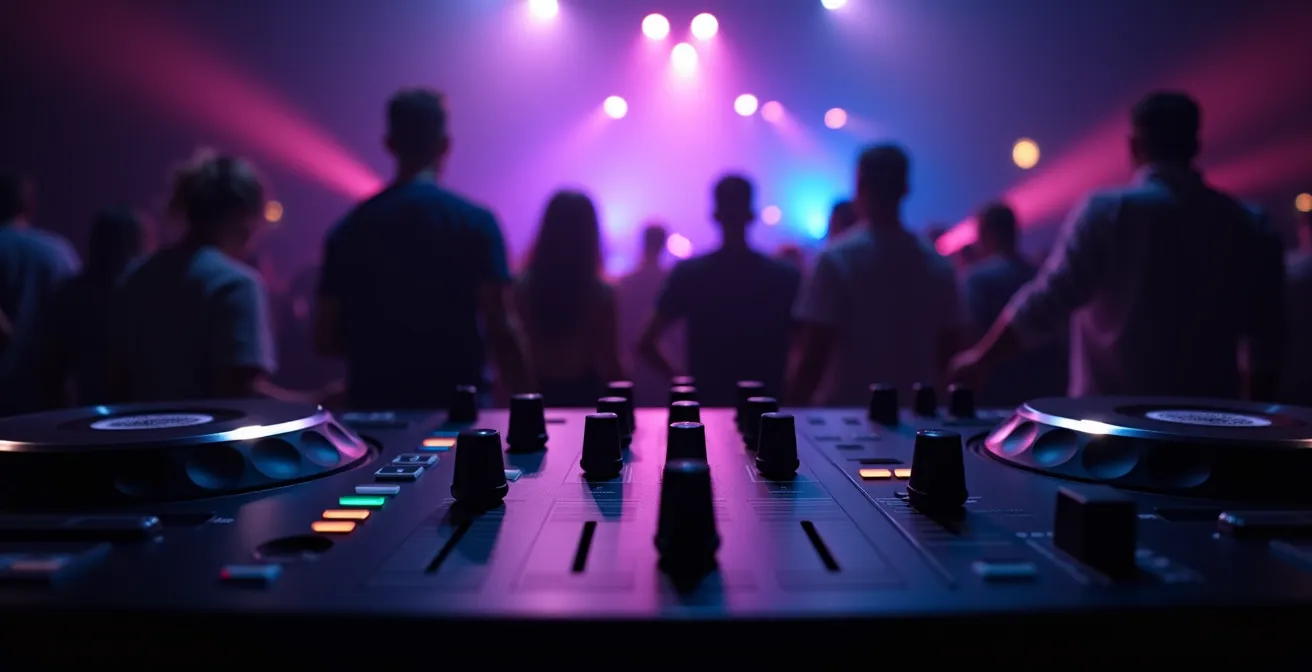
House music, with its roots in disco and soul, is typically warmer, more melodic, and often features vocals. Its groove is designed to make you move your whole body. Techno, on the other hand, is often more mechanical, loop-based, and focused on rhythmic tension and release. It’s music for the mind as much as the body. A DJ who can’t differentiate them might jarringly mix a soulful vocal house track into a driving, industrial techno set, completely shattering the established mood and losing the dance floor.
This is why meticulous library organization is a hallmark of a professional DJ. Many organize their collections first by broad genres, and then by sub-genres and energy levels. This allows them to make quick, intuitive decisions in the heat of a mix. For example, a DJ’s library might be broken down into “Warm-Up House,” “Peak-Time Techno,” and “After-Hours Dub.” This level of organization isn’t just about being tidy; it’s a strategic system for effective set-building and storytelling. By knowing exactly what tool to reach for at any given moment, a DJ can masterfully guide the audience’s emotional and physical experience.
Ultimately, understanding genre is about understanding function and context. A DJ who has done their homework knows not just what a track sounds like, but what it’s for. This knowledge is what separates a person who simply plays records from a true curator who crafts an unforgettable experience.
Key takeaways
- True music curation is an active, intentional practice, not a passive act of consumption.
- Escaping the algorithmic echo chamber by embracing diverse genres is essential for personal and artistic growth.
- Understanding a genre’s history and context transforms listening from a simple activity into a deep, meaningful connection with the art form.
How to Trace the Lineage of Your Favorite Genre Back to its Roots?
The ultimate skill of a music archivist is the ability to perform “sonic cartography”—tracing the lineage of a genre back to its origins. This is where music listening transcends hobby and becomes a form of historical investigation. Understanding that your favorite hip-hop track samples a 70s funk drummer, who was himself influenced by jazz rhythms from the 40s, adds layers of meaning and appreciation. It connects you to a rich tapestry of cultural history and reveals the conversations happening between artists across decades.
This process stands in stark opposition to the decontextualized world of algorithmic playlists. As Billboard reports that unlike other streaming services, YouTube Music relies entirely on algorithms for its playlists, presenting music as a contextless stream of data points. There is no story, no lineage, no human element. To counter this, you must adopt the methods of a detective. One of the most effective techniques is the “Sample Chain Research Method,” which uses a single sample as a starting point for a deep dive into music history.
By following this trail, you are not just finding new music; you are reconstructing the creative DNA of the sounds you love. This practice builds a library that is not just a collection of files, but a web of interconnected stories. It transforms your listening from a solitary act into a dialogue with the past. Every track becomes a node in a larger network of influence and innovation, and your understanding of music deepens exponentially.
Your Action Plan: Tracing a Genre’s DNA
- Identify the Source: Use a resource like WhoSampled.com to find the original song sampled in one of your favorite modern tracks.
- Explore the Discography: Dive into the original artist’s full catalog on a database like Discogs to understand their broader body of work.
- Investigate the Label: Research other artists who were on the same record label during that era to discover the sound of that specific scene.
- Follow the Players: Look up the producers, session musicians, and engineers involved in the original recording; they are often the unsung heroes connecting different genres.
- Build the Timeline: Create a new playlist that follows the chronological evolution of the artists and sounds you’ve uncovered, documenting the genre’s lineage.
By adopting these active, intentional practices, you move beyond being a mere consumer of algorithmically-fed content. You become a participant in the culture, an archivist of your own taste, and a curator with a unique and compelling story to tell through your collection. The result is a music library with a soul.