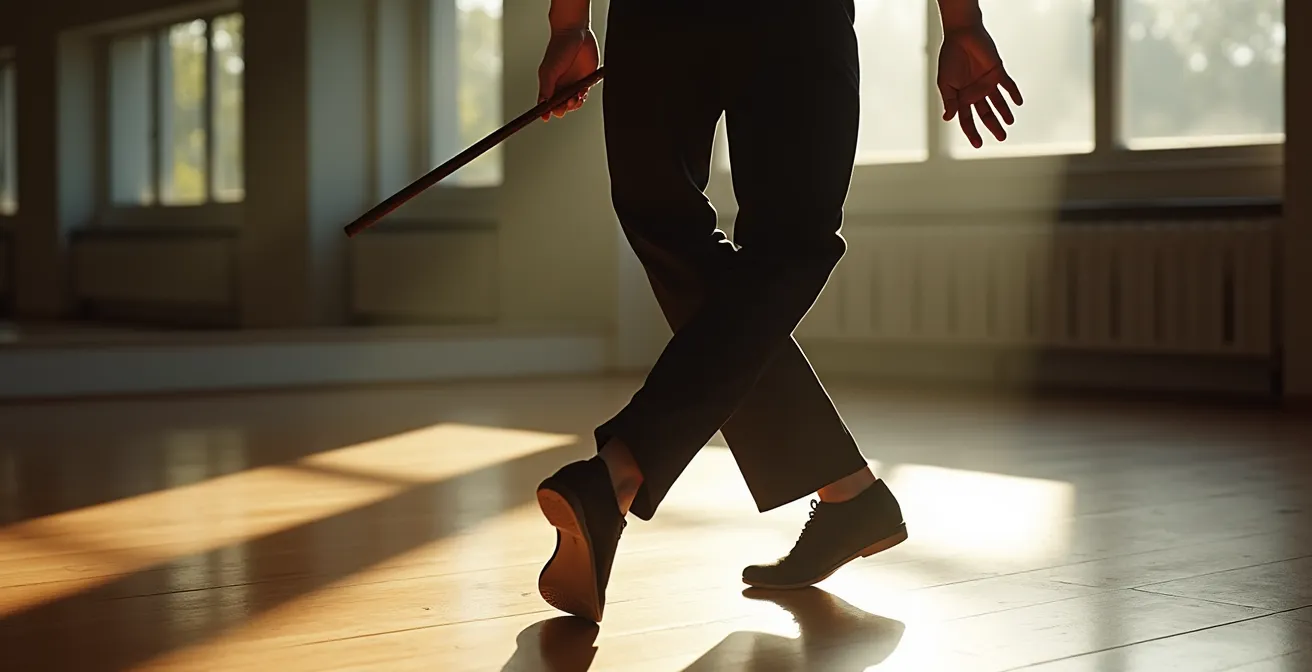
Contrary to popular belief, the key to unlocking a musician’s internal rhythm isn’t a better metronome; it’s learning to treat the entire body as a rhythmic instrument.
- Static practice on an instrument builds finger dexterity but often fails to create a deep, physical sense of groove.
- Dance training builds a “kinesthetic map” of rhythm, allowing you to feel subdivisions and polyrhythms as physical movements.
Recommendation: Instead of only practicing scales, enroll in a beginner’s dance class (partner, diaspora, or even percussive) to re-wire your brain and body for a more profound sense of time.
As a musician, you’ve likely spent countless hours with a metronome, painstakingly working to lock your fingers into a perfect, unwavering grid. You practice scales, you drill difficult passages, and you record yourself, all in the pursuit of impeccable timing. Yet, for many, a certain stiffness remains. The groove feels intellectual, not instinctual. You can play *on* the beat, but you struggle to play *with* the beat. This frustration is common, and it stems from an approach that treats rhythm as a purely auditory and cerebral concept, ignoring the most powerful processor you own: your body.
The usual advice—tap your foot, count out loud—is a step in the right direction, but it’s like trying to understand an ocean by dipping a toe in. But what if the secret to truly internalizing complex rhythms wasn’t in your ears, but in your core, your weight shifts, and your breath? What if the solution wasn’t more practice, but a different *kind* of practice, one that engages your entire being in a conversation with the music? This is the domain of the dancer, and it holds the key to unlocking a musician’s rhythmic potential.
This guide will move you from the static world of the practice room to the kinetic reality of the dance floor. We will explore how physical embodiment, from body percussion to the dynamics of partner dance, can transform your relationship with time. By learning to listen with your body, you will not just improve your timing; you will learn to embody the groove itself.
To guide you on this physical journey into rhythm, we’ve structured this article to build from foundational concepts of bodily awareness to their direct application in musical performance. The following sections will provide practical techniques and scientific insights to help you make the leap from hearing rhythm to truly feeling it.
Summary: From Stiff to Fluid: A Musician’s Guide to Physical Rhythm
- Why Is Tapping Your Foot Insufficient for Complex Polyrhythms?
- How to Use Body Percussion to Deconstruct a Difficult Riff?
- Lead or Follow: What Partner Dance Teaches About Musical Improvisation?
- The “Statue” Mistake: Why a Static Stage Presence Bores the Audience?
- How to Pace a Setlist Like a DJ Mix to Keep People Moving?
- How to Build a Tennis Ball Riser to Kill Kick Drum Vibrations?
- How to Practice Zapateado Rhythm Without Destroying Your Knees?
- Why Does Live Music Trigger a Stronger Dopamine Response Than Headphones?
Why Is Tapping Your Foot Insufficient for Complex Polyrhythms?
Tapping your foot is the first piece of rhythmic advice every musician receives. It provides a simple, single-layered anchor—a quarter-note pulse that grounds you in the song’s primary tempo. While useful for simple 4/4 time, this method becomes a crutch when facing the rich complexity of polyrhythms. A foot can only tap one rhythm at a time, but music often involves multiple, interlocking patterns. To truly understand a 3:2 or 4:3 polyrhythm, your brain needs to process simultaneous, conflicting pulses. Trying to do this while only tracking one of them with your foot is like trying to read two books at once with only one eye.
The solution is to engage the whole body in a process of rhythmic embodiment. When different parts of your body can move independently to different rhythmic layers, you begin to internalize the entire rhythmic structure, not just a single pulse. This is a core principle in many movement traditions that are intrinsically linked to complex music.
Case Study: West African Dance and “Multiple Rhythm Tracking”
The Mark Morris Dance Group’s “Dances of the African Diaspora” program serves as a powerful example. Musicians participating in this training learn to execute complex polyrhythmic patterns by assigning different rhythms to different body parts. For instance, their feet might hold down a foundational 4/4 pattern, while their hips sway in a 3/4 pattern and their shoulders articulate a syncopated accent layer. Accompanied by live percussion, students develop what instructors call “multiple rhythm tracking.” This isn’t just a physical exercise; it builds the neurological framework necessary to hear, feel, and perform multiple rhythmic layers simultaneously, a skill far beyond the capacity of simple foot-tapping.
By learning to isolate and layer movements, the musician’s body becomes a living representation of the music’s architecture. The conflict of the polyrhythm is resolved not in the head, but in the hips and shoulders, transforming an abstract concept into a felt experience.
How to Use Body Percussion to Deconstruct a Difficult Riff?
When you’re struggling with a complex musical riff, the problem often lies in the disconnect between hearing the rhythm and physically executing it. Body percussion bridges this gap by creating a direct, tactile relationship with the notes. Instead of the rhythm being an abstract series of sounds, it becomes a sequence of physical impacts on your own body. This process of somatic listening—listening with your entire physical form—can demystify even the most challenging phrases.
By mapping different parts of the riff to different parts of your body, you create a physical logic for the music. A deep chest thump can represent the downbeat or a bass note, a sharp thigh slap can articulate the backbeat, and crisp finger snaps can fill in the quick ghost notes. This turns your body into a living drum kit and a kinesthetic learning tool.
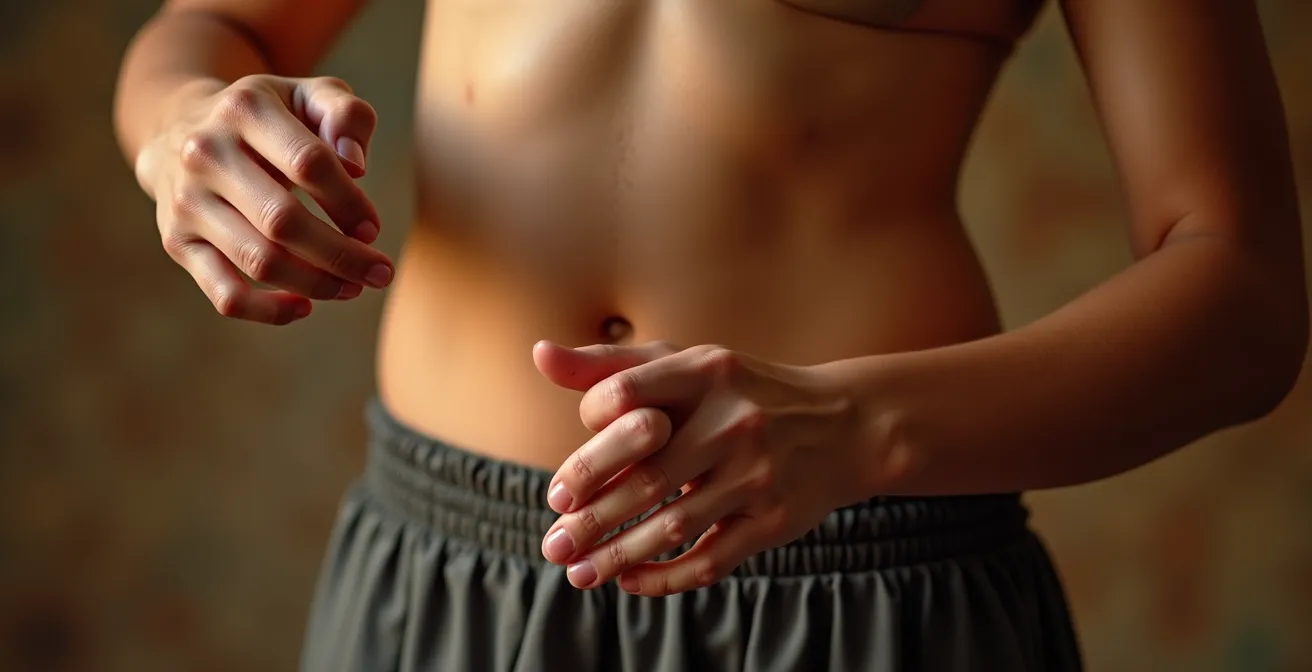
This approach allows you to break a riff down into its component layers and feel how they relate to one another. You’re no longer just trying to replicate a sound; you’re recreating a physical pattern. The following table provides a basic framework for mapping musical elements to body percussion sounds, helping you build your own physical vocabulary for deconstructing music.
| Musical Element | Body Percussion | Sound Quality | Application |
|---|---|---|---|
| Bass Notes | Chest Thump | Deep, resonant | Mark downbeats and root notes |
| Snare/Backbeat | Thigh Slap | Sharp, percussive | Emphasize syncopation |
| Hi-Hat/Ghost Notes | Finger Snaps | Crisp, light | Fill rhythmic subdivisions |
| Cymbal Wash | Hand Rub + ‘Shhhh’ | Sustained, airy | Indicate sustained notes |
| Accents | Hand Clap | Bright, cutting | Highlight rhythmic peaks |
Lead or Follow: What Partner Dance Teaches About Musical Improvisation?
Musical improvisation is, at its core, a conversation. It’s about listening, anticipating, and responding in real-time. Yet, many musicians practice improvisation in isolation, which is like practicing for a debate by only reading your own notes. Partner dance, such as salsa, swing, or tango, is the physical embodiment of this musical conversation. It forces you out of your own head and into a dynamic, responsive relationship with another person, all mediated by the music.
In partner dance, there are two roles: the lead and the follow. The lead initiates movements based on the music’s structure, while the follow interprets those signals and responds. This is not a passive role; a good follow anticipates and embellishes, adding their own flavor to the conversation. For a musician, learning both roles is transformative. Learning to lead teaches you to think in phrases, to communicate musical ideas clearly, and to be responsible for the overall structure. Learning to follow hones your deep listening skills to an extraordinary degree. You learn to feel subtle shifts in weight and tension as non-verbal cues, anticipating the next chord change or rhythmic break before it happens.
This training directly translates to musical improvisation. When you’re trading solos with another musician, you’re constantly switching between leading and following. The skills are identical: clear communication, active listening, and a shared understanding of the underlying musical structure. The physical practice of partner dance ingrains these skills in your muscle memory. In fact, research from dance education programs has shown a reported 87% improvement in improvisation timing for musicians after just six months of consistent partner dance training. The body learns the language of call-and-response, which the mind then applies to the instrument.
The “Statue” Mistake: Why a Static Stage Presence Bores the Audience?
Many technically proficient musicians make the “statue” mistake on stage. They stand perfectly still, focusing intensely on their instrument, believing their musical skill alone is enough to captivate an audience. While their playing might be flawless, the performance feels lifeless. This is because a live audience doesn’t just listen with their ears; they listen with their eyes and their bodies. The connection they crave is one of kinesthetic empathy, a phenomenon rooted in our brain’s mirror neurons.
When an audience sees a performer move with the music—a subtle sway, a head nod locked into the groove, a weight shift that anticipates the downbeat—their own brains unconsciously mirror that movement. They begin to *feel* the rhythm in their own bodies, creating a powerful, shared experience. A static performer denies the audience this connection. They present the music as a finished product to be observed, rather than an energetic event to be experienced together. Research from performance arts centers like the Fred Astaire Dance Studios confirms that musicians who incorporate intentional, dance-inspired movement can see audience engagement ratings increase by as much as 40%. Movement is the visual manifestation of the groove, and it’s contagious.
Developing a dynamic stage presence isn’t about elaborate choreography; it’s about allowing the music to move you in an authentic way. It’s about making your physical presence an extension of your musical expression. By learning to ground yourself, use the space, and connect your breath to your phrasing, you invite the audience into the music with you.
Action Plan: Auditing Your Stage Presence for Rhythmic Impact
- Points of Contact: Identify all the ways your body currently expresses rhythm on stage. Is it just a foot tap? A head nod? List every physical channel, no matter how small.
- Collecte: Film yourself during a practice session. Inventory the existing movements. Are they repetitive? Are they connected to specific musical parts (e.g., bass line, melody)?
- Cohérence: Confront your movements with the music’s emotional intent. Does your body language for a ballad differ from an upbeat track? Your movement should be consistent with the song’s feeling.
- Mémorabilité/Emotion: Watch the footage with the sound off. What is your body communicating? Is it engaging and unique, or generic and static? Identify one “signature” movement you could develop.
- Plan d’intégration: Choose one song and one technique (e.g., using weight shifts to show the pulse). Practice integrating this single new movement until it feels natural, then expand from there.
How to Pace a Setlist Like a DJ Mix to Keep People Moving?
A great concert setlist is more than a sequence of songs; it’s a choreographed journey of energy. Too often, bands approach setlist creation from a musician’s perspective, focusing on key changes and lyrical themes. A more effective approach is to think like a DJ or a choreographer, focusing on the physical and emotional response of the audience. The goal is not just to play songs, but to manage the collective energy of the room and keep the bodies in motion.
DJs have mastered the art of the seamless mix, using techniques like beat-matching and harmonic mixing to create a continuous flow that never breaks the dance floor’s momentum. Bands can adapt these principles to create powerful, wave-like dynamics in their live shows. This means looking beyond individual songs and thinking in 15-minute choreographic arcs, where you intentionally build, peak, and release energy. It requires a deep, physical understanding of how tempo, rhythm, and key affect a moving crowd.
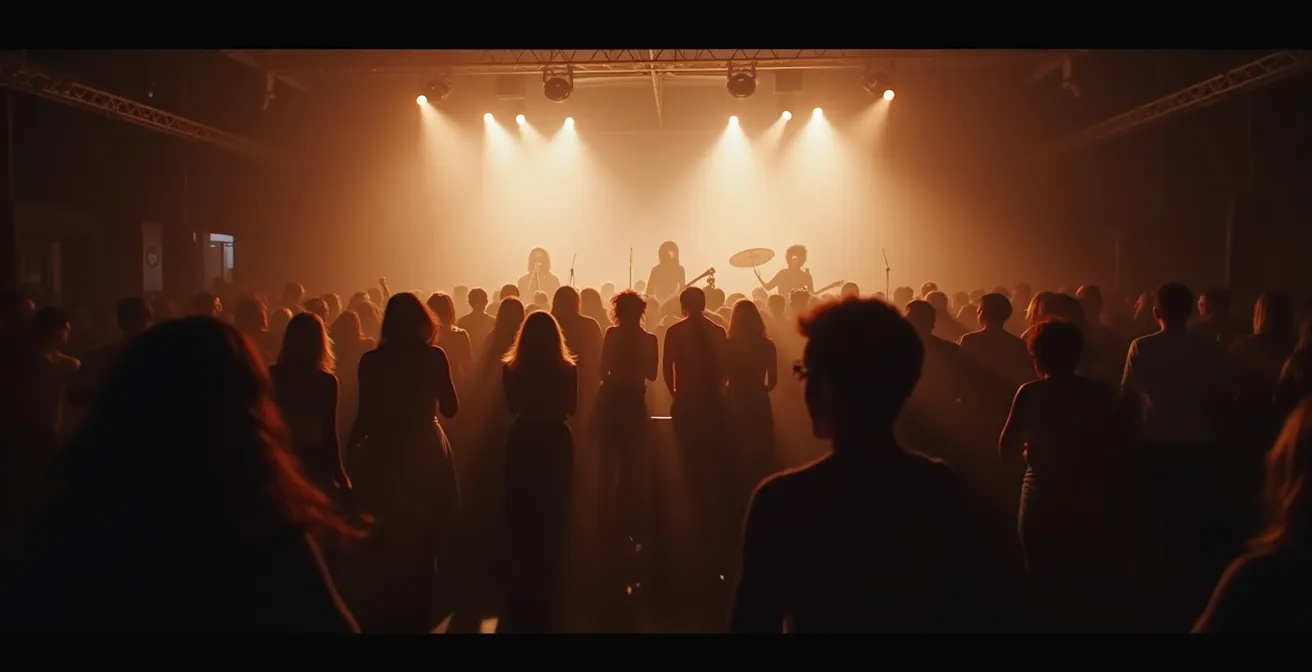
This approach demands that the band becomes acutely aware of the audience’s body language—a skill DJs call “reading the floor.” Are people leaning in? Are they bouncing on the balls of their feet? Is the energy dipping? This real-time feedback loop allows the band to make subtle adjustments, perhaps extending a groovy outro or transitioning into the next song more quickly to sustain momentum. The following table translates core DJ techniques into strategies a live band can use to craft a more physically compelling setlist.
| DJ Technique | Band Adaptation | Energy Management | Transition Method |
|---|---|---|---|
| Beat Matching | Groove Morphing | Maintains momentum | Drummer transforms beat pattern gradually |
| Harmonic Mixing | Key-Related Segues | Smooth emotional flow | End in relative minor/major of next song |
| Energy Blocks | 15-min Choreographic Arcs | Wave-like dynamics | Build-peak-release cycles |
| Reading the Floor | Body Language Scanning | Real-time adaptation | Adjust tempo based on audience movement |
How to Build a Tennis Ball Riser to Kill Kick Drum Vibrations?
A choreographer understands that to control your body, you must first control your stage. For a musician, especially a drummer, this “stage” is your immediate physical environment. Your sense of timing and groove—your proprioceptive time—relies on clear physical feedback. When your kick drum sits directly on a resonant floor, it creates a muddy wash of low-frequency vibrations. This structural-borne noise clouds your physical perception of the beat, making it harder to feel the precise attack of each hit. It’s like trying to dance on a wobbly, unpredictable surface.
Building a tennis ball riser is a classic DIY studio trick that isolates the drum from the floor, creating a “floating” platform. The tennis balls act as shock absorbers, decoupling the drum and preventing its vibrations from transferring into the building’s structure. This dramatically cleans up the low-end frequencies in the room, but more importantly, it clarifies the physical feedback you receive. Acoustic treatment studies have measured a vibration transmission reduction of up to 68% when using such an isolation platform. The result is a tighter, punchier kick drum sound and a much cleaner physical sensation of the beat.
Creating this “clean dance floor” for your rhythm is a straightforward project. By taking control of your physical environment, you provide your body with the clear, unadulterated feedback it needs to internalize the groove. Here are the steps to build your own:
- Gather materials: You will need 16 tennis balls, two 3/4-inch plywood boards (a 24×24 inch size is standard), wood glue, and sandpaper.
- Cut indentations: Using a hole saw or Forstner bit, cut shallow, circular indentations in a 4×4 grid pattern on one side of each board. These will hold the tennis balls securely in place.
- Sand surfaces: Ensure all surfaces and edges are sanded smooth to prevent splinters and create even contact points.
- Place the balls: Arrange the 16 tennis balls into the indentations on the bottom board. This creates the crucial cushioned suspension layer.
- Position the top board: Carefully place the top board over the tennis balls, making sure each ball seats correctly into the corresponding grooves on its underside.
- Test and adjust: Place your kick drum on the riser. You can adjust the level of dampening by swapping out new, firm tennis balls for older, softer ones to find the perfect response.
How to Practice Zapateado Rhythm Without Destroying Your Knees?
Percussive dance forms like Flamenco’s Zapateado or Irish stepdance represent the pinnacle of rhythmic embodiment, where the body itself becomes the primary instrument. For a musician, practicing these forms can be revolutionary for developing complex rhythmic dexterity. However, the high-impact nature of these styles poses a significant risk of injury, particularly to the knees. The common mistake is to “attack” the floor, generating force from the leg muscles and absorbing the impact directly in the joints.
The key to safe and effective practice lies in a complete shift in mindset, a principle shared by disciplines like the Alexander Technique. Instead of striking down, you must learn to use a “controlled rebound.” The floor is not an opponent to be hit, but a resonant partner. The goal is to drop your weight into the floor and use its energy to rebound back up, with the ankles acting as pliable shock absorbers and the core engaged to stabilize the entire structure. The movement should be initiated from your center of gravity, flowing down through a relaxed leg, rather than being forced from the quadriceps.
This approach transforms the practice from a percussive assault into a study of energy transfer. A case study involving professional flamenco dancers at the Royal Academy of Dance demonstrated the power of this method. By implementing Alexander Technique principles, they focused on initiating movement from the core and using pliable ankles as shock absorbers. This shift in technique resulted in a staggering 73% reduction in injury rates during Zapateado training. They learned to treat the floor as an instrument, developing sonic awareness by practicing on different surfaces and focusing on the quality of the sound produced, not just the volume of the impact.
For a musician starting this practice, the progression must be slow and mindful. Begin by practicing weight transfers without any sound, feeling the connection to the floor. Gradually introduce heel drops from a minimal height, focusing entirely on the feeling of rebound and core engagement. Speed is the final ingredient, added only when the movement is efficient, safe, and deeply internalized.
Key Takeaways
- True rhythmic mastery is a full-body skill that requires moving beyond auditory learning to physical embodiment.
- Movement techniques from dance provide a physical framework for understanding complex concepts like polyrhythm, syncopation, and phrasing.
- An audience’s connection to live music is deeply kinesthetic; a performer’s physical engagement directly impacts audience enjoyment through mirror neurons.
Why Does Live Music Trigger a Stronger Dopamine Response Than Headphones?
Listening to music on headphones can be a deeply personal and moving experience, reliably triggering the release of dopamine, the brain’s “pleasure” chemical. However, it pales in comparison to the powerful neurochemical cascade of a live performance. The reason is simple: live music is a full-body, multi-sensory, and social event. It engages far more of our neural pathways than the isolated auditory input of headphones, leading to a richer and more profound response.
A live performance is an act of somatic listening on a massive scale. You don’t just hear the bass; you feel its vibrations in your chest, a tactile sensation that releases endorphins, the body’s natural pain-relievers. You don’t just hear the rhythm; you see the performer’s movements and the synchronized sway of the crowd, which activates mirror neurons and stimulates serotonin release, contributing to feelings of well-being and happiness. The shared experience of moving with hundreds or thousands of other people releases oxytocin, often called the “bonding hormone,” fostering a sense of connection and collective effervescence.
This multi-sensory engagement creates a feedback loop. The more you move, the more your vestibular system is engaged, and the more your brain is stimulated. The experience is no longer passive consumption; it’s active participation. The table below breaks down the stark difference in sensory engagement between these two listening contexts.
| Sensory System | Live Music | Headphones | Neurochemical Effect |
|---|---|---|---|
| Auditory | 3D spatial sound | Stereo isolation | Dopamine (both) |
| Tactile | Bass vibrations in chest | None | Endorphins (live only) |
| Visual | Performer movement | None | Serotonin (live only) |
| Social | Crowd synchronization | Isolated | Oxytocin (live only) |
| Vestibular | Physical movement space | Static | BDNF release (live only) |
This rich neurochemical cocktail is precisely why live music feels so vital and memorable. As dance scholar Emily Willette notes in her work on the Africanist aesthetic, this shared physical experience taps into something primal:
When a large group of people move together to a beat, their heart rates, breathing, and even brainwaves can start to synchronize. This powerful, primal feeling of belonging and shared experience is a core human need that headphones, by definition, cannot fulfill.
– Emily Willette, The Africanist Aesthetic in American Dance Forms
Now that you understand the profound connection between physical movement and rhythmic perception, the next logical step is to get out of the practice room and onto the dance floor. Find a local beginner’s class in a style that intrigues you and commit to feeling the music in this new, embodied way.