Contrary to popular belief, effective AR in live music isn’t about adding spectacular digital layers; it’s about mastering the art of technological subtlety to deepen the audience’s existing emotional connection.
- Success hinges on managing the audience’s “cognitive load budget,” ensuring visuals enhance, not compete with, the performance.
- The most innovative experiences often translate sound into a multi-sensory visual language, creating moments the audience feels rather than just watches.
Recommendation: Shift your focus from creating a “visual spectacle” to designing an “invisible enhancement” that makes the live performance feel more immediate and resonant.
As a creative director, the pressure to innovate is constant. Augmented Reality (AR) is no longer a distant sci-fi concept but a tangible tool in the live entertainment arsenal, promising to revolutionize the concert experience. The common approach is to think bigger, brighter, and more bombastic—filling the stage with digital fireworks and dazzling effects. We’ve seen holographic resurrections and massive virtual creatures dominate festival stages, all in the name of creating an unforgettable show. This path is seductive, but it often leads to a critical error: a visual spectacle that screams over the music it’s meant to support.
But what if the true future of AR in live performance isn’t about adding more noise? What if its real power lies in its subtlety? This guide moves beyond the hype to offer a strategic framework for integrating AR. The core principle is not to create a separate digital show that competes for attention, but to weave technology so seamlessly into the fabric of the performance that it becomes an extension of the music itself. We will explore how to manage the audience’s cognitive limits, create different experiences for in-person and at-home viewers, and translate sound into a visceral, synesthetic experience. The goal is to move from distracting spectacle to profound enhancement, ensuring the technology serves the art, not the other way around.
For those who prefer a visual format, the following video of Gorillaz’s immersive live performance is a masterclass in blending the physical and digital worlds, perfectly illustrating the creative potential we’ll be dissecting.
This article provides a complete roadmap for creative directors looking to harness the true power of AR. We will break down the ethical considerations of digital performers, the technical foundations of immersive sound, the strategic pitfalls to avoid, and the advanced creative techniques that will define the next generation of live shows.
Summary: A Strategic Guide to Augmented Reality in Live Performances
- Why Do Tupac and Dio Holograms Make Some Fans Uncomfortable?
- How to Mix Live Sound for a 360-Degree Speaker Array?
- VR Headset or Front Row: Will Virtual Concerts Ever Replace the Real Thing?
- The “Blue Screen” Mistake: Why Relying Too Much on Visuals Can Kill a Show?
- How to Design Stage Visuals That Look Good on Livestreams?
- How to Design a “Meme-able” Moment in Your Music Video?
- How to Map Video Projections onto 3D Sculptures for Stage Design?
- How to Translate Sound into Visual Art Through Synesthesia Techniques?
Why Do Tupac and Dio Holograms Make Some Fans Uncomfortable?
The “holographic resurrection” of artists like Tupac at Coachella or Ronnie James Dio on tour is often hailed as a technological triumph. Yet, for many fans, these moments trigger a sense of unease that goes beyond simple novelty. The discomfort stems from a perceived lack of authenticity and consent, turning a tribute into what some feel is a form of ethical uncanny valley. When a digital effigy performs without the artist’s living input or explicit blessing, it can feel exploitative rather than celebratory, raising complex questions about artistic legacy and digital necromancy. The technology, however impressive, can’t replicate the spontaneous, living connection that is the very soul of a live performance.
This is why a new model, focused on artistic agency, is emerging as the gold standard for digital legacy. It shifts the paradigm from resurrection to controlled representation.
Case Study: ABBA Voyage and Artist-Driven Digital Legacy
The acclaimed “ABBA Voyage” show represents a powerful alternative. Instead of creating a posthumous hologram, the living members of ABBA used advanced motion capture to create digital “ABBAtars.” This process ensured that every movement, expression, and nuance of the performance was dictated by the artists themselves. The result is not a hollow echo but a direct extension of their artistic will, a digital representation created with full consent and creative control. This bridges the gap between technological innovation and authentic performance, offering a blueprint for honoring an artist’s legacy without compromising its integrity.
For a creative director, navigating this sensitive territory requires a framework centered on respect for the artist and the audience. The goal is to use technology to enhance a legacy, not to puppeteer it. An ethical approach involves:
- Ensuring explicit artist consent for any posthumous or digital representation.
- Designing AR elements that enhance or support human performers rather than replacing them entirely.
- Maintaining absolute transparency with the audience about what is digital versus what is live.
- Prioritizing the preservation of the human connection between the artist’s legacy and the audience.
Ultimately, the question isn’t whether we can bring an artist back with technology, but whether we should. A successful integration respects the artist’s intent and the audience’s emotional investment, using AR as a tool for tribute, not a substitute for presence.
How to Mix Live Sound for a 360-Degree Speaker Array?
True immersion is a multi-sensory experience. While AR focuses on the visual plane, its impact is multiplied when coupled with an equally immersive soundscape. A 360-degree speaker array, or spatial audio system, is the key to breaking free from the traditional stereo (left-right) paradigm. Instead of sound coming from the stage, it can be placed and moved anywhere within the venue, enveloping the audience. This allows a creative director to create a sound experience where elements can fly overhead, whisper from behind, or emanate from the same virtual location as an AR object, creating a unified audio-visual reality. Mixing for such a system is less about balancing levels and more about choreographing sound in three-dimensional space.
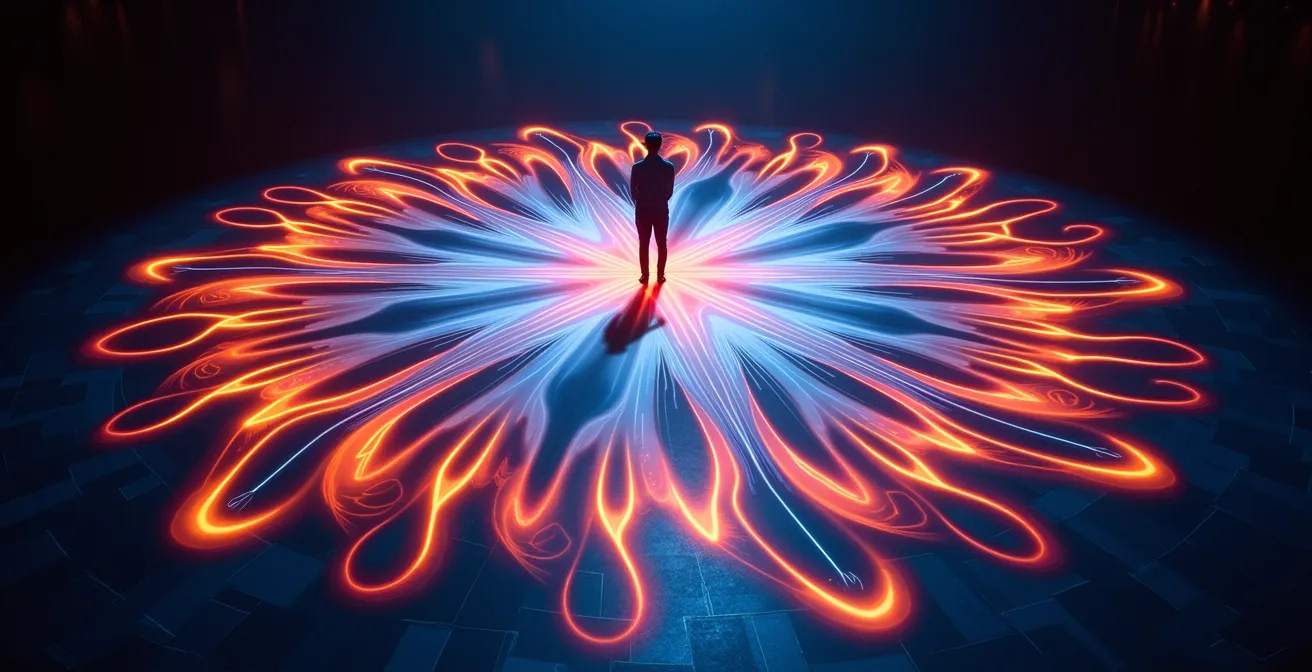
As the visualization shows, this isn’t just about surround sound; it’s about creating distinct audio zones and dynamic paths that sound can travel. This requires a shift to object-based audio mixing. Unlike channel-based mixing (stereo, 5.1), where sound is assigned to specific speakers, object-based audio treats each sound—a vocal, a synth stab, a guitar riff—as a discrete “object.” This object is given metadata describing its intended position in 3D space. The system’s processor then interprets this data in real-time to render the sound accurately across the specific speaker array of the venue, whether it has 30 or 300 speakers.
For a creative director, choosing the right audio system is crucial, as it directly impacts the complexity and precision of AR-synced audio triggers. Different systems offer varying levels of spatial resolution and integration capabilities.
| Audio System | Spatial Resolution | AR Trigger Capability | Best Use Case |
|---|---|---|---|
| Dolby Atmos | 128 audio objects | High – precise 3D positioning | Large venues with complex AR elements |
| L-ISA (L-Acoustics) | 96 objects | Medium – zone-based | Festival stages with multiple AR zones |
| d&b Soundscape | 64 objects | High – real-time tracking | Theater with moving AR elements |
The sound engineer’s role evolves from a mixer to a spatial designer, working alongside the visual team to ensure that when an AR dragon flies over the crowd, its roar travels with it. This creates a cohesive and deeply immersive experience where the line between what is seen and what is heard dissolves completely.
VR Headset or Front Row: Will Virtual Concerts Ever Replace the Real Thing?
The question of whether virtual reality (VR) will replace the visceral experience of a live concert is a recurring debate. However, framing it as a binary choice misses the point. The future isn’t about replacement; it’s about expansion and convergence. The data shows a massive appetite for digital experiences, with the virtual concert platform market projected to reach $297 billion by 2030. This growth doesn’t signal the death of live shows but the birth of the hybrid concert model, where the physical and digital realms coexist and enrich one another. AR is the bridge that connects these two worlds, offering enhanced experiences for fans both in the venue and at home.
Instead of trying to replicate the front-row experience in a VR headset, the most forward-thinking artists are using technology to create unique, shareable moments that blur the lines between audience and performance. This approach acknowledges that the at-home and in-person experiences are fundamentally different and should be designed as such.
Case Study: Coldplay’s Hybrid “Music of the Spheres” Tour
Coldplay’s recent tour is a prime example of a successful hybrid model. Fans attending the show in person could use a mixed-reality app to interact with AR elements from their music videos, such as dancing with the alien characters from “Higher Power.” This didn’t replace the live performance but added a personal, playful layer to it, generating unique content that was instantly shareable on social media. This strategy extends the life of the concert beyond the venue, turning attendees into content creators and brand ambassadors. Furthermore, the hybrid model contributed to a significant reduction in the tour’s environmental impact, demonstrating that technology can serve both creative and sustainability goals.
The consensus among technologists is that these worlds will continue to merge. As the Beats Den Music Technology Report notes, the future lies in a truly blended format. A single event could offer multiple tiers of engagement simultaneously.
In the future, concerts may combine VR, AR, and physical elements, allowing fans at home to attend virtually while those in person enjoy augmented visuals.
– Beats Den Music Technology Report, Future of Live Music with VR and AR Technology
For a creative director, the challenge is no longer to choose between physical and virtual, but to design a cohesive ecosystem where each platform offers a unique, compelling experience that contributes to a greater whole.
The “Blue Screen” Mistake: Why Relying Too Much on Visuals Can Kill a Show?
In the quest for visual spectacle, it’s easy to fall into the “Blue Screen” trap. This is the point where the AR elements become so overwhelming, constant, or demanding of attention that the audience spends more time looking at their screens or the augmented visuals than at the actual human performer. When this happens, the technology ceases to be an enhancement and becomes a distraction. The core emotional connection—the artist-to-audience link—is severed. This is a critical failure of user experience design, born from a misunderstanding of how the human brain processes information. An audience has a finite “cognitive load budget”—a limited capacity for attention. Overloading it with constant visual stimuli leads to fatigue and detachment, not immersion.
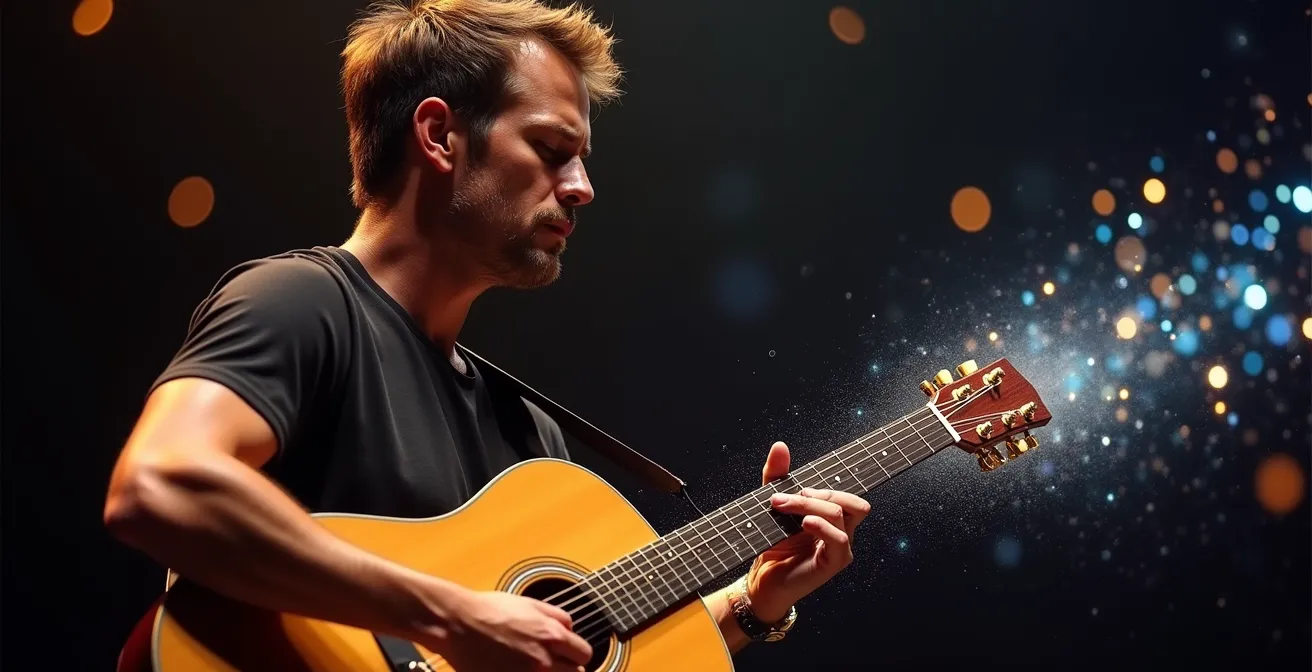
The solution is to practice technological subtlety. The most powerful AR moments are often the most fleeting and integrated. Instead of a non-stop visual assault, think of AR as punctuation in the show’s narrative. It should appear at key moments to amplify an emotion, reveal a hidden layer of meaning in a lyric, or transform the stage for a dramatic crescendo, and then gracefully recede to return focus to the performer. The illustration above captures this ideal: the AR elements are ethereal and responsive, emanating from the artist’s action, visually representing the music without obscuring the musician. It’s an extension of the performance, not a replacement for it.
To avoid the Blue Screen mistake, a creative director must strategically manage the audience’s attention. This requires a disciplined framework that prioritizes the core experience and uses AR with intention and restraint.
Your action plan: Cognitive Load Management for AR Shows
- Budget AR Activations: Limit AR activations to 3-5 key, impactful moments per 45-minute set, rather than a constant overlay.
- Design for Brevity: Create experiences for brief, powerful interactions, not continuous screen attention. The show must stand on its own without AR.
- Build in Layers: Design the show in removable layers, ensuring the core experience is compelling even if a fan’s phone dies or they choose not to participate.
- Test with Users: Use focus groups, potentially with eye-tracking technology, to test the cognitive load and ensure the audience is looking where you want them to.
- Create “Rest Moments”: Intentionally schedule moments with no AR elements between major sequences to allow the audience’s attention to recover and refocus on the stage.
By treating audience attention as a precious resource and “spending” it wisely on high-impact moments, you can ensure that your AR elements create lasting memories instead of just visual noise.
How to Design Stage Visuals That Look Good on Livestreams?
In the age of hybrid concerts, the stage is no longer a single canvas; it’s a dual-canvas experience. Visuals must be designed to be compelling for the live audience in the venue while also being optimized for the millions watching on a screen at home. What looks spectacular from 100 feet away in a stadium can look cluttered or incomprehensible in a 9:16 vertical video on a smartphone. Designing for the livestream isn’t an afterthought; it’s a parallel creative track that requires camera-aware choreography from day one. This means collaborating closely with the broadcast director to design “hero shots” where the performer, the stage lighting, and the AR elements align perfectly for a specific camera angle.
This dual-canvas approach opens up exciting creative possibilities. You can design AR experiences that are exclusive to the at-home audience, giving them a unique value proposition and a reason to tune in. This can transform the livestream from a passive viewing experience into an interactive one.
Case Study: Coachella’s Dual-Canvas AR Strategy for Flume
For Flume’s 2022 performance at Coachella, the festival partnered with Unreal Engine to pioneer a dual-canvas strategy. While the on-site audience saw a stunning physical stage show, the YouTube livestream featured an entirely different layer of AR. Viewers at home were treated to exclusive psychedelic 3D visuals, including massive, surreal parrots that appeared to float around the stage and interact with the set. These elements were invisible to the live crowd but created a spectacular, broadcast-only experience that elevated the livestream far beyond a simple concert recording. This strategy catered to two distinct audiences simultaneously, maximizing the impact of the performance across both platforms.
Executing a successful dual-canvas experience requires meticulous planning and a deep understanding of broadcast technology. The visual design must consider camera positions, lens choices, and real-time compositing to ensure a seamless integration.
- Map AR to Cameras: During pre-production, map specific AR elements to be triggered by certain camera positions or movements.
- Design Hero Shots: Choreograph moments where performers appear to interact directly with AR elements from a predetermined camera angle.
- Separate AR Layers: Create different AR layers for wide shots (e.g., large environmental effects) and close-ups (e.g., subtle effects around the performer).
- Leverage Platform Partnerships: Collaborate with streaming platforms to create enriched 3D visuals that are specific to the broadcast feed, as seen in the Coachella example.
By thinking like a film director as much as a stage designer, you can create a holistic visual experience that captivates both the cheering crowd and the global online audience.
How to Design a “Meme-able” Moment in Your Music Video?
The concept of a “meme-able moment” has evolved. It’s no longer just about a quirky dance move or a funny visual in a pre-recorded music video. In the context of live, technology-driven experiences, the most powerful meme-able moment is one the audience co-creates and shares themselves. Instead of giving them something to watch, you give them a tool to create. AR provides the perfect mechanism for this, turning every fan’s smartphone into a portal for interactive, personalized content that is primed for social media. The goal is to design an AR experience so delightful and visually striking that the immediate impulse is to capture and share it.
This strategy is particularly effective for engaging younger demographics, who are digital natives and fluent in the language of user-generated content. According to Live Nation, by leveraging AR, they were able to reach more than 90% of 13-24 year olds in the US, a demographic that is notoriously hard to captivate with traditional advertising. This isn’t just marketing; it’s participatory culture.
Case Study: Snapchat AR Lenses at EDC Festival
At the Electric Daisy Carnival (EDC) in 2022, Live Nation partnered with Snapchat to launch a series of location-based AR Lenses. Festival-goers could point their phones at the stage or the sky to unlock exclusive experiences. A giant version of EDC’s iconic neon owl would come to life and fly over the crowd, or virtual neon plants would appear to grow from the ground. These weren’t passive visuals; they were interactive filters that placed the user (and their friends) inside the spectacle. The result was a flood of unique, instantly shareable content across social platforms, with each post acting as an organic advertisement for the festival, driven by genuine fan excitement.
To design such a moment, the focus must be on the user’s perspective. The experience should be simple to activate, visually rewarding, and inherently social. Think less about a complex narrative and more about a single, iconic visual that can be easily captured in a 10-second video or a selfie. The most successful AR activations are those that empower the audience to become part of the show’s aesthetic, turning thousands of attendees into individual content creators.
By providing the tools for creativity, you transform the concert experience from a one-way broadcast into a two-way conversation, generating a viral marketing wave that is far more authentic and impactful than any traditional campaign.
How to Map Video Projections onto 3D Sculptures for Stage Design?
Projection mapping—the art of projecting video onto non-flat surfaces—has been a staple of innovative stage design for years. It can transform static sculptures, buildings, or set pieces into dynamic, living canvases. The process involves creating a 3D model of the target object, designing animated content that fits its contours precisely, and using specialized software to align the projector’s output with the physical object in real-time. This technique creates the stunning illusion that the object itself is changing texture, shape, or glowing from within. However, the future of this technique lies in its fusion with Augmented Reality, creating a hybrid reality stage where the lines between physical and virtual are completely erased.

The next frontier is to treat the projection-mapped sculpture not as the final product, but as a starting point. Imagine a scenario where the intricate light patterns projected onto a sculpture begin to “peel away” from its surface, transforming into floating AR elements that drift out into the space around the stage, visible through a fan’s smartphone. This creates a breathtaking transition from a shared, public visual (the projection) to a personal, interactive one (the AR). The physical object becomes a gateway to a hidden digital dimension.
The workflow for a creative director involves a multi-stage process:
- 3D Scanning & Modeling: The physical sculpture is first scanned to create a precise digital twin. This model is the foundation for both the projection and AR content.
- Content Creation: Two sets of visuals are created. The first is the projection content designed to fit the sculpture’s surface. The second is the AR content, designed to emerge from or interact with the physical object.
- Real-Time Engine Integration: Both visual layers are brought into a real-time engine like Unreal Engine or Unity. This allows a show operator to seamlessly trigger the transition from the projection-mapped state to the AR state.
- On-Site Calibration: The final, and most critical, step is the meticulous on-site calibration to ensure the digital and physical worlds are perfectly aligned from every key vantage point.
By combining these two powerful visual tools, you can create a stage design that is not only visually stunning but also narratively compelling, taking the audience on a journey from the real to the surreal.
Key takeaways
- The most effective AR enhances the live performance with subtlety, not spectacle, by managing the audience’s “cognitive load budget.”
- Future-proof design involves a “dual-canvas” approach, creating distinct but connected experiences for in-venue and at-home audiences.
- True immersion is multi-sensory, requiring the integration of spatial audio with AR visuals to create a unified, believable reality.
How to Translate Sound into Visual Art Through Synesthesia Techniques?
The most profound application of AR in live music moves beyond simple audio-reactivity—where visuals pulse to the beat—and into the realm of digital synesthesia. Synesthesia is the neurological phenomenon where the stimulation of one sense leads to an automatic, involuntary experience in a second sense. Applied to stage design, this means creating a sophisticated visual language where specific sounds are consistently and meaningfully translated into specific colors, shapes, and movements. This isn’t just about making visuals that “look cool”; it’s about building a subconscious connection in the audience’s mind between what they hear and what they see, deepening their emotional and sensory understanding of the music.
This approach transforms AR from a decorative layer into an interpretive one. For example, a mournful saxophone solo could consistently be translated into slow-moving, deep blue particles, while an aggressive drum fill could trigger sharp, angular bursts of red. Over the course of a show, the audience learns this language intuitively, allowing the visuals to communicate the music’s emotional texture on a deeper level. This sophisticated translation is not only creatively fulfilling but also commercially viable. Research shows a significant portion of fans are not just open to these enhanced experiences, but are actively willing to pay for them, with 58% of festival-goers willing to spend $20 on an AR experience.
Building a synesthetic visual language requires a more granular approach than simply linking visuals to volume or bass frequencies. It involves a close collaboration between the artist, the creative director, and the technical team to map the entire sonic palette of the show.
- Instrument-to-Color Mapping: Assign consistent color palettes to specific instruments or instrumental groups (e.g., strings are always warm golds, synths are cool cyans).
- Frequency-Responsive Particles: Design particle systems that respond to specific frequency ranges, so that a high-hat and a sub-bass produce visually distinct effects.
- Matching Visual Decay: Create visual “decay rates” that mirror the natural sustain of the instruments. A piano note’s visual representation should fade out just as the sound does.
- Biometric Integration: For the ultimate synesthetic link, use biometric data from the performers—like heart rate or movement—to drive the real-time generation of visuals, directly translating their physical energy into art.
By adopting these techniques, you can create an AR experience that doesn’t just accompany the music, but becomes an inseparable part of its emotional expression, offering the audience a new and profound way to experience the songs they love.