Investing in emerging art isn’t gambling; it’s a data-driven discipline focused on market validation over personal taste.
- Gallery representation and institutional support are far stronger value indicators than social media hype.
- Provenance documentation and edition scarcity are critical financial multipliers for long-term ROI.
Recommendation: Prioritize artists with a clear art-historical context and a professional market infrastructure supporting their career trajectory.
The dream of discovering the next art-world star—of acquiring a piece for a few thousand dollars that one day commands millions at auction—is a powerful lure. For the aspiring collector, however, the art market is notoriously opaque, a labyrinth of unwritten rules and insider knowledge. The common advice often given to novices, “just buy what you love,” is well-intentioned but fundamentally flawed as an investment strategy. It positions you as a consumer, not a strategic investor. While personal connection to a work is important, it rarely correlates with financial appreciation.
The reality is that high-growth art is treated as a serious asset class. In fact, a landmark study revealed that 85% of wealth managers recommend art as a long-term investment, signaling a shift from pure aesthetics to calculated financial planning. This requires moving beyond emotional responses and learning to read the market’s structural signals. The value of an artwork is not just in the canvas and paint; it’s constructed and protected by a complex infrastructure of galleries, critics, and institutions.
But what if the true key to success wasn’t simply finding art you like, but understanding the machinery that manufactures value? This guide abandons the platitudes and offers an insider’s framework. We will dissect the financial mechanics behind an artist’s career, from the power of a gallery’s endorsement to the critical mistakes that can erase an asset’s value overnight. It’s time to shift from a consumer mindset to an investor’s discipline and learn to identify the signals that point toward real, sustainable growth.
This article provides a structured approach to navigating the emerging art market. Below, you’ll find a breakdown of the key financial and strategic pillars that separate speculative gambles from sound investments.
Summary: A Strategic Guide to Investing in Emerging Art
- Why Does a Gallery Stamp Double the Price of a Canvas?
- How to Calculate the Price of an Artwork Based on Size and Resume?
- Original or Limited Print: Which Offers Better ROI for Small Budgets?
- The “Instagram Art” Trap: Why Viral Art Rarely Holds Value Long Term?
- Where to Hang Art in Your Home to Avoid UV Damage?
- Why Is Owning Your Masters More Valuable Than a $100,000 Advance?
- The “Trunk” Mistake: Why Leaving Your Guitar in the Car Is Fatal?
- How to Write an Artist Statement That Isn’t Pretentious Gibberish?
Why Does a Gallery Stamp Double the Price of a Canvas?
A top-tier gallery’s involvement is not a mere “stamp of approval”; it is the single most important piece of market infrastructure for an emerging artist. The premium paid for a gallery-represented work isn’t for the physical art alone, but for a suite of services that actively build, manage, and protect the artist’s market value. A gallery invests significant capital and resources into an artist’s career, and the price reflects this long-term strategic partnership. They are not just selling a painting; they are selling a stake in a carefully managed career trajectory.
Thinking of a gallery as a simple retailer is a fundamental mistake. They are market makers. Their primary function is to transform an artist’s creative output into a stable and appreciating financial asset. They achieve this through a series of highly strategic actions, shielding the artist’s work from the volatility of the open market and ensuring a controlled, upward price momentum. For an investor, buying through a reputable gallery provides a crucial layer of due diligence and market security that is impossible to replicate independently.
The value-add services provided by a serious gallery are extensive and directly contribute to the asset’s long-term appreciation potential:
- Authenticated Provenance: The gallery provides and guarantees the chain of ownership, a critical factor for future resale.
- Strategic Career Development: They secure curated exhibitions, facilitate museum acquisitions, and place work in influential private collections.
- Market Protection: Galleries actively manage the artist’s secondary market presence, often buying back works at auction to prevent price drops and maintain stability.
- Logistical Management: They handle professional storage, insurance, and international shipping, ensuring the asset’s physical integrity.
- Exclusive Access: Representation grants access to a vetted network of serious collectors and private sales opportunities, creating a stable collector base.
How to Calculate the Price of an Artwork Based on Size and Resume?
A common mistake for new collectors is believing that art is priced solely by a simple formula, such as `(height + width) x factor`. While this “price per square inch” method exists for very early-stage artists to establish initial consistency, it is quickly superseded by a far more sophisticated valuation model. For any artist with a developing career, the artist’s resume is a more significant price driver than the physical size of the work. The price is a reflection of institutional validation and market momentum.
To assess this, investors must learn to perform a comparable artist analysis. This method, a cornerstone of professional art advisory, moves beyond simplistic measurements to benchmark an artist against their true peers. It’s a financial analysis that weighs the “soft” assets of a career—exhibition history, critical reception, and gallery representation—to arrive at a justifiable price point. This process is essential for determining if a work is fairly priced or if its valuation is based on unsubstantiated hype.
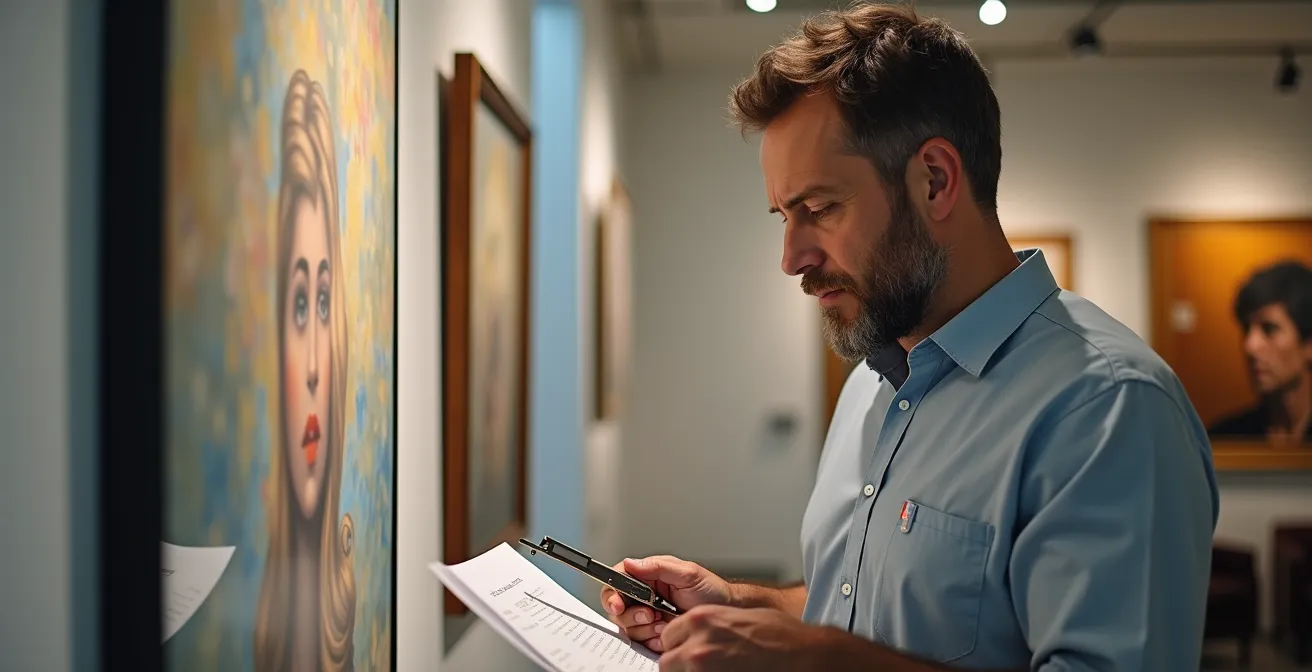
As the illustration above suggests, a proper valuation is a meticulous process. It involves a qualitative assessment of the artist’s entire career. The key is to identify a “basket” of three to five artists who are at a similar career stage, represented by galleries of a comparable tier, and who have a similar record of institutional shows or placements in major collections. By analyzing the price points for works of similar size and medium within this peer group, an investor can triangulate a fair market value and identify potential outliers—both over and undervalued.
Original or Limited Print: Which Offers Better ROI for Small Budgets?
For collectors with budgets under $10,000, the choice between a unique work and a limited edition print is a critical strategic decision. An original work (a painting, sculpture, or drawing) offers the highest potential for appreciation, as it is a one-of-a-kind asset. However, it also carries the highest entry cost and the most significant risk. If the artist’s market fails to develop, the original piece can become highly illiquid. Conversely, prints offer a more accessible entry point and greater liquidity, but their appreciation potential is generally more modest.
The savvy investor, however, looks for opportunities within the print market that mimic the scarcity of original works. Not all prints are created equal. Artist’s Proofs (APs), which are a small number of prints made outside the main edition for the artist’s use, often carry a premium and have higher appreciation potential. Furthermore, the size of the edition is a primary driver of value. An analysis of auction results reveals that edition sizes under 50 show significantly higher value retention and appreciation compared to larger editions. A giclée print from an open edition is a decorative object, not an investment.
The following table breaks down the risk/return profile for different types of artworks, providing a clear framework for allocating capital based on your investment goals.
| Investment Type | Entry Cost | Liquidity | Appreciation Potential | Risk Level |
|---|---|---|---|---|
| Original Works | $5,000-$50,000+ | Low | Very High | High |
| Artist Proofs (AP) | $1,000-$10,000 | Medium | High | Medium-High |
| Limited Edition Prints | $500-$5,000 | High | Medium | Low-Medium |
| Giclée Prints | $100-$1,000 | Very High | Low | Low |
The “Instagram Art” Trap: Why Viral Art Rarely Holds Value Long Term?
In the digital age, social media has become a powerful discovery tool, but for the serious investor, it is also a minefield of false signals. The “Instagram Art” trap is the phenomenon of artists who achieve massive online followings with visually appealing, easily digestible work that ultimately lacks the conceptual depth and institutional support necessary for long-term value. Virality does not equal market viability. It’s a classic case of confusing an audience with a market.
An audience “likes” and “shares”; a market buys, holds, and creates secondary demand at escalating prices. As art advisor Lawrence Van Hagen notes, this distinction is critical for investors. An artist can accumulate a million followers, but if none of them are established collectors willing to sustain high price points through galleries and auction houses, the market is a house of cards. This hype-driven art often experiences a rapid price surge followed by an equally dramatic collapse once the trend fades, leaving speculators with illiquid assets.
Investors should differentiate between an ‘Audience’ and a ‘Market.’ An artist can have a million followers but no real collectors willing to pay and sustain high prices.
– Lawrence Van Hagen, The Gentleman’s Journal Art Investment Guide
To avoid this trap, an investor must look beyond follower counts and assess the foundational pillars that support sustainable value. This requires a disciplined audit of the artist’s practice, looking for signals of quality and seriousness that transcend online popularity. The following checklist provides a framework for this due diligence.
Your Action Plan: Vetting an Artist Beyond the Hype
- Craftsmanship: Assess the artist’s technical skill and mastery of their chosen medium. Is there evidence of rigorous training and execution?
- Concept: Evaluate the intellectual depth of the work. Is there a coherent artistic vision and a consistent conceptual thread through their portfolio?
- Art Historical Context: Verify that the work is in dialogue with art history. Does it build upon, challenge, or intelligently reference past movements and artists?
- Curatorial Validation: Check for institutional support. Has the artist been included in shows curated by respected professionals, or received positive reviews in serious art publications?
Where to Hang Art in Your Home to Avoid UV Damage?
Acquiring an asset is only half the battle; protecting it is equally crucial. The physical condition of an artwork is a primary driver of its value, and nothing is more destructive than improper display and environmental exposure. Sunlight, humidity, and temperature fluctuations are the silent assassins of an art collection. A faded signature, warped canvas, or discolored paper can slash an artwork’s value, making a once-promising investment virtually unsellable. Therefore, knowing where and how to display art is not a matter of interior design, but of asset preservation.
The number one enemy is ultraviolet (UV) light, found in direct and even indirect sunlight. It causes irreversible fading in pigments and degradation of paper and canvas fibers. Art should never be hung where it receives direct sunlight at any point during the day. North-facing walls are generally the safest, as they receive the least direct light. For any valuable piece, investing in UV-protective glazing (glass or acrylic) is a non-negotiable cost. Furthermore, archival framing, which uses acid-free matting and backing boards, is essential. These materials prevent chemical “burns” and discoloration from migrating from the frame to the artwork over time, preserving its pristine condition.
Certain areas in a home are high-risk zones and should be avoided for displaying valuable art. These include:
- Bathrooms: Extreme humidity can cause paper to ripple, canvas to sag, and promote mold growth.
- Kitchens: Airborne grease, smoke, and cleaning fumes can create a film on the artwork’s surface that is difficult and expensive to remove.
- Near Fireplaces or Vents: Rapid temperature and humidity fluctuations from heating and cooling systems can cause materials to expand and contract, leading to cracking and warping.
Why Is Owning Your Masters More Valuable Than a $100,000 Advance?
In the music industry, the fight for “owning your masters” is legendary. It’s the difference between being a high-paid employee and owning the asset that generates revenue in perpetuity. In the art world, the direct equivalent of master rights is provenance. Provenance is the documented, unbroken history of an artwork’s ownership, from the moment it leaves the artist’s studio. For an investor, a work with weak or incomplete provenance is like a song with unclear ownership—a high-risk asset with a compromised value ceiling.
Clear, verifiable provenance can significantly enhance an artwork’s value by reducing the risk of forgery, theft, or disputed title. A documented history that includes exhibition records, publications, and inclusion in prestigious collections acts as a powerful value multiplier. In fact, a market analysis shows that artworks with complete provenance documentation command 30-50% higher prices at auction than comparable works with gaps in their history. The Certificate of Authenticity (COA) from the artist or a reputable gallery is the foundational document, but a truly robust provenance is a living file.
As a collector, you are not merely a buyer; you are a custodian responsible for building the asset’s provenance. This is an active, not passive, role. Upon acquiring a work, you should immediately take steps to cement your place in its history. This includes keeping all purchase receipts, gallery correspondence, and exhibition catalogs where the work is featured. Ensure your name is correctly listed as the owner in the gallery’s records and, if applicable, in the artist’s catalogue raisonné. This meticulous record-keeping is not administrative busywork; it is the process of reinforcing your asset’s value for its eventual resale.
Key Takeaways
- Focus on institutional validation and gallery representation, not social media metrics, as the primary indicators of an artist’s long-term potential.
- Understand that a gallery’s role is to strategically build and protect an artist’s market, making their involvement a key part of the asset’s value.
- Treat provenance documentation and the physical preservation of the artwork as critical components of your investment’s financial health.
The “Trunk” Mistake: Why Leaving Your Guitar in the Car Is Fatal?
In the world of high-end instruments, leaving a vintage guitar in a car trunk is a cardinal sin. The extreme temperature swings can warp the wood, crack the finish, and destroy the instrument’s playability and value in a matter of hours. The art world is littered with its own equivalent “trunk mistakes”—critical but avoidable errors in handling, transport, and installation that can prove just as fatal to your investment. An artwork is a fragile physical object, and negligence can erase its value faster than any market downturn.
Professionalism in handling is not an optional extra; it is a core component of asset management. Never transport an unframed canvas or work on paper without rigid, acid-free support. When shipping, always use specialized art movers who provide climate-controlled transport and museum-quality packaging. The temptation to save a few hundred dollars by using a standard moving company or transporting a large work in your own car exposes the asset to unacceptable risk from vibration, impact, and environmental shock. Insurance companies can and will deny claims resulting from improper handling.
Upon receiving a new artwork, a strict receiving and installation protocol must be followed to protect both the piece and your investment:
- Acclimation: Upon delivery, let the crated or wrapped artwork acclimate to the room’s temperature and humidity for a full 24 hours before unwrapping. This prevents condensation and material shock.
- Condition Reporting: Carefully inspect the work for any potential shipping damage as you unwrap it, documenting its condition with high-resolution photos.
- Hardware: Use museum-quality hanging hardware rated for at least three times the artwork’s weight. Never rely on a single nail or wire.
- Documentation: Document the final installation with photographs from multiple angles. This serves as a crucial record for insurance purposes and adds to the work’s provenance file.
How to Write an Artist Statement That Isn’t Pretentious Gibberish?
For an investor, the artist statement is a crucial due diligence document. It’s a window into the artist’s intellectual rigor, conceptual clarity, and self-awareness of their place within art history. A statement filled with vague, pretentious jargon—”exploring the human condition,” “creating a dialogue”—is a major red flag. It often signals a lack of a coherent artistic project and an inability to articulate a specific vision. This is not a question of literary taste; it’s an assessment of the artist’s seriousness as a professional.
Conversely, a strong statement is specific, confident, and grounded in the language of art and craft. It connects the artist’s practice to tangible materials, specific techniques, or a clear line of art-historical inquiry. It demonstrates that the artist has a well-defined project that they can articulate to curators, critics, and collectors. This intellectual clarity is often a leading indicator of an artist who is prepared for a long-term, sustainable career. They are not just making objects; they are building a body of work with a defensible conceptual foundation.
As an investor, you must learn to distinguish between the empty rhetoric of a hobbyist and the precise language of a professional. The following table provides a clear guide to identifying green flags that signal a serious practice versus red flags that suggest a lack of conceptual depth.
| Red Flags | Green Flags |
|---|---|
| ‘Exploring the human condition’ | ‘Using 17th-century glazing techniques to subvert digital aesthetics’ |
| ‘My work speaks for itself’ | ‘Building on Richter’s blur techniques to examine memory fragmentation’ |
| ‘Creating a dialogue between viewer and art’ | ‘Combining industrial materials with traditional tapestry methods’ |
| ‘Questioning reality’ | ‘Documenting gentrification through site-specific installations’ |
Armed with this financial and structural framework, the next step is to begin applying it. Start by analyzing the resume and market infrastructure of one emerging artist you’re following—not for their aesthetic alone, but for the institutional and financial signals that now stand out to you.