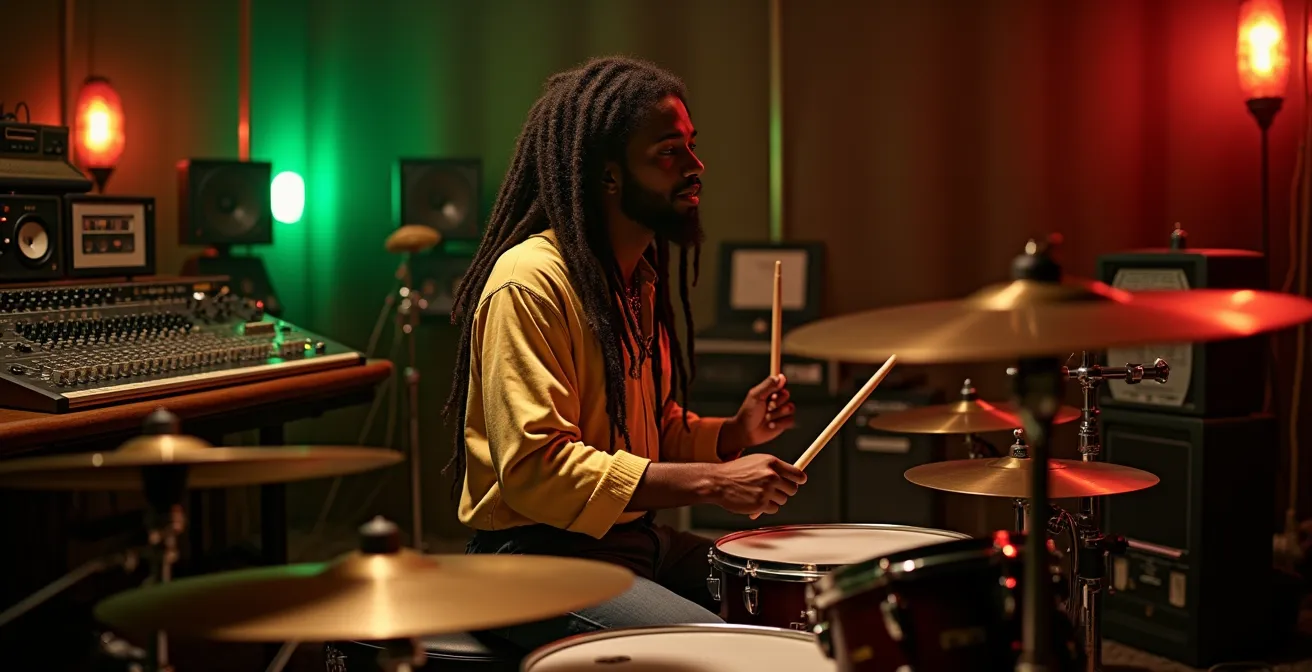
The secret to the reggae ‘one drop’ isn’t just placing the kick on beat 3; it’s about unlearning your rock instinct to push the beat and learning to treat silence as the groove’s anchor.
- The empty “one” of the measure creates a rhythmic pull, not a push, fundamentally changing the feel from rock’s forward momentum.
- The sharp, staccato guitar “chop” on the upbeat acts as a percussive counterweight to the heavy bass and drum on the downbeat.
Recommendation: Record yourself playing over a simple reggae track. Don’t listen to the notes you play; listen for the quality of the space on beat one. If it feels empty and powerful, you’re on the right track.
So, you’re a rock drummer or bassist, and you’ve got chops. You can play fast, you can play loud, and you know how to drive a beat. But when you try to play reggae, something’s… off. You’re playing all the right notes, the kick is on the three, the skank is on the upbeat, but it sounds stiff, rushed, and it just doesn’t have that deep, hypnotic sway. You’ve probably heard all the usual advice: “play behind the beat,” “relax,” “feel it, man.” For a musician trained to be on top of the beat, this feels like being told to run a race by walking backward.
The problem is that you’re approaching it like a rock musician. You’re trying to add reggae patterns to your existing rhythmic framework. But that’s not how it works. You have to tear that framework down and build a new one from the ground up, and the foundation of that new structure is silence. The authentic reggae feel, the very soul of the “one drop” rhythm, isn’t found in the notes you play. It’s found in the power of the beat you *don’t* play: the silent first beat of the measure.
This guide will deconstruct that feeling. We won’t just tell you *what* to play. We’ll show you how to fundamentally shift your internal clock from the forward-pushing momentum of rock to the deep, gravitational pull of reggae. We’ll explore why silence is an instrument, how to get the right percussive texture from your guitar and bass, and why your whole body, not just your foot, needs to become the metronome. Get ready to unlearn everything you think you know about keeping time.
To help you navigate this rhythmic journey, this article breaks down the essential components for capturing that elusive reggae groove. From the philosophical importance of space to the practical physics of sound, you’ll find everything you need to transform your playing.
Summary: Mastering the Elusive ‘One Drop’ Groove
- Why Is Silence the Most Important Instrument in Dub Reggae?
- How to Get That Sharp “Chop” Sound on the Upbeat?
- Downbeat or Upbeat: Where Should the Bass Drum Really Land?
- The “Rock Rush” Mistake: Why Playing Ahead of the Beat Kills the Reggae Vibe?
- How to EQ Your Bass Amp for That Earth-Shaking Dub Tone?
- How to Build a Tennis Ball Riser to Kill Kick Drum Vibrations?
- Why Is Tapping Your Foot Insufficient for Complex Polyrhythms?
- How to Build a Sound System That Physically Moves the Crowd?
Why Is Silence the Most Important Instrument in Dub Reggae?
In most Western music, silence is just a rest—a pause before the next event. In reggae, and especially its psychedelic offshoot, dub, silence is an active ingredient. It’s the canvas. When a dub producer drops the drums and bass out of a mix, leaving only a vocal drenched in echo, that moment of emptiness is more powerful than any crash cymbal. This isn’t just an absence of sound; it’s what we call sonic space. It’s a moment of tension and release that creates a dynamic, breathing quality in the music. Historically, this use of silence has deep roots; research from reggae production experts shows that these drops could symbolize anything from political censorship to a spiritual void.
For you as a player, this means you must learn to love the space. The “one drop” is defined by the empty first beat of the bar. This is your Silent Anchor. A rock drummer thinks, “1-2-3-4,” with an emphasis on the 1 to launch the measure forward. A reggae musician feels the “one” as a silent, magnetic pull. The entire groove is drawn back towards it. Instead of playing *to* the next beat, you are playing *from* the silence of the last one. It’s a complete reversal of rhythmic gravity.
To internalize this, you have to practice playing the silence. It sounds strange, but it’s about feeling the pulse without physically striking it. Use exercises like the “drop out” technique, where you abruptly mute everything to feel the void. This conscious engagement with emptiness is the first and most critical step in rewiring your brain for the reggae pocket. It’s not about counting rests; it’s about making those rests the most meaningful part of the bar.
How to Get That Sharp “Chop” Sound on the Upbeat?
If the downbeat is about weight and space, the upbeat is about tension and texture. The classic reggae guitar “skank” or “chop” isn’t a relaxed strum; it’s a tight, percussive, and staccato sound. For rock guitarists used to letting chords ring out, this requires a completely different right-hand and left-hand technique. The goal is to make the guitar function more like a percussion instrument, such as a hi-hat or a shaker, than a harmonic one. It provides the high-frequency energy that balances the low-end dominance of the bass and kick.
To achieve this, think of the guitar strings as a hot potato. You want to touch them for the briefest possible moment. This is a two-part motion: the strum itself is quick and sharp, but crucially, you must immediately release the pressure with your fretting hand right after the pick strikes the strings. This action instantly mutes the chord, creating that signature detached “chop.” The note should have almost no sustain. It’s a “chick” sound, not a “straaang.”
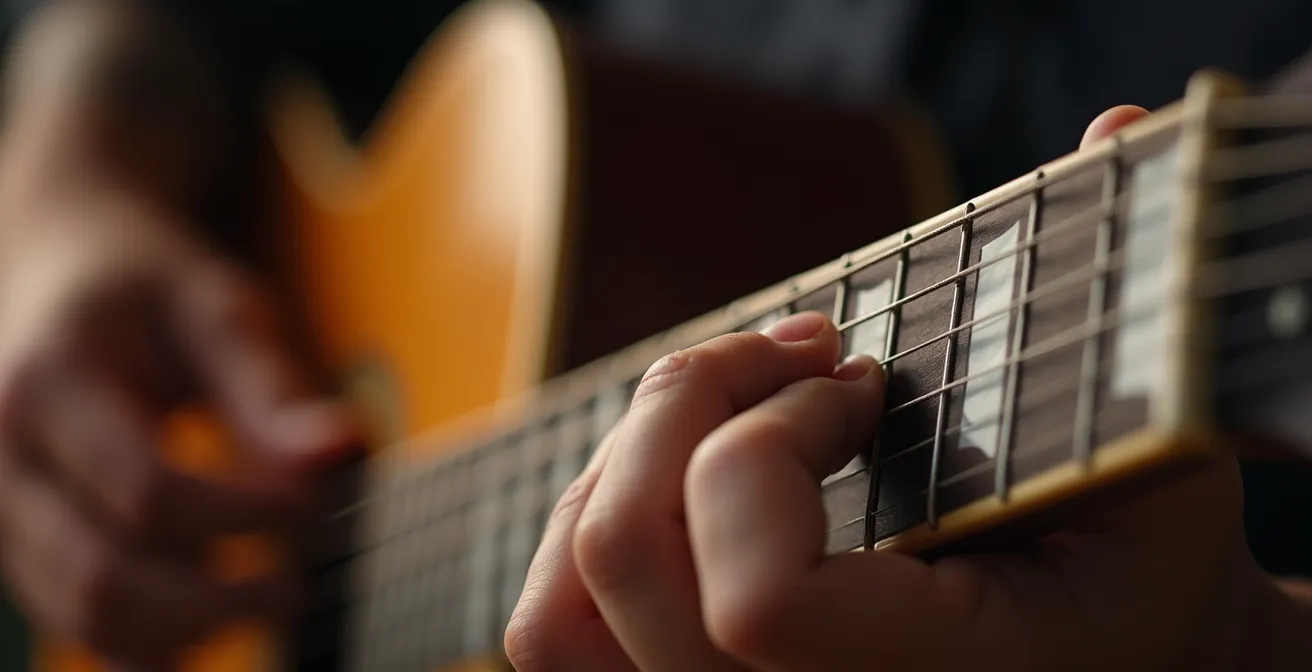
As the close-up of a guitarist’s hands shows, the technique is about precision and control. The fretting hand does as much work as the picking hand, acting as a “damper” to kill the sound. This percussive attack is the “weight” of the upbeat. It’s not a light, flimsy sound. It has an assertive presence that cuts through the mix and creates a rhythmic conversation with the bass and drums. Without this sharp, disciplined chop, the groove loses its essential polyrhythmic tension and can quickly sound muddy and undefined.
Downbeat or Upbeat: Where Should the Bass Drum Really Land?
For any musician coming from a rock or pop background, the placement of the kick drum on the first beat of the measure is almost sacred. It’s the pulse, the starting gun, the foundation. The single most jarring and essential element of the “one drop” rhythm is its complete abandonment of this rule. The one drop is a statement of defiance against that convention.
The one drop rhythm is characterized by the dominant snare drum stroke and bass drum kick both sounding on the third beat of every measure in 4/4 time, while beat one is left empty. The style is unique and solid, with a clean sound, leaving relatively large open musical space for improvisation.
– Carlton Barrett technique analysis, TalkBass Forum Discussion
As the analysis of the style’s pioneer, Carlton Barrett, highlights, the kick drum and the cross-stick snare land together on beat three. This creates a powerful, unified thump that feels like a heartbeat. The empty “one” isn’t a weakness; it’s the source of the rhythm’s power. It creates a feeling of suspension and release that is meditative and deeply physical. The bass guitar then often plays a melodic phrase that “answers” the silence on beat one, further solidifying its importance.
Of course, the one drop is not the only reggae drum pattern. Understanding its relatives, “rockers” and “steppers,” helps to put its unique feel in context. Rockers introduces a kick on beat one, giving it a more rolling, driving feel, while steppers places a kick on every beat for a militant, marching pulse.
| Pattern | Kick Placement | Feel/Effect |
|---|---|---|
| One Drop | Beat 3 only (beat 1 empty) | Meditative, heartbeat feel |
| Rockers | Beats 1 and 3 | Rolling, driving feel |
| Steppers | All four beats | Militant march feel |
While all are valid, an analysis of reggae’s rhythmic evolution shows the one drop remains the quintessential feel. For a rock musician, practicing rockers can be a good bridge, but true mastery requires fully embracing the spacious, heartbeat pulse of the classic one drop and making that landing on “three” feel like home.
The “Rock Rush” Mistake: Why Playing Ahead of the Beat Kills the Reggae Vibe?
The “Rock Rush” is the number one killer of a reggae groove. It’s the unconscious tendency of rock-trained musicians to play slightly ahead of the beat, pushing the music forward with aggressive energy. In rock, this creates excitement. In reggae, it sounds nervous and completely undermines the relaxed, heavy feel. Reggae doesn’t push; it pulls. It has a laid-back rhythmic gravity that sits deep in the pocket, and if you fight against it, the groove falls apart. To get it right, you have to consciously aim to play on the “back” of the beat.
This “lazy” feel is a discipline, not sloppiness. It requires immense control to play with precision while maintaining a relaxed posture and feel. Authentic reggae tempos are often slower than you’d think; professional drummers recommend that you practice in a range of 50-140 BPM to truly internalize the feel at different speeds. The key is to make the groove feel heavy and inevitable, like a slow, powerful wave, rather than a frantic sprint. The goal is to make people move their bodies without them even realizing it.
To break the habit of rushing, you need to change your entire mindset and physical approach. Here are a few mental tricks that can help:
- Pretend you’re tired and play lazy. This doesn’t mean being sloppy. It means embracing a relaxed physical approach. Your shoulders should be down, your grip loose. Let gravity do some of the work.
- Pull, pull, pull the beat. Constantly imagine that you are pulling the beat back toward you from a point just ahead of the click. Never push it forward. Stay behind it, but remain tight and in control.
- Focus on the whole, not the parts. The magic happens when the bass and drums lock into a single entity. Listen to the other players more than you listen to yourself. Your job is to fuse with them.
Your 5-Point Groove Audit: Moving from Rock Push to Reggae Pull
- Points of contact: Identify where you’re rushing. Record yourself and listen for notes landing on or slightly ahead of the click track, especially on the hi-hats or guitar upbeats.
- Collecte: Isolate the “one.” Loop a single bar of your playing and focus only on that empty first beat. Are you filling it with nervous energy, or are you letting it breathe with power?
- Cohérence: Compare your kick/snare with the hi-hat/skank. Is the rhythm section a unified “pulling” entity, or is one part “pushing” against the others and causing a rhythmic clash?
- Mémorabilité/émotion: Does the groove make you want to nod your head slowly or tap your foot fast? The feel should be a heavy, relaxed sway, not an urgent, anxious tap.
- Plan d’intégration: Pick one element to fix. For the next 10 minutes, focus only on pulling back the hi-hats. Then, work on the bass notes. Don’t try to fix everything at once.
How to EQ Your Bass Amp for That Earth-Shaking Dub Tone?
In reggae and dub, the bass isn’t just part of the rhythm section; it’s the lead melody and the physical foundation of the track. A proper reggae bass tone is not about intricate, high-end definition. It’s about physical weight and sonic dominance in the low frequencies. Your goal is to create a sound that you feel in your chest as much as you hear with your ears. This often means unlearning the EQ habits of rock and funk, where cutting through the mix with midrange punch is the priority.
The first step is to filter out the noise. A truly heavy dub tone is achieved by subtraction, not addition. You should start by significantly cutting your high-mid and treble frequencies. You want to eliminate string noise, fret buzz, and any thin, “clanky” sounds. What you’re left with is the pure, round, fundamental low-end of the note. Think of it as a smooth, massive sphere of sound, not a sharp, pointy arrow. Use flatwound strings if you can, as they naturally have a darker, thumpier tone with less high-end content.
In a professional dub studio setting, the approach is even more nuanced. Rather than just boosting the bass volume, producers create space for it. This involves careful equalization that cuts frequencies in other instruments—like guitars and keyboards—that might clash with the bassline. By carving out a dedicated space in the mix, the bass can be perceived as louder and more powerful without actually turning up the fader. Effects like a gentle compressor can help even out the dynamics for a consistent, solid foundation, while panning other elements left and right leaves the powerful center channel exclusively for the bass and kick drum to rule.
How to Build a Tennis Ball Riser to Kill Kick Drum Vibrations?
The quest for that perfect, clean low-end isn’t just about EQ and playing technique; it’s also about physics. When a kick drum or a bass cabinet sits directly on the floor, especially a wooden stage or a resonant floor, a significant amount of its low-frequency energy is transferred directly into the structure. This causes the floor to vibrate, which can create a muddy, indistinct booming sound that muddies up your mix and annoys your neighbors. The solution is acoustic isolation: physically decoupling your gear from the floor.
A simple, cheap, and surprisingly effective way to do this is by building a DIY tennis ball riser. The concept is straightforward: you place a sturdy platform (like a piece of plywood) on top of several tennis balls. The drum kit or amp then sits on the platform. The air-filled, flexible rubber of the tennis balls acts as a shock absorber, absorbing the vibrations and preventing them from passing into the floor. This results in a much tighter, punchier, and more defined low-end sound, as you’re hearing the speaker or drum itself, not the room’s sympathetic vibrations.
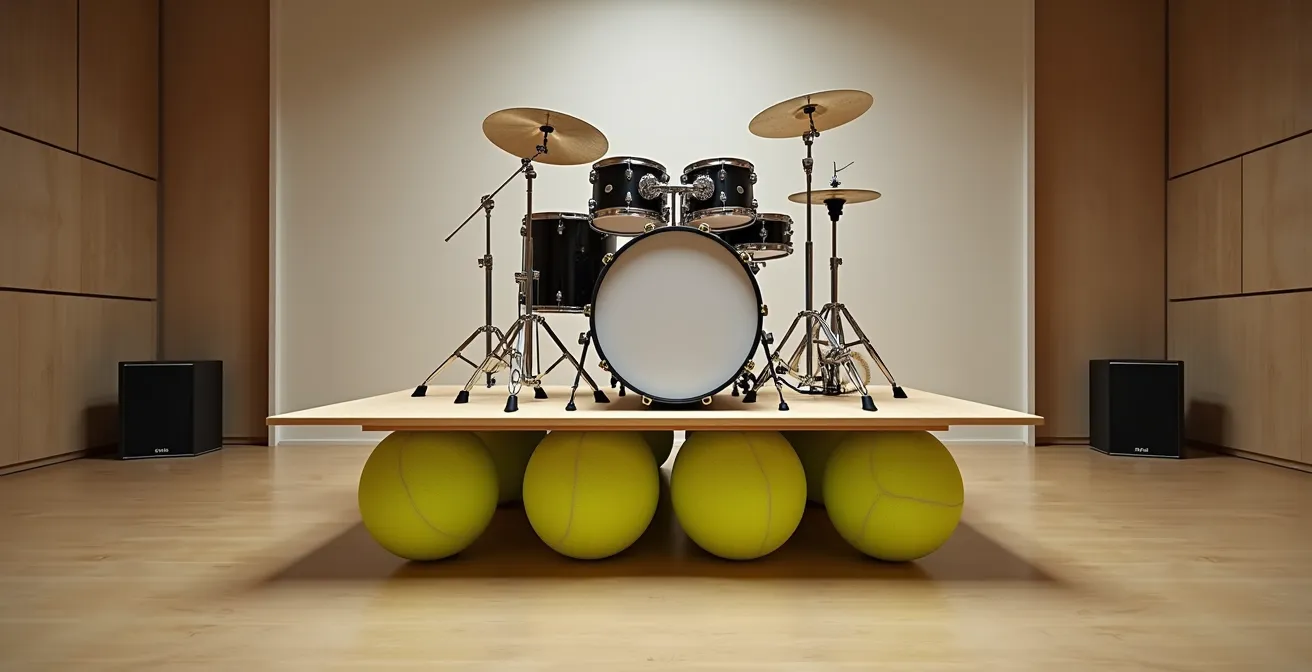
While tennis balls are a great starting point, you can create a hierarchy of isolation based on your budget and needs. The effectiveness of the material is key to how well it absorbs unwanted vibrations and cleans up your sound.
- Good: Tennis balls are affordable and provide effective basic isolation for home practice or small gigs.
- Better: High-density foam pads or repurposed washing machine anti-vibration feet offer improved absorption and stability.
- Best: Specialized acoustic isolation materials like Sylomer provide professional-grade, near-total decoupling for recording studios or critical listening environments.
Why Is Tapping Your Foot Insufficient for Complex Polyrhythms?
In simple 4/4 rock music, tapping your foot on the downbeats is a reliable way to keep time. It’s a single, consistent anchor. However, in reggae, the rhythmic conversation is far more complex. You have the hi-hats playing straight eighth or sixteenth notes, the guitar chopping on the upbeats, the kick and snare landing together on a downbeat, and the bass weaving a melodic, often syncopated line through it all. If your only internal reference point is a tapping foot, you’re trying to navigate a three-dimensional space with a one-dimensional map. It’s simply not enough information.
To truly internalize a complex polyrhythm, you need to embody it. This means using your whole body as a metronome, with different limbs tracking different parts of the groove. This is about developing multi-limb independence. For example, your left foot might keep the steady quarter-note pulse, your right hand taps the upbeats on your leg, and you vocalize or “hum” the bassline. By physically separating the different rhythmic layers, your brain begins to understand how they interlock to form a cohesive whole. You stop thinking of it as one complex rhythm and start feeling it as several simple rhythms happening simultaneously.
The Stewart Copeland Approach: A Whole-Body Metronome
A great example of this is the playing of Stewart Copeland from The Police, a rock drummer famous for his reggae-infused style. Analysis of his approach shows that while every performance has unique improvisations, the foundation is a deeply internalized, multi-layered feel. He often starts with a strong downbeat feel but then overlays it with intricate, syncopated cymbal work and a hybrid kick pattern that borrows from both reggae and samba. He’s not just “keeping time”; his entire body is a living expression of the polyrhythm, allowing him to play with both freedom and perfect precision.
Practicing multi-limb exercises is the key to unlocking this ability. Start simple: tap a downbeat with your left foot while tapping an upbeat with your right hand. Once that’s stable, try vocalizing a simple triplet-based bassline over it. It will feel awkward at first, but this is how you build the neural pathways required to stop just playing a beat and start truly embodying the groove.
Key takeaways
- The ‘one drop’ rhythm’s power comes from the silent first beat, which creates a ‘pull’ rather than a ‘push’.
- Authentic reggae feel requires unlearning rock instincts and embracing a relaxed, ‘behind the beat’ pocket.
- The bass tone should be about physical weight and low-end dominance, achieved by cutting high frequencies, not just boosting lows.
How to Build a Sound System That Physically Moves the Crowd?
The reggae experience is ultimately communal and physical. It’s not just music to be heard; it’s music to be felt. This philosophy is embodied by Jamaica’s legendary sound system culture. A sound system isn’t just a PA; it’s a towering, custom-built stack of speakers, often mobile, designed with one primary goal: to produce bass frequencies so powerful that they physically move the air and the bodies of the crowd. It’s about creating a shared physical experience where the bassline becomes a tangible force.
As historical records from Kingston’s sound system culture reveal that these mobile DJ collectives and their massive speaker stacks were more than just parties; they were crucial sites of community, identity, and resistance. The “soundclash,” a competition between rival sound systems, became a central part of the culture, pushing engineers and DJs to build bigger, louder, and clearer systems to win over the crowd. This created an arms race of audio innovation focused almost exclusively on low-frequency reproduction.
Building a system with this kind of physical impact is about more than just buying big subwoofers. It’s about understanding the entire signal chain. It starts with a clean source, goes through a mixer with flexible EQs to carve out space for the bass, and then into a series of amplifiers and crossovers that send specific frequencies to specific speakers. Giant, dedicated bass bins (scoops) are used to handle the sub-bass frequencies, while separate mid-range and high-frequency horns handle the rest. The goal is massive volume without distortion, allowing the bass to be overwhelmingly powerful yet remain clear and musical. This is the ultimate expression of the reggae philosophy: a sound that unites a crowd by making everyone feel the same heartbeat, delivered with earth-shaking force.
Now that you understand the theory, from the silent anchor to the physical force of the sound system, the real work begins. The next step is to take these concepts from the screen into the practice room. Record yourself, listen critically, and start the process of unlearning your old habits to make space for a deeper, more authentic groove.