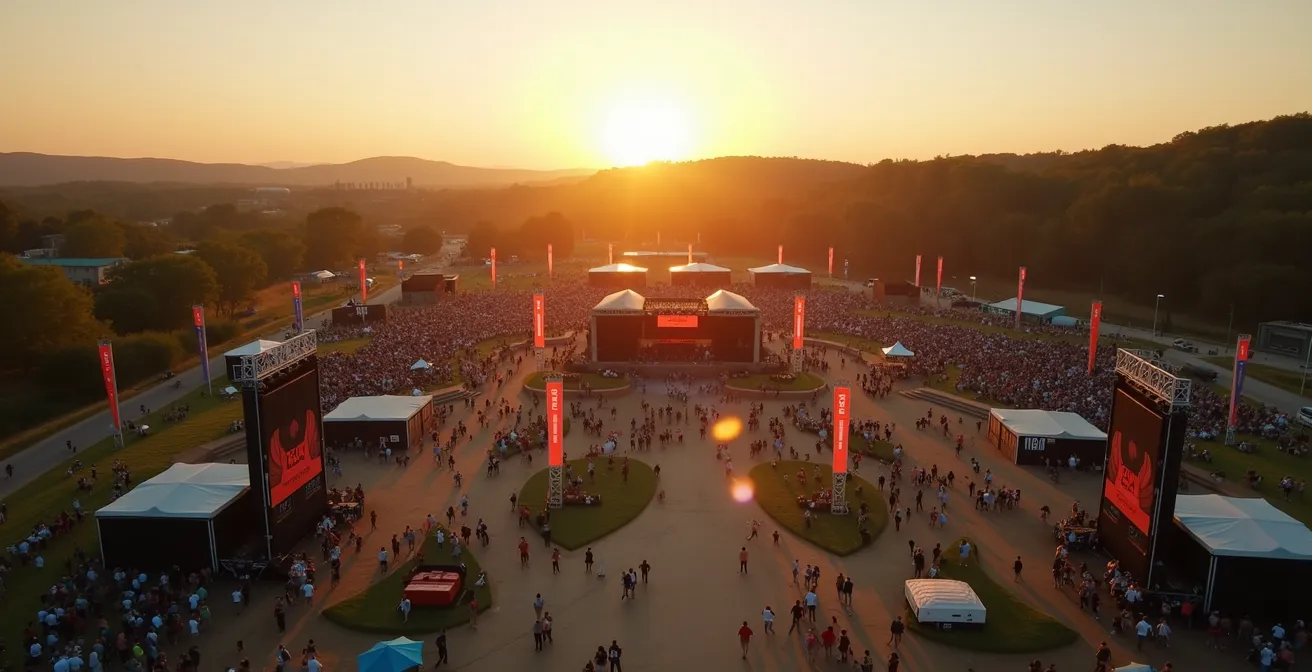
Managing sound bleed at multi-genre festivals goes beyond physical distance and acoustic barriers. The most effective strategy lies in temporal and spectral programming—using the schedule itself as a tool. By intelligently sequencing genres with different frequency profiles and calculating precise changeover times, you can create acoustic “rest periods” that prevent sonic chaos and protect the unique vibe of each stage, turning potential clashes into a seamless audience experience.
For any festival site coordinator, the ultimate challenge isn’t just booking great acts; it’s preventing them from acoustically destroying each other. The classic nightmare scenario—a thundering metal band scheduled next to an intimate folk stage—is a logistical failure that can ruin the experience for thousands. The conventional wisdom often points to simple physical solutions: increase the distance, build barriers, or point speakers in different directions. While not incorrect, these measures are often impractical, expensive, or simply insufficient against the pervasive power of low-frequency sound.
The true art of multi-stage sound management is more nuanced. It involves thinking in four dimensions, where time and frequency are as critical as length and width. The biggest mistake is viewing the schedule as a mere list of performance times. Instead, it should be your primary instrument for acoustic control. What if the solution to sound bleed wasn’t just about stopping sound waves, but about orchestrating them? The key lies in shifting from a purely physical mindset to one of strategic spectral and temporal programming.
This guide moves beyond the basics of stage placement. We will deconstruct the methods used by world-class festivals to manage their soundscapes, focusing on how clever scheduling, an understanding of genre-specific acoustics, and targeted technology can solve your biggest sound bleed headaches. It’s about creating distinct sonic worlds that can coexist, ensuring that the bass drop at the EDM tent doesn’t become an unwelcome guest at the reggae stage.
This article provides a comprehensive logistical framework for controlling sound bleed across your festival site. Explore the detailed sections below to master the techniques that turn acoustic chaos into curated harmony.
Summary: A Coordinator’s Guide to Festival Sound Control
- Why Is Putting a Rapper After a Rock Band a Smart Programming Move?
- How to Calculate Changeover Times Between Different Band Setups?
- Headliners or Hidden Gems: Which Sells More Weekend Passes?
- The “Vibe Clash” Mistake: Why Aggressive Security Can Ruin a Reggae Stage?
- Where to Place the EDM Tent to Keep the Bass Away from the Acoustic Stage?
- Why Is Distinguishing Between House and Techno Crucial for DJs?
- How to Stack Speaker Boxes to Avoid Phase Cancellation Outdoors?
- How to Build a Sound System That Physically Moves the Crowd?
Why Is Putting a Rapper After a Rock Band a Smart Programming Move?
On the surface, programming vastly different genres back-to-back seems like a recipe for a jarring audience experience. However, from a sound management perspective, it’s a highly effective strategy known as spectral programming. The core principle is that different genres occupy different dominant frequency ranges. A typical rock band’s sound is dense in the mid-range (1-5kHz) with guitars and vocals, while much of modern hip-hop is defined by its powerful sub-bass frequencies (below 100Hz). By alternating between these contrasting sonic profiles, you give the overall acoustic environment a “rest” in specific frequency bands.
Instead of a continuous barrage of low-end rumble from two consecutive bass-heavy acts, this alternation creates natural sonic separation in time. When the rock band finishes, the mid-range frequencies that tend to travel far and cause intelligible bleed dissipate. When the rapper starts, the primary energy shifts to the sub-bass, which, while powerful, is perceived differently than the melodic bleed from the previous act. Research from multi-genre festivals confirms the effectiveness of this approach, showing that strategic genre sequencing can lead to a 15-20 dB reduction in perceived sound bleed between adjacent stages.
This technique turns the schedule into an active equalization tool. Rather than fighting a constant build-up of sound in one frequency range, you are actively managing the spectral energy across the entire festival site over time. It’s a proactive measure that works with the physics of sound, not against it.
Action Plan: Programming for Spectral Separation
- Map Frequency Profiles: Before finalizing the schedule, analyze the typical frequency footprint of each act. Rock bands often dominate the 1-5kHz range, whereas hip-hop and electronic acts are centered on sub-100Hz frequencies.
- Schedule Contrasting Genres: Intentionally alternate acts with different spectral demands on adjacent stages. This allows specific frequency bands to “rest,” preventing cumulative sonic fatigue for the audience and environment.
- Implement Silent Buffers: Build in 5-10 minute periods of silence or very low-level ambient music between sets with drastically different sound profiles. This helps reset audience perception and clears the acoustic space.
How to Calculate Changeover Times Between Different Band Setups?
Changeover times are not just logistical necessities; they are a critical component of temporal sound management. A well-planned changeover is more than just dead air; it’s a strategic buffer that allows the previous act’s sound to fully dissipate, resets the audience’s auditory palate, and prevents the chaotic overlap of sound checks with live performances. The duration of this buffer depends entirely on the complexity of the transition, from a simple DJ handover to a full backline swap for a 7-piece band.
Calculating these times requires a detailed breakdown of two main components: the physical changeover (moving gear, drum kits, and instruments) and the digital reconfiguration (patching inputs, loading console scenes, and line checks). A transition from a solo DJ to a full band is the most time-intensive, often requiring 25-30 minutes, whereas a switch between two similar electronic acts might only take 15 minutes. Underestimating these windows is a common mistake that leads to rushed sound checks bleeding into adjacent stages or, worse, delayed start times that throw off the entire festival schedule.

An innovative solution to this is the “leapfrog” scheduling system. As seen at major festivals like Primavera Sound in Spain, this involves using two adjacent main stages that are never active simultaneously. While one stage hosts a performance, the crew on the silent adjacent stage has an entire set’s duration to execute a flawless changeover. This effectively eliminates changeover-related sound bleed between the two main stages, turning a logistical challenge into a seamless part of the show’s design.
The following table provides a baseline for estimating changeover requirements, which you can adapt to your festival’s specific needs.
| Setup Type | Physical Changeover | Digital Reconfiguration | Total Time Needed |
|---|---|---|---|
| Solo DJ to Band | 15-20 min | 5-10 min | 25-30 min |
| Rock Band to Electronic Act | 20-25 min | 10-15 min | 35-40 min |
| Same Genre Transition | 10-15 min | 3-5 min | 15-20 min |
Headliners or Hidden Gems: Which Sells More Weekend Passes?
While the booking strategy of headliners versus “hidden gems” is a commercial decision, it has profound implications for site-wide acoustic management. Headliner stages are magnets for massive crowds and demand high sound pressure levels (SPL), making their placement the single most important factor in your sound zoning plan. Placing a main stage in the center of the site is a common mistake that guarantees sound bleed in every direction. The most successful large-scale festivals treat their site layout as a macro-level acoustic tool.
The Glastonbury Festival is a masterclass in this approach. Its sprawling layout strategically uses distance and natural topography—hills and wooded areas—as sound barriers. The main stages, like the Pyramid and Other Stage, are placed far apart, while genre-specific zones, like the late-night dance area “Silver Hayes,” are relegated to the far corners of the site. This strategic zoning ensures that the high-energy bass from the dance stages doesn’t interfere with the main acts or violate strict local noise curfews after the headliners have finished. This design respects the principle that you must direct each stage’s sound primarily to its immediate audience.
Direct each stage’s sound to its immediate crowd so acts can play simultaneously without one overshadowing another.
– Event Design Expert, Social Tables Festival Planning Guide
“Hidden gem” stages, with their smaller crowds and lower volume requirements, offer flexibility. They can be tucked into acoustically isolated pockets of the festival site, like natural amphitheaters or wooded clearings, creating intimate experiences without contributing to the overall noise floor. The key is to map your site not just for foot traffic and capacity, but for its inherent acoustic properties, using the landscape itself as part of your sound system.
The “Vibe Clash” Mistake: Why Aggressive Security Can Ruin a Reggae Stage?
Effective sound management isn’t just about controlling decibels; it’s about protecting the intended atmosphere, or “vibe,” of each stage. A “vibe clash” occurs when elements from one area bleed into another, not just acoustically but experientially. A classic example is the bleed of an aggressive, high-energy environment into a chill-out zone. You can have the perfect sound system for a reggae stage, but if it’s located next to a high-traffic thoroughfare with harsh security lighting and an intrusive security presence, the relaxed atmosphere is irrevocably broken.
Creating successful sensory-aware zones requires a holistic approach that goes beyond audio. The placement of the stage is paramount. Using natural topography like hills or groves of trees as barriers provides not only acoustic isolation but also visual separation, creating a feeling of a secluded sanctuary. This concept of vibe-zoning extends to every operational detail. Security protocols must be adapted to the environment; on a reggae or ambient stage, security teams should be trained in non-confrontational positioning and minimal physical presence, blending into the periphery rather than standing as an imposing force.
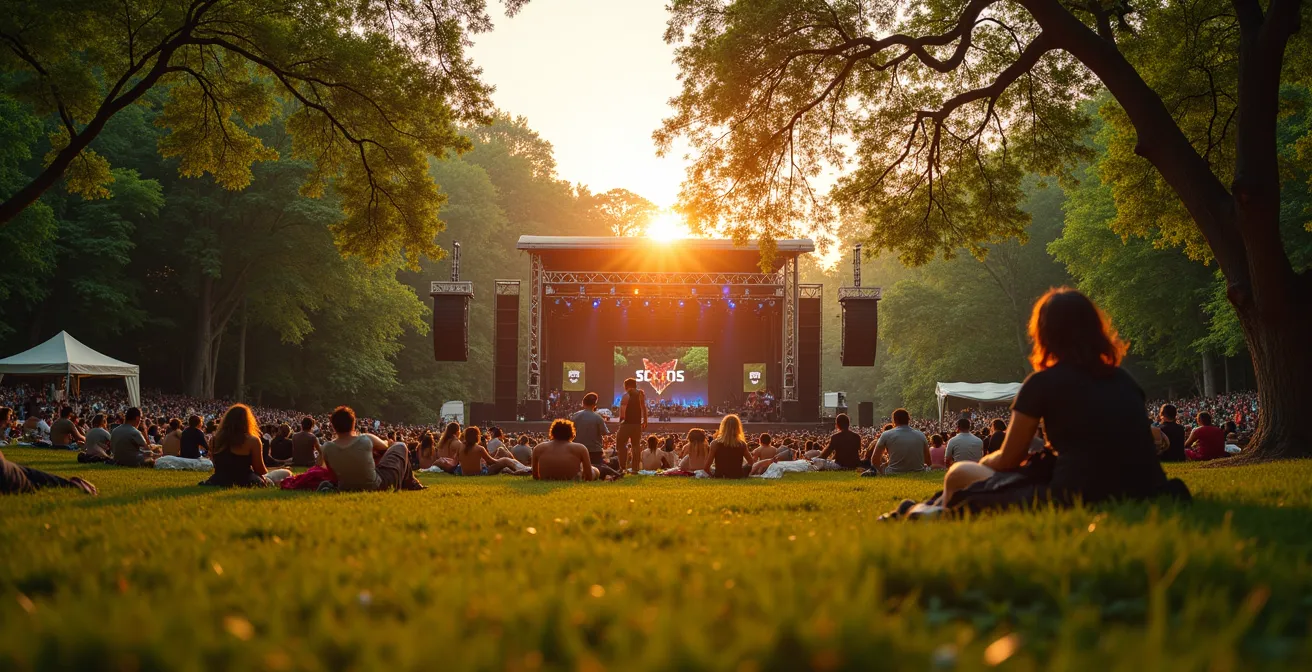
Even the technology must align with the vibe. Cardioid subwoofer arrays can be deployed to keep the bass contained within the zone, preventing low-end rumble from adjacent high-energy stages from intruding. Likewise, lighting should be ambient and warm, reinforcing the relaxed mood, rather than using harsh, functional floodlights that create a sterile and unwelcoming feel. Protecting the vibe is an active process of curating every sensory input, not just the sound.
Checklist: Creating a Sensory-Aware Zone
- Isolate with Topography: Position chill-out stages in naturally secluded areas, using hills, trees, or other landscape features as both sound and visual barriers.
- Adapt Security Protocols: Train security staff assigned to these zones in non-confrontational positioning and minimal physical presence to maintain a relaxed atmosphere.
- Contain the Bass: Deploy cardioid subwoofer arrays to focus low-end energy on the dancefloor and prevent bass bleed from or into adjacent high-energy stages.
- Use Atmosphere-Appropriate Lighting: Replace harsh security floodlights with ambient, warm lighting to preserve the intended intimate or relaxed mood of the stage.
Where to Place the EDM Tent to Keep the Bass Away from the Acoustic Stage?
The single greatest challenge in multi-genre festival acoustics is containing low-frequency energy. The deep, omnidirectional bass from an EDM tent can travel for hundreds of meters, easily overwhelming a nearby acoustic or spoken-word stage. The solution lies not in simply turning the bass down, but in directing it with precision using advanced subwoofer configurations, most notably the cardioid subwoofer array. Unlike a standard subwoofer that radiates sound in all directions, a cardioid array is configured to create intentional phase cancellation behind the speakers.
This is achieved by arranging subwoofers in a specific physical and electronically delayed pattern. The result is a heart-shaped (cardioid) dispersion pattern where sound energy is focused forward onto the crowd, while being significantly reduced at the rear. Technical measurements demonstrate that cardioid configurations can achieve a 15 dB or more reduction in bass behind the array. This is a massive decrease in SPL that can mean the difference between a muddy, chaotic soundscape and clean, distinct audio zones. For a festival coordinator, this technology allows you to place high-energy and low-energy stages closer together than would otherwise be possible.
World-class events have refined this technique. For example, The Temple Stage at Glastonbury utilized a sophisticated array of high-powered subwoofers aimed in four directions to concentrate intense bass on the dancefloor while actively preventing it from spilling into the nearby town or adjacent stages. Comparing different array configurations is crucial for choosing the right tool for your site’s specific layout.
| Configuration | Space Required | Rear Rejection | Best Use Case |
|---|---|---|---|
| Cardioid Array | Compact (stacked) | 15-17 dB | Stages with neighbors behind |
| End-Fire Array | Extended (linear) | 10-15 dB | Long narrow festival sites |
| Hybrid Setup | Variable | 15-20 dB | Complex multi-stage layouts |
Why Is Distinguishing Between House and Techno Crucial for DJs?
For a festival coordinator, the nuances between electronic sub-genres like house and techno might seem like a minor detail for DJs to worry about. However, this understanding is a powerful tool for managing sound bleed between adjacent electronic stages. While both are bass-driven, their rhythmic structures and dominant frequencies differ. House music often has a warmer, more melodic bassline in the 100-150Hz range, while techno is typically characterized by a deeper, more percussive sub-bass focus below 80Hz. Programming these compatible-but-distinct genres on adjacent stages can turn unavoidable sound bleed into a positive experience.
This concept is known as creating an acoustic cross-fade. In the transition zones between two stages, where sound inevitably mixes, the compatible BPMs (beats per minute) and complementary frequency ranges can blend in a way that feels intentional. As one festival audio engineer noted, this strategy creates “accidental remixes” rather than a chaotic mess.
Programming harmonically and rhythmically compatible subgenres on adjacent stages can make unavoidable bleed less jarring, creating ‘accidental remixes’ in transition zones rather than a chaotic mess.
– Festival Audio Engineer, Electronic Music Festival Sound Design Guide
To execute this, keep adjacent stages within a close BPM range (e.g., 120-135 BPM) to avoid rhythmic clashing. Then, use directional speaker arrays to minimize the overlap of the more intelligible mid-range frequencies, while allowing the compatible low-end frequencies to blend more naturally in the space between. This transforms a problem—sound bleed—into a feature of the festival’s sound design, enhancing the journey for attendees moving between stages. It’s a sophisticated approach that acknowledges that perfect silence between stages is impossible, so the goal should be to make the bleed as musically pleasing as possible.
How to Stack Speaker Boxes to Avoid Phase Cancellation Outdoors?
Once you’ve managed the bleed between stages, the next challenge is ensuring consistent, high-quality audio coverage *within* each stage’s designated zone. A common and destructive issue at outdoor events is phase cancellation. This occurs when sound waves from two or more speakers arrive at a listener’s ear at slightly different times, causing them to cancel each other out. The result is the creation of “dead zones” in the audience where certain frequencies, particularly bass, seem to disappear entirely. Acoustic measurements reveal that phase cancellation can reduce audio quality by up to 20 dB in these spots, creating a frustratingly uneven experience for the crowd.
Properly stacking or “flying” speakers in a line array is the first line of defense. A line array is a column of speakers designed to work as a single source, creating a controlled, coherent wave front that minimizes destructive interference. However, for very large crowds, the main array alone is not enough. This is where delay towers become essential. These are smaller speaker stacks placed partway back in the audience area. They receive a slightly delayed audio signal from the main mix, timed precisely so that their sound arrives at the back of the crowd at the same moment as the sound from the main stage speakers.
This technique reinforces the sound for the back of the audience without simply increasing the overall volume at the front. World-class festivals like Coachella are masters of this, deploying extensive systems of line arrays and meticulously timed delay towers. Their engineers use real-time monitoring and specialized software to adjust for atmospheric changes like wind and humidity, ensuring flawless coverage across the entire venue. For a site coordinator, ensuring your audio provider is proficient in deploying and timing delay towers is non-negotiable for any large stage.
Key Takeaways
- Effective sound management is not just about physical separation; it’s about strategic scheduling (temporal and spectral programming).
- Understanding the frequency profiles of different genres allows you to use contrasting acts to create acoustic “rest periods” and reduce bleed.
- Advanced technology like cardioid subwoofer arrays and delay towers are essential tools for containing bass and ensuring even coverage.
How to Build a Sound System That Physically Moves the Crowd?
The ultimate goal of any high-energy stage, whether it’s for EDM, rock, or hip-hop, is to create a visceral, physical experience where the crowd can feel the music. This “chest-thumping” impact comes from a very specific frequency range: the sub-60Hz spectrum. However, delivering this sensation without creating uncontrollable sound bleed is the final piece of the acoustic puzzle. The mistake is to equate physical impact with sheer volume across all bass frequencies.
In reality, the frequencies that provide that satisfying physical sensation (sub-60Hz) are not the same ones that typically create muddy, undefined bass bleed. That “mud” often comes from an uncontrolled build-up in the 80-200Hz range, which is highly omnidirectional and less impactful physically. A world-class sound system is therefore not just about being loud; it’s about being precise. It focuses immense energy into the sub-60Hz range while carefully controlling the 80-200Hz range to maintain clarity and prevent off-site bleed.
This is where sound containment strategies become paramount. As demonstrated at events like Boomtown Fair in the UK, if a stage is positioned near a residential area, a cardioid subwoofer array becomes a tool for community relations as much as for sound quality. By focusing the bass forward onto the crowd and cancelling it at the rear, you can deliver the physical impact the audience craves while drastically reducing noise complaints from neighbors. The strategy is to deliver maximum impact where it counts and surgical control where it doesn’t.
| Frequency Range | Physical Impact | Sound Bleed Risk | Crowd Experience |
|---|---|---|---|
| Sub-60Hz | Maximum physical sensation | Low (with cardioid) | Chest-thumping impact |
| 80-200Hz | Moderate vibration | High (omnidirectional) | Muddy if uncontrolled |
| 200Hz+ | Minimal physical | Moderate | Clarity and definition |
Ultimately, a successful multi-genre festival is an ecosystem of carefully curated sonic environments. Adopting a holistic strategy that combines intelligent scheduling, thoughtful site layout, and precise audio technology is the only way to move beyond firefighting acoustic problems. The next step is to integrate this logistical and acoustic mindset into every stage of your festival planning process.