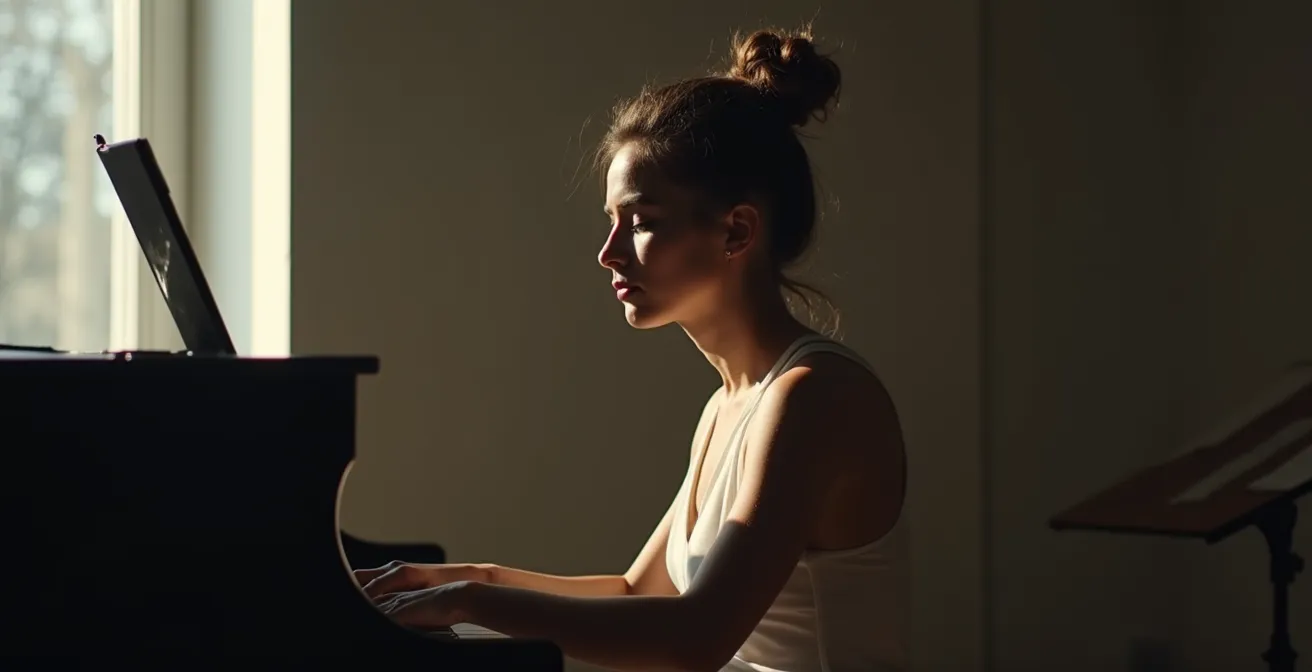
We’re often told to just “feel the music,” but what happens when you feel nothing but the pressure of hitting the right notes? The truth is, emotional performance isn’t magic; it’s a craft. This guide reframes expression as a tangible skill, showing you how to use techniques from acting, art, and even dance to build a bridge between your technical ability and a soul-stirring performance. It’s time to stop waiting for inspiration and start creating it.
You’ve done the work. The hours of scales, the meticulous note-learning, the relentless pursuit of precision. You play the right notes, in the right order, at the right time. Yet, when you listen back, there’s a hollowness, a sterile perfection that chills you. It’s the sound of a skilled technician, not an artist. You sound correct, but you don’t sound alive. This is the most frustrating plateau for any dedicated musician: the chasm between technical mastery and emotional truth.
The conventional wisdom is to “feel more” or “connect with the music,” but this advice is as unhelpful as telling someone to “be taller.” It offers no path, no method, no ladder to climb out of the ditch of robotic playing. We are led to believe that emotion is a mystical force that some performers are born with, a divine inspiration that strikes like lightning. This belief is not only wrong; it’s destructive. It keeps talented, hardworking musicians trapped in a cycle of self-doubt, forever waiting for a feeling that may never come on its own.
But what if the key wasn’t about waiting to feel, but about learning to *do*? What if emotion in music was less about spontaneous feeling and more about a set of deliberate, learnable, and craftable techniques? This is the perspective of the artistic director, the actor, the dancer—and it is the perspective that will unlock your expressive potential. We are not here to wait for the muse; we are here to build her a stage, light it perfectly, and give her a reason to appear.
This guide will deconstruct the architecture of musical emotion. We will explore the psychological traps that silence your voice, the theatrical tools that can give it life, and the physical connection that makes it resonate. You will learn to treat expression not as an accident, but as an intention. You will learn to sculpt sound, to paint with silence, and to move an audience, even on days when you feel moved by nothing at all.
This article provides a structured path to bridge the gap between your fingers and your heart. Follow along as we dissect the craft of expression, transforming your understanding of what it truly means to make music.
Summary: The Art of Sculpting Emotion in Music
- Why Does Obsessing Over Mistakes Kill the Vibe of a Performance?
- How to Use Acting Techniques to Sell a Song You Don’t Feel?
- Dynamics or Rubato: Which Tool Creates More Immediate Emotion?
- The “Melodrama” Mistake: When Does Expression Become Cheesy?
- When to Stop Playing to Let the Music Breathe?
- The “Soulless Robot” Mistake: Why Technique Without Pain Is Not Flamenco?
- The “Eye Symbol” Mistake: Why You Draw What You Know Instead of What You See?
- How to Improve Your Musical Timing by Taking a Dance Class?
Why Does Obsessing Over Mistakes Kill the Vibe of a Performance?
The first obstacle to emotional playing is fear. Specifically, the paralyzing fear of hitting a wrong note. When you are on stage, your mind fixated on avoiding errors, you are engaging in a high-stakes cognitive task. This intense focus, paradoxically, is the very thing that strangles the life out of your music. It’s a scientifically observable phenomenon related to how our brains function under pressure. You are, in essence, activating the wrong neural network for the job.
Your brain has a network known as the Default Mode Network (DMN). It’s the part of your brain that is active during self-reflection, daydreaming, and thinking about the past or future—the very processes involved in connecting to the emotional core of a story or a piece of music. It’s your “human” network. However, intense, focused tasks—like frantically trying to remember the next passage—do the opposite. As research shows, typical cognitive load tasks are now known to deactivate the DMN. By obsessing over technical perfection mid-performance, you are literally shutting down the part of your brain that generates and processes deep emotion and connection.
This creates the “soulless robot” effect. Your brain’s “technician” mode is fully engaged, executing the programmed commands flawlessly. But the “artist” mode, the DMN, is offline. The result is a performance that might be technically perfect but feels empty because it’s being generated by a different part of your consciousness. The inner world of the music, its story and its feeling, remains inaccessible.
The solution isn’t to stop caring about notes, but to shift *when* you care. The practice room is for deconstructing, analyzing, and building technical security. The stage is for trusting that work and intentionally activating your DMN—by focusing on the story, the emotional arc, the character you are portraying. You must give your brain permission to switch from “calculating” to “experiencing.” Only then can the vibe, the soul of the performance, emerge.
How to Use Acting Techniques to Sell a Song You Don’t Feel?
Here is a secret that every professional performer knows: you do not have to feel an emotion to portray it authentically. Actors don’t wait to feel genuine grief to play a tragic scene; they use a specific set of tools to construct that emotion for the audience. As a musician, you can do the same. The master key is to shift your mindset from “How do I feel this?” to “What would a person who feels this *do*?” This is the foundation of Stanislavski’s ‘Magic If’ and it is your most powerful tool against emotional emptiness.
Instead of trying to dredge up a personal memory of sadness for a somber adagio, you ask, “What if I were a character who has just lost everything? What would my breathing be like? How would I carry myself? How would I speak?” These questions give you concrete, playable actions. The emotion becomes a verb. As one professional opera singer described the painstaking process of ‘Actioning’ a role, it demands focused attention to assign an active intent to every single phrase. In a post for New York Dramatic Voices, she notes it’s “slow, painstaking work” but it’s what finds the nuance and truth in the performance.
This process of building an “emotional score” is your practical solution. It involves defining the character, the context, and the specific intention behind each musical line. Here’s a simple framework to start:
- The Magic If: Start every piece by asking, “What if I were a character who feels…?” instead of “How can I feel…?”
- Given Circumstances: Who is this character? Where are they? What just happened? What do they want? Answering these creates the world of the piece.
- Action Verbs: Assign a transitive verb to each phrase. Are you *pleading* with this melody? *Accusing* with this chord? *Consoling* with this arpeggio? This makes the intention specific and playable.
- Physical Score: Connect these intentions to your body. A phrase of pleading might be played with a lighter touch and a slight lean-in. A moment of anger might engage your core and a firmer contact with the instrument.
By focusing on these truthful actions, a curious thing happens: genuine feeling often follows as a byproduct. But even if it doesn’t, your performance will have the structure, intention, and authenticity of emotion. You are no longer trying to be a conduit for a mysterious feeling; you are the architect of an emotional experience.
Dynamics or Rubato: Which Tool Creates More Immediate Emotion?
Once you accept that emotion is a craft, your musical markings transform from mere instructions into an artist’s palette. Two of the most powerful colors on this palette are dynamics (volume) and rubato (timing). While both shape expression, they speak to different parts of our primal emotional brain and create vastly different effects. Understanding their distinct roles is key to wielding them with intent, rather than just applying them because the score says so.
Dynamics are the tool of power and intensity. Changes in volume trigger a visceral, almost animalistic response in the listener. A sudden forte can signal surprise, anger, or awe, tapping into our fight-or-flight instincts. A gradual decrescendo into pianissimo can create a profound sense of intimacy or vulnerability, drawing the audience in as if sharing a secret. The effect is immediate and physical. Think of the jump-scare in a movie (a sudden dynamic shift) versus the quiet, tense whisper. Both are powerful, but they operate on different emotional axes.

Rubato, on the other hand, is the tool of thought and breath. The subtle push and pull of time mimics the hesitations of human speech, the intake of breath before a profound statement, or the rush of thoughts during a moment of panic. It gives the music a human, vulnerable quality. Rubato tells the listener that this is not a machine playing; it is a living being, thinking and feeling in real-time. It conveys longing, reflection, and spontaneity. While dynamics shout, rubato confides.
So which is more immediate? It depends on the emotion you are sculpting. For raw, primal feelings, dynamics are your most direct weapon. For nuanced, complex, and deeply human sentiments, rubato is your scalpel. The true mastery, of course, lies in their combination, creating a rich emotional narrative that is both powerful and profound.
This table breaks down their distinct emotional families, helping you choose the right tool for the right moment.
| Musical Element | Emotional Family | Immediate Effect | Best Context |
|---|---|---|---|
| Dynamics (Volume) | Power, intimacy, intensity (anger, surprise, awe) | Primal, visceral response | Baroque (terraced), Pop (sudden drops) |
| Rubato (Timing) | Thought, breath (hesitation, longing, reflection) | Human, vulnerable quality | Romantic (Chopin), Jazz improvisation |
| Combined Effect | Complex emotions | Crescendo + Accelerando = Panic/Excitement | All genres with varying emphasis |
The “Melodrama” Mistake: When Does Expression Become Cheesy?
As you begin to experiment with expressive tools, a new fear emerges: the fear of going too far. No artist wants to be accused of being cheesy, over-the-top, or melodramatic. This fear can be so strong that it sends us retreating back into our safe, technical shell. We choose to be boring rather than risk being sentimental. But the line between profound emotion and melodrama isn’t about the *amount* of feeling you show; it’s about its *authenticity* and *context*.
Melodrama happens when the outward expression feels unearned by the internal logic of the piece. It’s a grand gesture with no substance behind it, a shout where a whisper would have been more powerful. The antidote to melodrama is not to feel *less*, but to understand *more* deeply. It’s about connecting every expressive choice to a specific “why.” Why does the music get louder here? Not just because the score says “crescendo,” but because the character is experiencing a surge of hope, or because the storm is finally breaking. Your expression must be rooted in the story.
A common misconception is that you need to reach a high level of technical proficiency before you can be truly expressive. This is a fallacy that keeps countless musicians in a state of emotional paralysis. As one insightful article on PianoTV.net astutely points out, this simply isn’t true. There are artists with minimal technical skill whose raw energy is captivating, and technical virtuosos who leave audiences cold. The article’s conclusion is profound: “you can convey emotion through music right from day 1. You can do it when you’re playing Mary Had a Little Lamb or Moonlight Sonata.”
This is the key to avoiding melodrama. Authenticity begins the moment you decide to play “Mary Had a Little Lamb” not as a series of notes, but as a story—perhaps a gentle lullaby, a playful skip in the park, or a mournful farewell. The scope of the emotion matches the scope of the piece. When your dynamic swells and your timing shifts are all in service of that simple, honest story, they will never feel cheesy. They will feel true. Melodrama is an attempt to apply a “big” emotion externally; authentic expression is allowing the piece’s own “small” truth to radiate from within.
When to Stop Playing to Let the Music Breathe?
In our quest for expression, we focus intently on the notes we play. But some of the most powerful emotional statements are made in the moments we *don’t* play. Silence is not the absence of music; it is an active, integral part of it. It is the frame that gives the painting its value, the white space that gives the words their meaning. As an artistic director, I tell my performers: your rests are as important as your notes. Learning to use them with intention is an advanced form of musicality.
Think of silence as musical punctuation. It provides structure, clarity, and dramatic tension. Just as a paragraph of text without commas or periods becomes an incomprehensible jumble, a musical phrase without rests becomes a breathless, frantic monologue. The strategic use of silence allows both the performer and the audience a moment to process what has just been said and to anticipate what is coming next. It’s in these pools of quiet that the emotional weight of a phrase can truly land.
A musician’s guide to expression offers a brilliant way to conceptualize this. It suggests linking rests to their grammatical equivalents, providing a clear, actionable framework for phrasing:
- A short rest can function as a comma, offering a brief pause for thought within a larger musical idea.
- A longer rest at the end of a phrase acts as a period, signaling the completion of a musical sentence.
- A fermata placed over a rest is like a paragraph break; it’s a significant pause, a moment for a key idea to truly sink in before moving on.
- A sudden, unexpected silence after a loud chord can create a profound sense of shock or suspense, leaving the audience holding its breath.
The ultimate goal is to connect your phrasing to your own body’s natural rhythms—specifically, your breathing. Before you play a phrase, inhale. Let the length and character of that inhalation inform the phrase itself. As you end the phrase, exhale. This physiological connection ensures your phrasing never feels arbitrary. It will feel organic, necessary, and alive. Learning when to stop playing is learning how to speak, not just recite.
The “Soulless Robot” Mistake: Why Technique Without Pain Is Not Flamenco?
Let’s address the most destructive idea in music education, the one that is almost certainly the source of your “soulless robot” problem: the philosophy of “first the notes, then the music.” It sounds logical. It sounds methodical. And it is the single most effective way to guarantee a lifeless performance. No professional artist works this way. To create art, the intention, the emotion, the “pain” of the story must be baked into every single note from the very first moment you learn it.
The title of this section mentions flamenco for a reason. Flamenco is perhaps the ultimate expression of this principle. There is no such thing as “technical” flamenco without *duende*—the raw, indescribable soul and pain of the art form. The guitarist’s rasgueado is not just a series of strums; it is a visceral cry. The dancer’s footwork is not just rhythm; it is the hammering of a heart. To learn the technique without its emotional reason-for-being is to learn nothing at all.
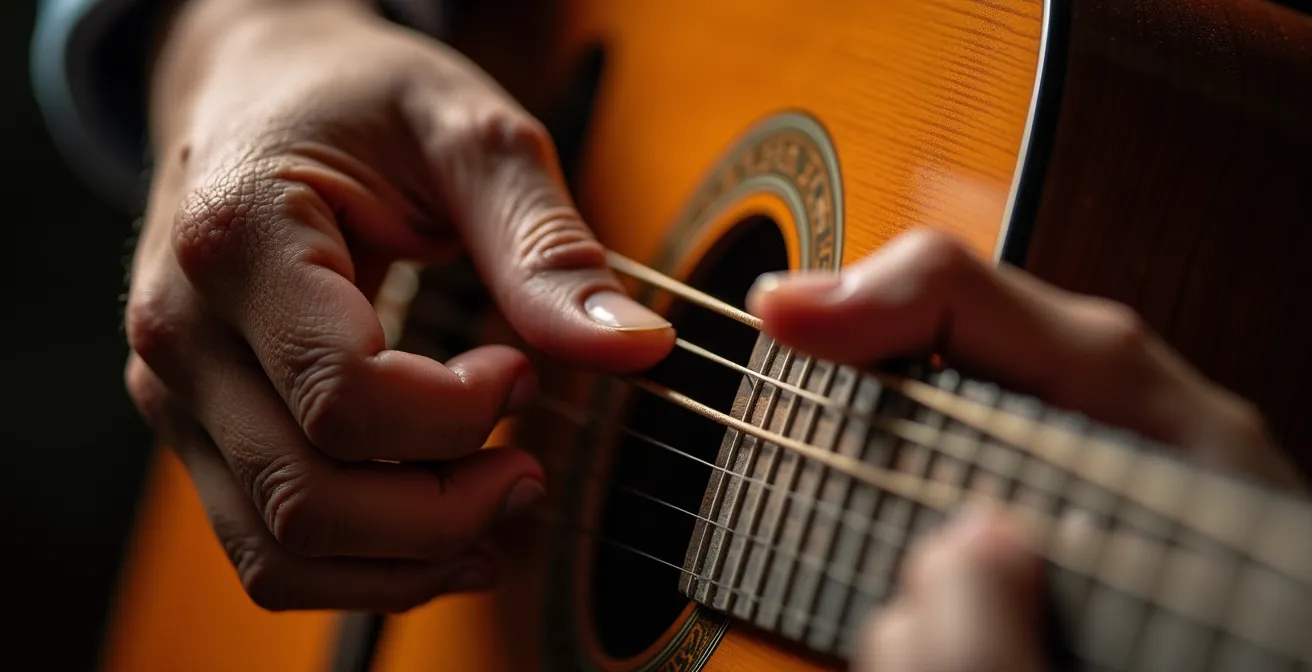
This principle, while most visible in flamenco, applies to all music. As the director of Key-Notes Piano Studio eloquently states in a blog post, this idea is profoundly self-destructive. He argues passionately against this separation of labor:
Practicing with emotion does not mean that we are to emote all over the keyboard during practice. It means that what we wish to express must be integrated into our every motion… Each motive, each phrase needs to be imbued with the emotions we wish to express, from the very beginning of study. A different articulation, a new dynamic shading, another tone color will result in a different emotion expressed.
– Key-Notes Piano Studio, Emotions in Practice and Performance
This is the paradigm shift you must embrace. Your practice is not a two-step process. Every time you play a scale, play it with an emotional intention. Is this a sad scale? A joyful scale? A hesitant scale? By embedding the “why” into the “how” at the micro-level, you are training your neuromuscular system to be expressive by default. Your hands will not just learn the notes; they will learn the feelings associated with them. You are building an instrument—your own body—that is incapable of playing a soulless note, because it has never practiced one.
The “Eye Symbol” Mistake: Why You Draw What You Know Instead of What You See?
In the world of visual art, beginner students often make a classic error known as the “symbol” mistake. When asked to draw an eye, they don’t draw the specific, unique eye in front of them; they draw the generic almond-shape-with-a-circle that they’ve learned is the *symbol* for an eye. They draw what they know, not what they see. As a musician, you are likely making the exact same mistake. You are playing the symbol for “sad” instead of expressing the unique, specific sadness of the piece you are performing.
When a piece is marked “triste,” you might reach for a toolbox of generic “sad” techniques: play slower, play softer, use some rubato. This is the musical equivalent of drawing the eye symbol. It’s a generalized, second-hand emotion. The real work of an artist is to investigate the specific character of *this particular sadness*. Is it a quiet, resigned sadness? A bitter, angry sadness? A nostalgic, bittersweet sadness? Each of these demands a completely different set of musical choices.
The solution is to break free from your pre-conceived musical “symbols” and engage in a process of pure, unjudged discovery. It’s about learning to “see” with your ears and feel with your hands. One of the most powerful ways to do this is to borrow a technique from drawing itself: contour drawing. The following exercise is designed to bypass your analytical brain and connect you directly to the physical gesture of an emotion.
Your Action Plan: Unlocking Expression with Musical Contour
- Identify the Emotional Core: Before playing a note, name the specific emotion you want to convey. Not just “happy,” but “the quiet joy of a sunrise.”
- Visualize the Shape: Close your eyes and imagine that emotion as a physical shape or line. Is it jagged and sharp? Long and flowing? A tight spiral?
- Trace the Contour on Your Instrument: Now, “draw” that shape with your music. Focus only on the contour (pitch going up/down), dynamics, and rhythm. Ignore “correct” notes completely. Make the sound feel like the shape looks.
- Listen for Authenticity: Record these “contour drawings.” Listen back, not for technical accuracy, but for emotional truth. Which one feels most like “the quiet joy of a sunrise”?
- Integrate with the Music: Once you’ve found an expressive gesture that feels authentic, begin to weave the actual notes of your piece into that emotional contour. You’re no longer just playing notes; you’re imbuing them with a specific, discovered emotional DNA.
This process forces you to create a new, personal language for each emotion, moving beyond cliché. You stop playing symbols and start creating experiences. You learn to play not what you “know” about sadness, but the truth of the sadness you have discovered within the music.
Key Takeaways
- Emotional performance is not a mystical gift but a craft that can be learned and practiced like any other technique.
- Obsessing over wrong notes activates the wrong part of your brain, shutting down the networks responsible for emotional expression.
- Authenticity is the antidote to melodrama; a small, true emotion is always more powerful than a large, false one.
How to Improve Your Musical Timing by Taking a Dance Class?
We have explored the mind, the craft, and the spirit. Now, we must turn to the body. As musicians, we often think of our art as a product of our minds and fingers, but we forget the foundational instrument we all possess: our physical form. Your sense of rhythm, your phrasing, and your ability to convey energy are not abstract concepts; they are deeply rooted in your physical experience of the world. If you want to fix your robotic timing, stop looking at the metronome and start moving your feet.
Taking a dance class—be it ballroom, salsa, or even a simple movement workshop—is one of the most transformative things a musician can do. It forces you to internalize rhythm in a way that intellectual practice cannot. You don’t just *understand* the syncopation; you *feel* it in your hips. You don’t just count the waltz; your entire body learns to sway in three. This process of embodying rhythm rewires your brain on a fundamental level.
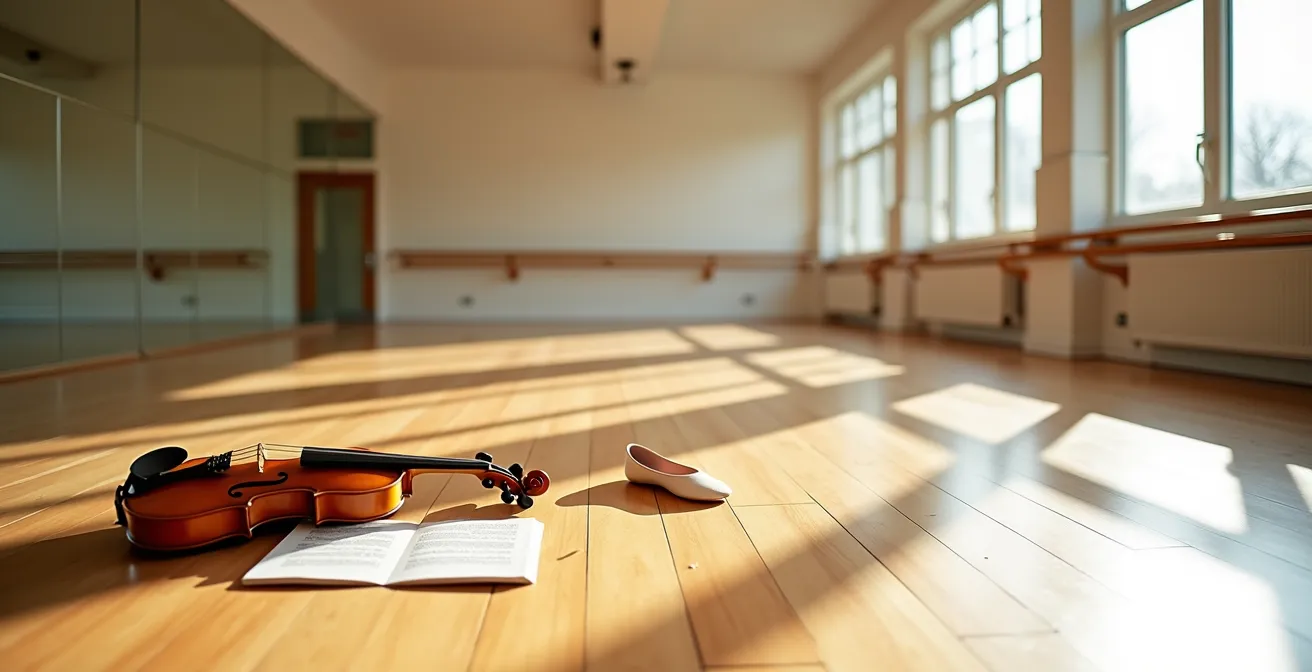
This isn’t just artistic philosophy; it’s grounded in neuroscience. Our brains are hardwired to sync with external rhythms. As neuroscience research demonstrates, music with a strong beat literally causes our brainwaves to resonate in sync with that beat. This phenomenon, known as neural entrainment, is the physical basis for why we tap our feet or nod our heads to music. By dancing, you are engaging in a full-body form of neural entrainment. You are teaching your entire nervous system to feel time, not just measure it.
This corporeal understanding of rhythm translates directly back to your instrument. Your phrasing will start to feel more like breathing. Your sense of tempo will be more grounded and flexible. You will understand on a cellular level that a crescendo is not just getting louder; it is a gathering of energy, a physical surge that you can feel in your core. You will stop being a technician executing rhythmic commands and become a dancer whose instrument is simply an extension of their own moving body. Your music will finally have a pulse because you will have found it within yourself.
You now hold the keys. You understand that emotion is not a feeling you must passively wait for, but a series of actions you can proactively take. From the psychological discipline of the actor to the physical wisdom of the dancer, you have a new set of tools. The “soulless robot” is a myth you no longer need to believe in, a ghost that can be banished by intention, practice, and a deeper understanding of your craft. The journey from technician to artist is a conscious choice, and it is one you can make today, in your very next practice session.