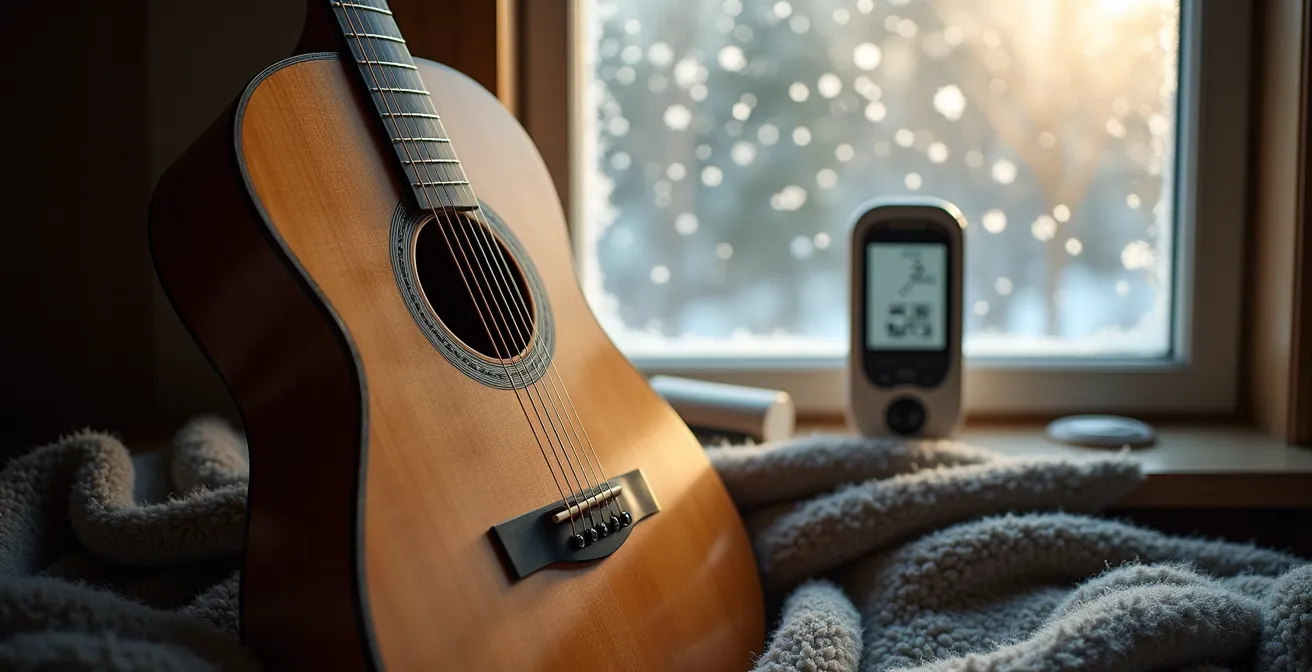
In summary:
- Maintain a stable environment of 45-55% relative humidity using a two-way case humidifier.
- Learn to spot early warning signs like sharp fret ends (“fret sprout”) and a sunken top before cracks appear.
- Never leave your guitar in a car, especially the trunk, where extreme temperature and humidity shifts are guaranteed.
- Understand that solid wood guitars are more sensitive to humidity changes than laminate or carbon fiber models.
- Consistently wipe down strings and fretboard to remove corrosive sweat, which is more concentrated in dry winter air.
The first sign of winter for a guitar owner isn’t the snow; it’s the unsettling buzz of a low E string suddenly rattling against a fret. That sound is a warning shot. Your acoustic guitar, a delicate instrument made of thin sheets of wood, is reacting to the invisible enemy that just invaded your home: dry air. Many players know the common advice—get a humidifier, keep it in the case—but treat it as a chore rather than a strategy. They react to problems instead of preventing them.
This approach misses the fundamental point. The real danger isn’t just a single day of low humidity. It’s the constant, daily stress cycles of the wood expanding and contracting as your heating system kicks on and off. Protecting your instrument isn’t about a simple checklist; it’s about adopting a technician’s mindset. It requires understanding and managing the distinct micro-climates of your room, your guitar case, and your vehicle. The goal is to create a stable state of moisture equilibrium for the wood.
But what if the key wasn’t just blindly adding moisture, but mastering a system of active environmental management? This guide moves beyond the platitudes. We will explore the physics of why wood cracks, how to use humidification tools correctly, and the crucial habits that separate a pristine instrument from one destined for the repair shop. We’ll build a preventative system to ensure your guitar doesn’t just survive the winter, but thrives in it.
This article provides a comprehensive roadmap for winterizing your instrument. We’ll delve into the science behind humidity damage, compare different guitar materials, and offer actionable steps for recording and maintenance in dry conditions.
Summary: A Technician’s Guide to Winter Guitar Care
- Why Does Dry Air Make Your Action Drop and Strings Buzz?
- How to Properly Use a Case Humidifier Without Over-Watering?
- Solid Wood or Laminate: Which Guitar Survives Travel Better?
- The “Trunk” Mistake: Why Leaving Your Guitar in the Car Is Fatal?
- When to Wipe Your Strings to Double Their Lifespan?
- When Is the Best Time of Day to Record Wooden Instruments?
- When to Wash Your Brushes to Prevent Acrylic Build-Up in the Ferrule?
- How to Record Acoustic Instruments at Home Without Room Boxiness?
Why Does Dry Air Make Your Action Drop and Strings Buzz?
An acoustic guitar is a living, breathing object. The wood cells constantly exchange moisture with the surrounding air, seeking equilibrium. When winter arrives and indoor heating systems activate, the relative humidity plummets. This forces the moisture out of your guitar’s wood, causing it to shrink. The most dramatic effect occurs on the arched top of the guitar. As the soundboard loses moisture, it flattens and sinks slightly. This subtle movement pulls the bridge down with it, lowering the height of the strings—what we call the action. Suddenly, strings that cleared the frets perfectly now buzz against them as you play.
This isn’t just an annoyance; it’s the first symptom of a serious condition. Another critical warning sign is “fret sprout.” The wooden fretboard shrinks, but the metal frets do not. This causes the fret ends to protrude from the sides of the neck, feeling sharp to the touch. This indicates the wood is dangerously dry. As a guitar technician, my first recommendation is to establish a baseline. Most manufacturers agree that the ideal environment for a solid wood guitar is between 45-55% relative humidity. Anything below 40% for an extended period puts your instrument in the danger zone for developing cracks in the top, back, or sides—damage that is expensive and sometimes impossible to fully repair.
Learning to spot these early signs is the cornerstone of preventative care. It allows you to intervene before the wood is stressed to its breaking point. This simple diagnostic check should become a weekly habit during dry months.
Your Weekly Humidity Audit Checklist
- Feel for Fret Sprout: Carefully run your hand along both edges of the fretboard. If you feel sharp or protruding fret ends, the wood is too dry.
- Monitor the Top: Look at the reflection of a straight line (like a light fixture) across the top of your guitar, just below the bridge. If the reflection appears flat or sunken instead of slightly convex, the top has lost moisture.
- Test the Action: Play notes on each string up and down the neck. Listen for any new or unusual buzzing that wasn’t there before, especially on the lower frets.
- Inspect the Finish: In good light, examine the guitar’s top for any fine, hairline cracks appearing in the lacquer. This is a late-stage warning sign that the wood beneath is under extreme tension.
- Check the Case: The inside of your case should feel neutral, not noticeably dry or dusty. A perpetually dry interior means the case itself is wicking moisture away from your guitar.
By catching these indicators early, you shift from reacting to damage to proactively managing your instrument’s health.
How to Properly Use a Case Humidifier Without Over-Watering?
Once you’ve diagnosed a dry environment, the immediate solution is a humidifier. However, the common mistake is to think any moisture is good moisture. A dripping sponge or an overwet humidifier can be just as damaging as dryness, potentially causing mold, loosening glue joints, and creating a musty odor. The goal is not just to make the guitar “wet,” but to create a stable micro-climate inside the case. This is where modern technology offers a superior solution over simple sponges.
The key is to use a system that provides two-way humidity control. Unlike a traditional humidifier that only releases moisture, a two-way system can also absorb excess moisture if the ambient humidity spikes. This ensures the environment inside the case remains consistently within the safe 45-55% range, providing crucial humidity inertia against external fluctuations. It automates the process of maintaining equilibrium.
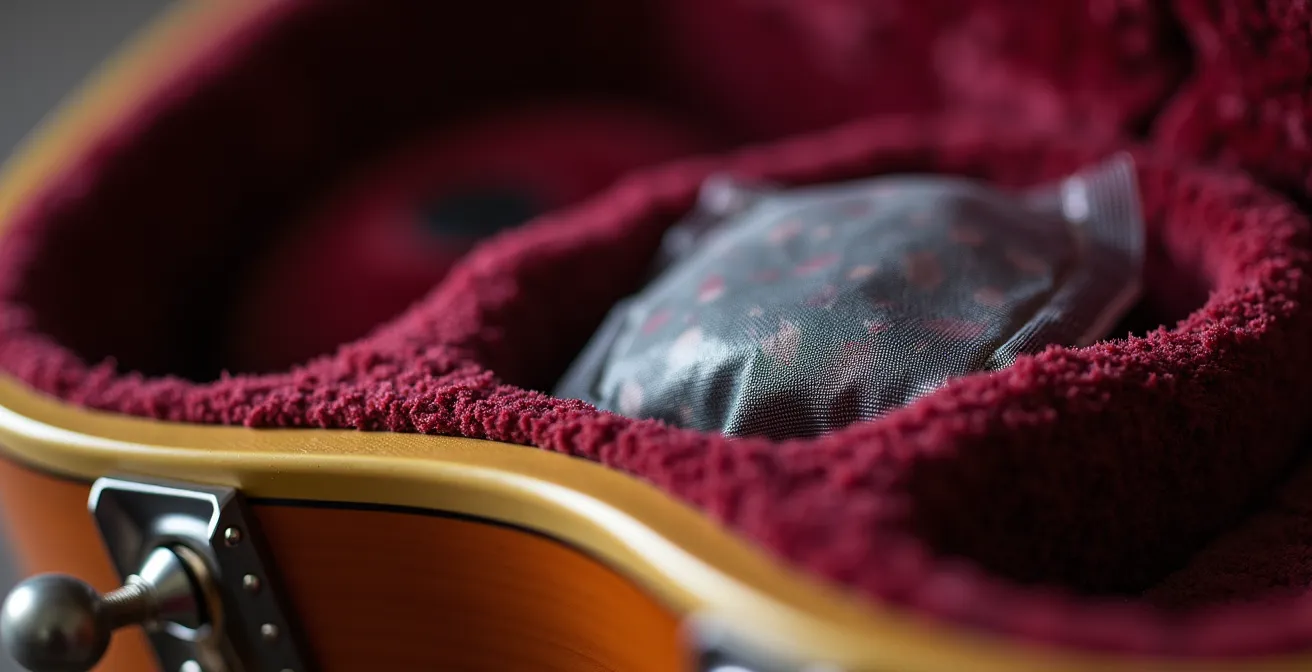
As you can see in the detailed view above, these systems are designed to be maintenance-free and sit securely within the case. They work tirelessly to buffer your instrument from the stress cycles of a heated home. This is the difference between a passive approach and active environmental management.
Case Study: The D’Addario Humidipak System
A prime example of this technology is the D’Addario Humidipak. It utilizes a patented two-way humidity control technology that automatically adds or absorbs moisture to maintain an ideal humidity level. As confirmed by D’Addario, the system requires no manual adjustments based on season or location. It is engineered to maintain that critical 45%-50% relative humidity, effectively creating a perfect, self-regulating micro-climate inside your instrument case. It is important to note this system is for maintenance in a closed case, not for dehumidifying a highly humid room.
Choosing a two-way system transforms your guitar case from a simple box into a protective, stabilized habitat for your instrument.
Solid Wood or Laminate: Which Guitar Survives Travel Better?
Not all guitars react to winter in the same way. The construction material of your instrument is the single biggest factor in its resilience to humidity and temperature changes, especially during travel. A common question from musicians is whether a high-end, all-solid-wood guitar is more or less durable than a more affordable laminate model. When it comes to environmental stability, the answer is clear: laminate is more resilient.
A solid wood guitar top is a single, thin piece of tonewood (like spruce or cedar). This construction allows it to vibrate freely, producing rich, complex, and resonant tones. However, this same quality makes it extremely sensitive to humidity changes. It will swell in high humidity and shrink dramatically in low humidity, making it highly susceptible to cracking. In contrast, a laminate guitar is constructed from multiple thin layers of wood pressed and glued together, with the grains running in different directions. This cross-grained structure provides significant rigidity, making the guitar far less likely to expand, shrink, or crack due to environmental shifts. The trade-off is a less vibrant and complex tone, as the stiff top cannot resonate as freely.
For players who frequently travel, perform in different climates, or simply want a low-maintenance “campfire guitar,” laminate or even carbon fiber instruments offer peace of mind. However, for those who prioritize tone above all, a solid wood guitar is worth the extra care it requires. The table below, based on industry expertise, breaks down the trade-offs.
| Material Type | Humidity Sensitivity | Temperature Resilience | Crack Risk | Tonal Impact |
|---|---|---|---|---|
| Solid Wood Top | Very High | Low | High Risk | Superior resonance |
| Laminate Construction | Low | High | Minimal Risk | Limited resonance |
| Solid Top/Laminate Back | Moderate | Moderate | Medium Risk | 80% of solid tone |
| Carbon Fiber | None | Excellent | No Risk | Unique bright tone |
This data, which aligns with analysis from sources like Sweetwater’s care guides, shows there’s no “best” material, only the right material for your specific needs and tolerance for maintenance.
Understanding your guitar’s construction is the first step in providing the appropriate level of care it needs to survive the winter unscathed.
The “Trunk” Mistake: Why Leaving Your Guitar in the Car Is Fatal?
If there is one piece of advice that every guitar technician will give you with absolute conviction, it’s this: never, ever leave your wooden instrument in a car, especially not in the trunk. A car is not a neutral space; it’s an environmental torture chamber for a guitar. In winter, the temperature inside a parked car can plummet far below freezing overnight. In summer, it can soar to well over 120°F (49°C). The trunk is even worse, as it experiences the most extreme and rapid temperature swings with no insulation.
This rapid change is called temperature shock. When you bring a freezing cold guitar into a warm house, the wood expands rapidly and unevenly. The finish, which expands at a different rate, cannot keep up and develops a network of fine cracks known as “finish checking.” In severe cases, the wood itself can crack or glue joints can fail catastrophically. The trunk is the absolute worst place for transport, a fact emphasized by nearly all experts.
As the editorial team at Guitar Tricks bluntly states in their guide to instrument care:
Never, ever, transport your guitar in a car trunk. Temperatures inside car trunks are extreme in any kind of weather. It’s the quickest way to destroy a guitar.
– Guitar Tricks Editorial Team, Guitar Tricks Blog – Weatherproofing Your Guitar
The only safe place for a guitar in a vehicle is the passenger cabin, where the temperature is regulated. And even then, it should be the last thing you put in the car and the first thing you take out.

Your hands, as shown above, should be the ones moving the instrument, keeping it within the climate-controlled part of the car and minimizing its exposure time to the harsh outdoor elements.
Treat your guitar like you would a person or a pet—don’t leave it to suffer in the extreme environment of a parked car.
When to Wipe Your Strings to Double Their Lifespan?
While humidity control is the primary defense against cracks, a consistent maintenance routine is crucial for preserving your guitar’s playability and the health of its components, like the strings and fretboard. Wiping down your strings after every play session is a well-known tip, but its importance is magnified tenfold during the winter. The reason is simple chemistry.
In dry winter air, our bodies are more dehydrated. This means our sweat has a higher concentration of salts and acids. When this corrosive mixture is left on your strings, it rapidly accelerates oxidation, leading to rust, a dull tone, and a gritty feel. But the damage doesn’t stop at the strings. This acidic residue seeps into the pores of your fretboard wood. On a dry, vulnerable fretboard, this can hasten the breakdown of the wood fibers and finish over time. Wiping your strings is not just about string longevity; it’s about fretboard preservation.
The proper technique involves using a clean, dry, lint-free microfiber cloth. After playing, pinch each string with the cloth and slide it from the bridge to the nut. This lifts the oils and acids off the string surface. Then, slide the cloth underneath the strings to wipe the surface of the fretboard itself. This simple, 30-second ritual can easily double the life of a set of strings and protect your fretboard from long-term damage. During winter, it’s also wise to wipe them *before* playing to remove any dust that could act as an abrasive on the dry wood.
By making this part of your routine, you are actively fighting the corrosive effects of winter on your instrument’s most-touched components.
When Is the Best Time of Day to Record Wooden Instruments?
For recording artists, the principles of winter care extend beyond simple preservation and directly impact the quality of your sound. A guitar’s tone is not static; it changes with its moisture content. A dry guitar often sounds thin, brittle, and overly bright, while an over-humidified one can sound dull and muted. The key to a consistent, rich recording tone is achieving moisture equilibrium not just in the case, but in the recording space itself.
The “best” time to record is not a specific hour, but rather a state of environmental stability. It’s when your instrument has fully acclimated to the recording room and both are resting comfortably in that 45-55% humidity sweet spot. Recording immediately after turning on a heater or right after bringing the guitar into the room from its case will result in an instrument that is still in flux, meaning its tone could shift during the recording session.
To achieve a professional and consistent tone, you must manage the environment with a technician’s precision. This involves patience and measurement. The goal is to ensure the guitar and the room are in perfect harmony before you ever press record.
Here is a professional procedure for ensuring tonal stability during a recording session:
- Place hygrometers: Position one digital hygrometer in your guitar case and another in the recording room to get accurate, independent readings.
- Acclimate the instrument: Bring the guitar in its open case into the recording space at least 2-3 hours before you plan to record. This allows the wood to adjust gradually.
- Wait for equilibrium: Do not start recording until both hygrometers show matching readings (within a 5% RH variance) and have held steady for at least one hour.
- Record during stability: The ideal recording window is when the room maintains a steady 45-50% humidity without wild fluctuations from heating or cooling cycles.
- Avoid recording after HVAC cycles: Give the room’s humidity at least an hour to re-stabilize after a heating or air conditioning unit has been running.
By following this process, you ensure the tone you capture is the true, stable voice of your instrument, not a temporary state caused by environmental stress.
Key Takeaways
- Winter guitar care is an active system of managing micro-climates, not a passive checklist.
- The safe zone for wooden instruments is 45-55% relative humidity; use a two-way system to maintain it.
- Learning to spot early warnings like fret sprout and a sinking top is critical for preventing cracks.
When to Wash Your Brushes to Prevent Acrylic Build-Up in the Ferrule?
While seemingly from a different world, the discipline of a painter offers a powerful metaphor for guitar care. A painter knows that the most critical moment in a brush’s life is immediately after use. If acrylic paint is allowed to dry deep within the bristles and up into the metal band—the ferrule—it becomes rock-hard, ruining the brush forever. The ferrule is the point of no return. A guitarist must ask: what is the “ferrule” of my guitar?
The answer lies in the small, critical contact points where grime and corrosion can build up unseen. Think of the nut slots, the bridge saddle, and the surface of the fretboard between the frets. Just as paint builds up in a brush, the concentrated salts and acids from your sweat build up in these areas. This “acrylic build-up” of the guitar world is a corrosive agent that eats away at strings and slowly degrades the wood. The principle is identical: immediate cleaning prevents permanent damage.
This is why wiping down your strings and fretboard after every session, as discussed earlier, is so vital. It’s the guitarist’s equivalent of washing their brushes. You are removing the corrosive medium before it has a chance to set and cause irreversible harm. Letting sweat sit on your strings overnight is like leaving a brush full of paint to dry on the easel. You are guaranteeing a shorter lifespan for your tools and compromising the quality of your work.
By adopting the same disciplined cleaning habit as a painter, you ensure the critical “ferrules” of your instrument remain clean, functional, and free from destructive build-up.
How to Record Acoustic Instruments at Home Without Room Boxiness?
The final piece of the environmental puzzle extends beyond the guitar case and into the recording room itself. Many home studio recordings suffer from “boxiness”—a build-up of unpleasant frequencies caused by sound waves reflecting off hard, parallel surfaces like bare walls and floors. The common solution is acoustic treatment: adding absorbers and diffusers to control these reflections. However, these materials serve a dual purpose that directly benefits your guitar’s health.
Soft, porous materials like acoustic panels, thick rugs, heavy curtains, and even couches act as passive humidity buffers. Just like the wood of your guitar, they absorb moisture when the air is humid and release it when the air is dry. By strategically placing these items in your recording space to treat acoustic problems, you are also creating a more stable macro-environment for your instrument. This helps to slow down the drastic humidity swings that occur when a heating system cycles on and off.
This creates a win-win scenario. The room sounds better for recording, with less boxiness and a more controlled, professional sound. Simultaneously, the room becomes a safer space for your guitar, with its humidity buffered by the very materials that are improving your audio. You are essentially turning your entire room into a large, slow-reacting version of a guitar humidifier, helping to maintain that critical 45-55% humidity range that is optimal for both instrument health and recording acoustics.
By treating your room for sound, you are inadvertently creating a more stable and protective habitat for your most sensitive wooden instruments.
Frequently Asked Questions About Winter Guitar Care
Should I wipe my strings before or after playing in winter?
Both are recommended during dry winter months. Wipe before playing to remove dust and micro-debris that can act as abrasives on dry wood. Wipe after to remove concentrated salts and acids from winter-dehydrated sweat.
How do coated strings protect the fretboard in winter?
Coated strings like Elixir or D’Addario XS create a barrier preventing corrosive sweat from directly contacting the vulnerable dry fretboard wood, offering extra protection during winter months.
Why is string maintenance more critical in winter?
Dry indoor air leads to player dehydration, concentrating salts and acids in sweat. This accelerated corrosion combined with vulnerable dry wood makes consistent string wiping essential for both string and fretboard preservation.