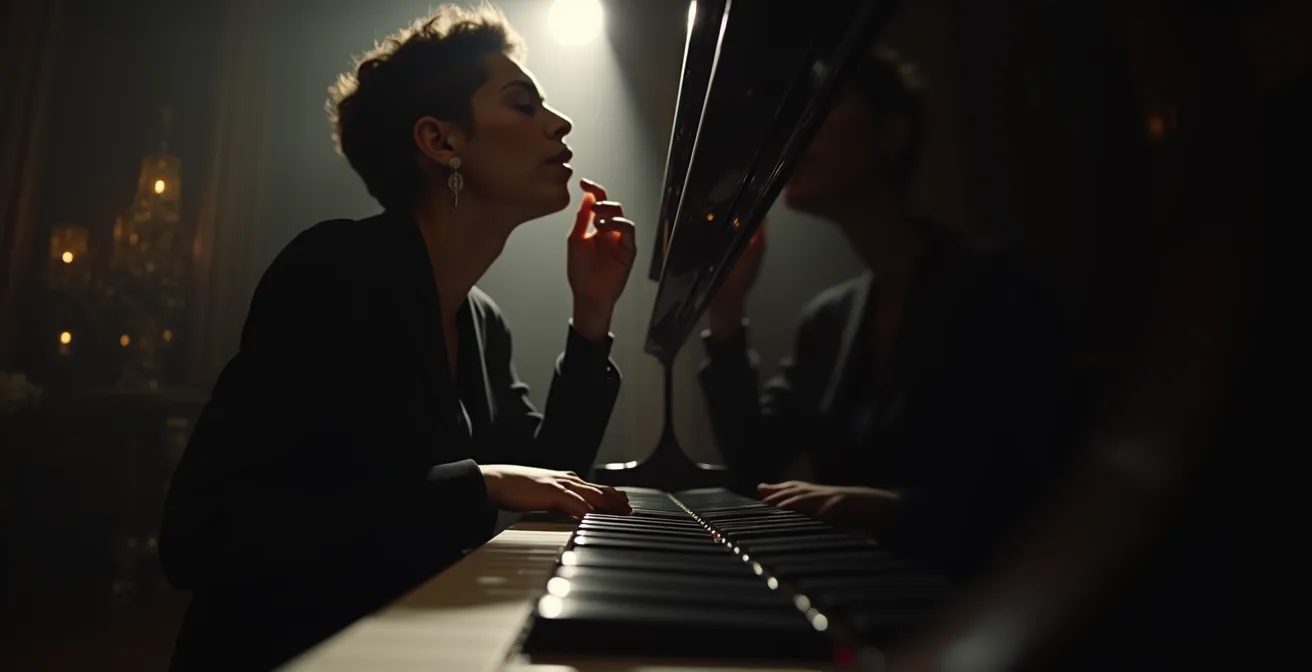
The secret to soulful blues playing isn’t learning a new scale; it’s unlearning the idea that notes exist only on the piano keys.
- True blue notes are microtonal, “in-between” pitches that create emotional tension, not fixed points on a scale.
- Techniques like string bending and vocal sliding aren’t just for effect; they are ways to emulate the human voice’s expressive cries.
Recommendation: Stop trying to ‘hit’ the blue note and start ‘feeling’ for it by sliding or bending into the pitch, listening for the point of maximum emotional impact.
Every aspiring vocalist or guitarist eventually hits a wall. You’ve learned the blues scale, you can play the licks, but your music still sounds… polite. It lacks the raw, gut-punch emotion of the masters. You hear B.B. King make a single note weep, or Etta James pour a lifetime of heartache into one phrase, and you wonder: “What is that sound? It’s not on my guitar fretboard, and it’s certainly not on the piano.” The common advice is to simply “flatten the third, fifth, and seventh.” But this is a misleading oversimplification.
This approach treats blue notes as fixed destinations, like any other note in a Western scale. It completely misses the point. The soul of the blues isn’t in the destination; it’s in the journey. It’s in the way a note is approached, bent, and held in a state of exquisite tension. It’s a sound that exists in the cracks, in the microtonal spaces between the rigid, tempered pitches of a piano. It’s not a note; it’s a microtonal gesture, an expressive cry that predates the instrument itself.
But if the true blue note isn’t a fixed pitch, how can you ever learn to control it? The key is to stop thinking like a Western-trained musician and start thinking like a blues historian. The answer lies not in theory, but in the emulation of the most expressive instrument of all: the human voice. This guide will deconstruct the myth of the “blue note scale” and give you a framework for finding these soulful, in-between sounds. We will explore the emotional science behind them, the physical techniques to produce them, and the artistic discipline required to use them with taste and power.
To truly grasp this concept, we will break down the mechanics, the feel, and the philosophy behind these expressive sounds. This exploration will guide you from the theory of emotional sound to the practical application in your own music.
Summary: Unlocking the Expressive Power of Microtonal Blue Notes
- Why Does Lowering the Third Degree Create Immediate Sadness?
- How to Control String Bending to Hit the Perfect Microtone?
- Major or Minor Blues: Which Scale Should You Use Over a Dominant Chord?
- The “Oversinging” Trap: Why Too Many Runs Ruin the Soul of the Blues?
- How to Use Blue Notes to Create a Conversation With the Audience?
- How to Adapt Your Acoustic Strumming Hand for Electric Solos?
- Dynamics or Rubato: Which Tool Creates More Immediate Emotion?
- How to Use Jazz Chords in Pop Songs Without Losing the Mainstream Audience?
Why Does Lowering the Third Degree Create Immediate Sadness?
The immediate emotional impact of a “blue” third isn’t just cultural conditioning; it’s rooted in psychoacoustics. The Western major scale, with its bright major third, has trained our ears to expect a certain consonant, “happy” resolution. When a performer introduces a flattened third over a major or dominant chord, it creates a powerful expressive dissonance. This clash defies our harmonic expectations, creating a tension that our brain often interprets as melancholy, yearning, or soulfulness. It’s the sound of an emotional reality that doesn’t quite fit into a neat, predictable box.
This note isn’t just a minor third played out of context. It’s often a “neutral third,” a pitch that hovers in the microtonal space between the minor and major. This ambiguity is the key. Scientific research has shown that this is not just an approximation. A University of Rochester study on popular music found that legendary singers don’t just hit notes from an alternate scale; they precisely land in these “in-between” spaces. For example, a vocalist might sing a note perfectly halfway between E and E-flat over a C major chord, creating a sound that is neither major nor minor, but emotionally charged with both.
The sadness comes from this unresolved tension. The note wants to be major, but it’s pulled down by a minor gravity. It’s this tonal ambiguity that gives the blues its profound emotional depth. The piano, with its fixed keys, can only approximate this sound by playing adjacent notes together. But for a vocalist or guitarist, this space is an open field for expression. Learning to feel and control these micro-adjustments is the first step toward true blues expression.
Your Action Plan: Finding the Blue Note Feeling
- Understand the concept: Realize blue notes are microtonal pitches living between the standard notes of the major and blues scales.
- Practice the gesture: For guitar, practice bending strings slowly; on synths, use the pitch bend wheel. Listen for the “sweet spot.”
- Isolate the slide: For voice or trombone, practice sliding very slowly between the minor and major third, holding the notes in between.
- Approximate on piano: To train your ear, play adjacent keys like F and F-sharp simultaneously to hear a dissonant approximation of a blue note.
- Focus on intent: Remember that the goal is to enrich the rigid Western tuning system with raw, expressive possibility. The emotion comes first.
Ultimately, this sound is the musical equivalent of a human voice cracking with emotion—a moment of vulnerability made beautiful.
How to Control String Bending to Hit the Perfect Microtone?
For a guitarist, the string bend is the most direct path to the soul of the blue note. However, most beginners make a critical mistake: they treat a bend as a mechanical action to get from note A to note B. The art of the blues bend is not about reaching a destination pitch, but about the quality of the journey. It’s about vocal emulation—making the guitar string sing, cry, and sigh like a human voice. The perfect microtone isn’t a fixed target on a tuner; it’s the point of maximum emotional tension you feel in your hands and hear in your ear.
This control starts with listening. Instead of bending a whole step because a tab told you to, try this: play a note and bend it upwards as slowly as possible. Listen to the pitches you pass through. There will be a “sweet spot” before the target note where the dissonance with the underlying chord is most poignant. That’s the microtone. That’s the heart of the blue note. It requires immense finger strength and, more importantly, ear training. You must learn to hear that “in-between” space and develop the muscle memory to land there with intention.
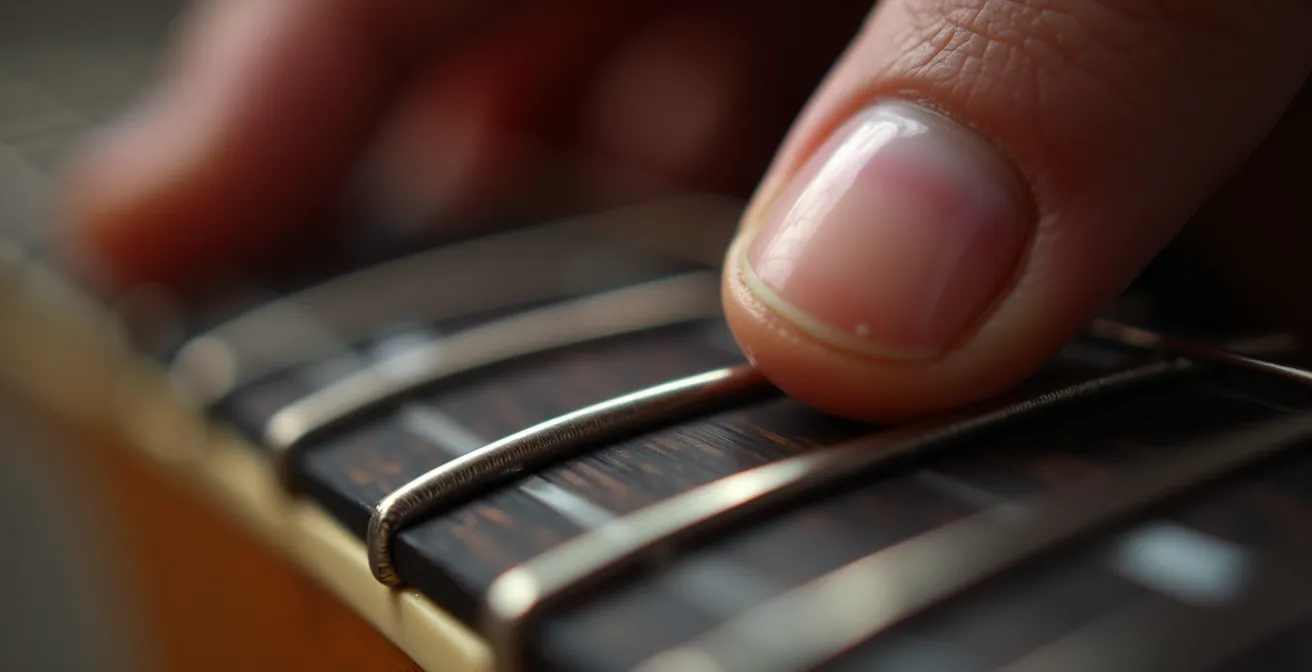
As the image above illustrates, this is a physical, tactile process. It’s about the pressure of the fingertip and the controlled strain against the string’s tension. This concept of the instrument as a voice is fundamental to the blues tradition. As blues-rock singer Susan Tedeschi said about her husband, slide guitarist Derek Trucks:
Derek playing the slide emulates the human voice a lot. When people ask me why my husband doesn’t sing, I say ‘listen again’. He sings every day on slide.
– Susan Tedeschi, South China Morning Post interview
Practice bending to that sweet spot and holding it, adding vibrato to make it “shiver” with emotion. This is how you stop playing notes and start telling stories.
Major or Minor Blues: Which Scale Should You Use Over a Dominant Chord?
One of the most confusing yet powerful aspects of blues is its harmonic ambiguity. The standard 12-bar blues progression is built on dominant 7th chords, which have a major third. Yet, the classic “blues scale” is a minor pentatonic scale with a flat fifth. So how can a minor-feeling scale work over major-feeling chords? This clash is not a mistake; it is the very engine of the blues. The art lies in knowing how to weave between major and minor sounds to create a constant, dynamic tension and release.
You should not choose one scale over the other; you should use both. Think of them as two different colors on your palette. The minor pentatonic scale (with its flat third and flat seventh) provides the grit, the soul, and the characteristic “bluesy” sound. The major pentatonic (or Mixolydian mode) provides the sweet, celebratory, and resolving notes that feel more at home over the dominant chords. A master soloist fluidly switches between them, often within a single phrase, to manipulate the listener’s emotions.
This “dissonant conflict” is the defining feature of the style. As musicologist Peter van der Merwe noted in his seminal work:
Though the blues scale has ‘an inherent minor tonality, it is commonly forced over major-key chord changes, resulting in a distinctively dissonant conflict of tonalities’.
– Peter van der Merwe, Origins of the Popular Style
Case Study: The Beatles’ “Can’t Buy Me Love”
A perfect mainstream example is The Beatles’ “Can’t Buy Me Love.” The song is in C major. In the verses, over the C7 chord, Paul McCartney consistently sings an E-flat (the minor, “blue” third) on the word “diamond.” This gives the verse its driving, bluesy feel. But when the chorus arrives, he switches to a bright, clear E natural, the major third, creating a feeling of joyful release. This constant dialogue between the minor-flavored blue notes in the verse and the straight major notes in the chorus is a masterclass in using tonal ambiguity for emotional effect.
Start by playing minor pentatonic licks over a dominant chord, but aim to resolve your phrases on a note from the major chord, like the root, major third, or fifth. This is the essence of blues storytelling: create tension with the blue notes, then find release in the chord tones.
The “Oversinging” Trap: Why Too Many Runs Ruin the Soul of the Blues?
In a world of vocal acrobatics and “more is more” performance styles, it’s easy to fall into the “oversinging” trap. This is the belief that technical prowess is measured by the number of notes you can fit into a bar. In blues, the opposite is true. The soul of the music lies not in complexity, but in the weight and meaning given to each individual note. A flurry of perfectly executed but emotionally empty runs will always be less impactful than one perfectly placed, soul-drenched blue note. B.B. King could move a stadium to tears with a single bend; he didn’t need a 32nd-note flurry.
The blue note is an expressive dissonance that creates tension. Like a powerful spice, a little goes a long way. If you fill every space with runs and riffs, you give the listener no time to feel the tension of that dissonance. You resolve it before it has a chance to register. The magic of the blues is in the space *between* the notes. It’s in holding a bent note just a little too long, letting the harmony grind against it, before finally letting it fall back into place. This creates a narrative of struggle and release that a fast run simply cannot convey.
Simplicity is not a lack of skill; it is the ultimate form of it. It requires the confidence and emotional maturity to let a single note carry the story. It’s about having the discipline to say more with less. As one vocal coach wisely advises:
Simple does not mean lazy, or not creative, or not energetic. Simple means acknowledging, and singing as such, the beauty of unornamented, unadorned notes. Sing simply, so that the beauty of the words comes through.
– TakeLessons Blog, 6 Things to Remember for Singing the Blues
Before you add another note to your solo or vocal line, ask yourself: does it serve the emotion? If not, it’s just noise. The most profound statements are often the most concise.
How to Use Blue Notes to Create a Conversation With the Audience?
The blues, at its heart, is a communal music. It evolved from field hollers and work songs—forms of communication designed to share a burden and create a sense of shared experience. A blue note is not just a musical device; it’s a conversational tool. When a performer bends a note into that “in-between” space, they are posing a question to the audience: “Do you feel this, too?” The shared release when the note resolves is the audience’s non-verbal “yes.”
This conversational element is baked into the very structure of the music. The classic AAB blues format, where a line is stated, repeated, and then answered, is a model of this. The first two lines (the “call”) set up a tension or state a problem, often punctuated by a searching blue note. The final line (the “response”) provides the resolution or commentary. As a performer, you can use this concept on a micro level. Play a lick that ends on a tense, bent blue note—the call. Pause, let the audience feel that tension. Then, play a resolving phrase—the response. You’ve just had a conversation without a single word.

This dialogue is what creates the electric atmosphere of a great live blues show. The performer isn’t just playing *at* the audience; they are playing *with* them. The bent notes, the crying slides, and the soulful vocal breaks are all musical questions that invite the listener into the story. The cheers, the nods, the “amens” from the crowd are the answers that complete the circle.
The Evolution of Blues as Dialogue
Early blues often consisted of a single line repeated multiple times. Over time, as described in analyses of blues structure, this evolved. The AAB pattern emerged, creating a more formal call-and-response. This wasn’t just a lyrical change; it was a harmonic one. The “call” lines often hang on the tense subdominant (IV) or dominant (V) chords, while the “response” brings it all home to the tonic (I). The blue notes are the expressive glue that holds this musical conversation together, making the questions more poignant and the answers more satisfying.
Your goal is to make the audience feel like they are part of the song, not just spectators. A well-placed blue note is the most direct way to invite them in.
How to Adapt Your Acoustic Strumming Hand for Electric Solos?
Many guitarists who start on acoustic learn a robust strumming technique, often using a pick to drive rhythm. When they transition to electric guitar for solos, they bring that pick-heavy approach with them, which can limit their expressive range. While a pick is great for attack and speed, the true nuance of blues soloing—especially the art of the microtonal gesture—is often found with the fingers. Adapting your strumming hand to incorporate fingerstyle or hybrid picking (using both pick and fingers) unlocks a new world of tonal color and dynamic control.
Using your fingers to pluck the strings provides a warmer, rounder tone than a plastic pick. More importantly, it gives you a direct, tactile connection to the string that is essential for subtle expression. You can pull the string gently for a soft attack or snap it for a percussive pop. This dynamic control is crucial for emulating the nuances of the human voice. A heavy-handed pick technique tends to produce notes of uniform volume, whereas fingerstyle allows for the gentle “scoops” and dynamic swells that make a solo breathe.
The transition doesn’t have to be all or nothing. As expert instructors often suggest, hybrid picking is a powerful bridge between the two worlds.
Players like Derek Trucks and Warren Haynes use their fingers (or a mix of pick and fingers—hybrid picking) to get a different tone and feel. Fingers can add subtlety and nuance you just can’t get with a pick alone. Try alternating between pick and fingers: pick one note and pluck the next with your middle finger. The tone and articulation possibilities expand instantly!
– Play Guitar Academy, Breaking Down Advanced Blues Techniques
This technique allows you to maintain the strong attack of a pick for driving, rhythmic phrases while using your free middle and ring fingers to add delicate, voice-like fills and double-stops. It gives you the best of both worlds: the power of the pick and the finesse of the fingers.
This adaptation is not just a technical change; it’s a philosophical shift toward treating the guitar less like a percussion instrument and more like a singing voice.
Dynamics or Rubato: Which Tool Creates More Immediate Emotion?
While the pitch of a blue note is critical, it is only one-third of the emotional equation. The other two, often-neglected elements are dynamics (how loud or soft you play) and rubato (the subtle pushing and pulling of time). A guitarist can play the “right” bent note, but if it’s played at a constant volume and with robotic timing, it will feel lifeless. The immediate emotion in blues comes from the interplay of all three. Asking which is more important is like asking if a singer needs lungs or a heart; they are inseparable.
Dynamics are the breath of music. Playing a note softly and letting it swell in volume can create a feeling of intense yearning. A sudden, loud attack can signify anger or surprise. Masters of the blues use dynamics to tell a story within a single note. Rubato, or rhythmic flexibility, is the heartbeat. Instead of playing in strict, metronomic time, a blues musician will often rush a phrase to build excitement or, more commonly, lay back and play slightly behind the beat. This “in the pocket” feel creates a relaxed, confident groove. Holding a bent note just a fraction longer than expected creates a powerful tension that makes its resolution all the sweeter.
The most expressive blue notes are rarely static pitches; they are part of a larger gesture. As one analysis points out, these notes are heard in motion. This confirms that the pitch is part of a dynamic and rhythmic gesture, as Flypaper by Soundfly explains, they are attached to tempered scale notes, either being bent-to, bent-from, or heard during a slide. It is a complete physical and emotional event.
The Soul of a Single Note: B.B. King
There is no better example of this than B.B. King. He was famously a man of few notes, but each one was packed with a novel’s worth of emotion. He didn’t play flashy licks. Instead, he would bend a single note with unparalleled control, his legendary vibrato making it sound like a voice cracking with emotion. He understood the power of the pause. He would hold a bend, letting the note breathe and hang in the air, creating unbearable tension before moving on. That patience, that control over dynamics and timing, is where the real magic of the blues lies.
To practice this, record yourself playing a simple solo. Then play it again, but focus only on varying the volume and timing of each note. You’ll discover that you can create more emotion without changing a single pitch.
Key Takeaways
- Blue notes are not fixed pitches but expressive, microtonal “gestures” that exist between the notes of a piano.
- Mastering blue notes is about emulating the human voice, using techniques like string bending and vocal slides to create emotional tension.
- The soul of the blues lies in restraint and the interplay between major/minor tonalities, dynamics, and timing—not in technical speed.
How to Use Jazz Chords in Pop Songs Without Losing the Mainstream Audience?
The journey into blue notes is, in many ways, the first step into a larger world of harmonic color. The principles of expressive dissonance and tonal ambiguity that define the blues are the same principles that, when expanded, lead to the rich complexities of jazz. While dumping a string of complex jazz chords into a pop song can alienate a mainstream audience, using the *spirit* of the blue note can add depth and sophistication without sacrificing accessibility.
The key is to treat jazzier harmonies like you treat a powerful blue note: use them sparingly and with clear intention. A well-placed major seventh or a ninth chord can add a moment of breathy sophistication. A quick diminished passing chord can create a cinematic transition. The mistake is to over-saturate the song. The audience needs a strong, simple foundation to hold onto. The complex colors should be accents that highlight the emotion of a lyric or a moment, not the basis of the entire song.
Ultimately, all of this harmonic exploration is possible because of the incredible sensitivity of human hearing. We are wired to perceive these subtle shades of sound. In fact, research on microtonal perception shows that humans can differentiate tones that are only 5-6 cents apart. This means we can theoretically hear as many as 20 distinct pitches between a C and a C-sharp. The single blue note is just one of these infinite possibilities. This biological fact is what makes expressive, microtonal music so powerful.
Instead of thinking about “adding jazz chords,” think about adding moments of unexpected color. A blue note is the most fundamental example—a touch of minor sadness over a major chord. A jazz chord is just a more complex version of the same idea. It’s a moment of tension that, if used wisely, makes the eventual resolution all the more satisfying for any listener, regardless of their musical training.
Start small. Take a simple pop progression and try replacing just one standard chord with a richer, jazzier voicing. Let it be a surprise, a moment of color in an otherwise familiar landscape. That is the true spirit of the blues.