Success at SXSW isn’t about being the best band; it’s about being the easiest band to do business with.
- The most crucial conversations happen in hotel lobbies and coffee shops, not in front of a loud stage.
- Your 30-minute set is a product demo; it must be flawlessly engineered to eliminate dead air and create one memorable, shareable moment.
Recommendation: Stop chasing “exposure” and start focusing on reducing professional friction for the delegates you want to meet.
You got the email. You’re an official artist at SXSW. The euphoria lasts about ten minutes, quickly replaced by a cold dread: you are one of nearly 2,000 bands descending on Austin, all fighting for the same sliver of attention from industry professionals who are tired, over-caffeinated, and relentlessly pitched. The default advice is to “network,” “play a great set,” and “have your EPK ready.” This is noise. It’s what everyone does, and it’s why most bands leave with nothing but a bar tab and ringing ears.
The fear of playing to an empty room is real, but it’s a symptom of a flawed strategy. You’re not there to win a battle of the bands. You’re there to conduct business. The industry people you want to meet aren’t just looking for good music; they’re looking for professionals who understand that their time is their most valuable asset. They are looking for artists who are easy to work with, easy to book, and easy to champion. This isn’t about being the loudest; it’s about being the clearest signal in a festival saturated with static.
The real key to SXSW is not out-performing everyone, but out-strategizing them. It’s about understanding the hidden curriculum of the festival. The secret isn’t on the stage—it’s in the lobby bar, in the efficiency of your soundcheck, and in the precision of your follow-up email. This is about shifting your mindset from artist to entrepreneur and focusing on a single metric: return on investment (ROI) for every ounce of energy you expend.
This guide will dissect the operational playbook that industry scouts and A&R reps wish every band knew. We will explore why the off-stage moments matter more, how to structure a set like a surgical strike, and when to make contact to turn a fleeting handshake into a career-defining partnership. Forget exposure; focus on execution.
Here, we lay out the no-nonsense framework to navigate the chaos of a showcase festival. The following sections provide a clear, strategic roadmap to ensure you leave Austin with more than just memories.
Summary: A Strategic Playbook for Your SXSW Showcase
- Why Is the Lobby Bar More Important Than the Stage at a Showcase?
- How to Structure a Short Set to Capture Attention Immediately?
- Full Backline or Plug-and-Play: Which Setup Gets You Rebooked?
- The “Exposure” Trap: Why Paying to Perform at Unofficial Showcases Is a Scam?
- When to Email the Contacts You Met to Convert Them Into Partners?
- How to Pace a Setlist Like a DJ Mix to Keep People Moving?
- When to Pitch Your Demo to a Manager Without Being Annoying?
- How to Build a Career in the Music Industry Without Playing a Note?
Why Is the Lobby Bar More Important Than the Stage at a Showcase?
The fundamental mistake bands make is believing the showcase is the main event. It’s not. The showcase is the final, formal step in a series of informal engagements. The real work—the connections that lead to deals—happens in the spaces between the noise. Consider the numbers: at a recent event, there was a cumulative showcase attendance of 140,060 for 1,248 acts. That’s an average of 112 people per show, spread across 65 stages. An A&R scout’s schedule is a brutal exercise in triage, and they will always prioritize the band that has already made a personal connection over a random name on a grid.
The lobby bar, the morning coffee line, the quiet corner of a delegate lounge—these are your primary stages. Why? Because they are low-friction environments. It’s infinitely easier to have a two-minute human conversation over coffee than it is to scream your band name over a bad PA to a distracted crowd. This is where you practice “engineered serendipity.” It’s about strategically placing yourself in the path of opportunity, not hoping it finds you in a dark, loud club.
Your goal before your set is to give key people a reason to come. Your goal after the set is to be a familiar face they already associate with professionalism. The strategy is to target specific delegate “watering holes” during off-peak hours, like hotel lobbies between 7-9am or during pre-show happy hours. Don’t pitch your band; ask for advice. A simple, “It’s our first time here, any tips for cutting through the noise?” is an opener that respects their expertise and starts a conversation, not a sales pitch. You’re not asking for a favor; you’re building a rapport that makes them *want* to see you succeed.
How to Structure a Short Set to Capture Attention Immediately?
Your 30-minute showcase set is not a concert. It is a product demonstration. Its sole purpose is to prove to any scout, agent, or booker in the room that you are a viable investment. You have, at most, 60 seconds to capture their attention before they check their phone and decide where they’re heading next. The opening of your set is not a warm-up; it is the entire pitch. You must start with your most defining, hook-filled song. There is no time for a slow burn.
Every second must be meticulously planned to eliminate “dead air”—the silence between songs that kills momentum and screams amateur. This is where loop pedals, pre-recorded samples, or tightly rehearsed transitions become non-negotiable tools. Announce your band name clearly within the first three minutes, then again before the end. It sounds basic, but in a chaotic environment, basic information is the first thing that gets lost. The goal is to remove all professional friction for someone trying to discover you.
Beyond the music, you need to create one singular, Instagram-worthy visual moment. This could be a coordinated jump, a specific lighting cue you’ve arranged with the tech, or a dramatic instrumental break. This “shareable moment” is your follow-up asset; it gives industry and new fans a simple, visual way to remember and post about you. As demonstrated by Annabel Lee at SXSW 2023, a high-energy opening and strategic visual moments can turn a handful of attendees into a packed patio, with their performance spreading by word-of-mouth in real time. They proved that a well-engineered set is a magnet.
This is a performance designed for ROI. Start strong, maintain momentum, state your name, create a visual, and end your set two minutes early to show you respect the schedule and the bands that follow. That professionalism gets noticed and gets you rebooked.
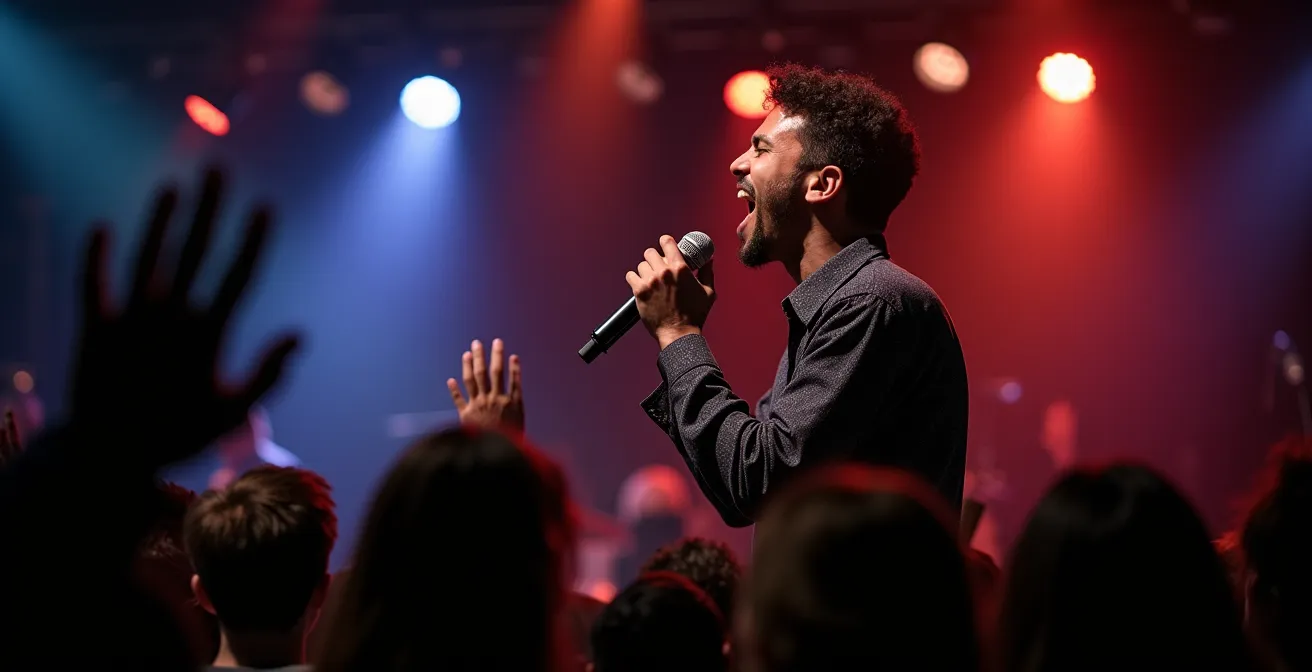
As you can see, the energy of a packed, intimate venue is palpable. Your job is to create that energy from the very first note, drawing people in from the street with an undeniable display of confidence and professionalism. A scout doesn’t just see a band; they see an asset that knows how to command a room.
Full Backline or Plug-and-Play: Which Setup Gets You Rebooked?
The decision between bringing your own full backline or using the house gear (“plug-and-play”) is not an artistic one; it’s a strategic one. While you may love the specific tone of your vintage amp, the most important person in the venue is not the audience—it’s the sound engineer. Making their job easier is one of the highest-ROI activities you can undertake. A quick, seamless changeover makes you a hero to the stage manager and the sound tech, and their opinion carries immense weight with venue bookers.
For a first-time showcase artist playing multiple shows, the answer is almost always plug-and-play. It minimizes risk (no shipping damage), lowers costs, and drastically reduces setup time from a potential 20 minutes to a swift 5-10. This efficiency is a powerful signal of professionalism. You demonstrate that you are an experienced, low-maintenance act that can handle the pressures of a festival environment. This is the kind of reputation that gets you invited back.
The sound tech is your secret A&R. Choosing the simplest setup makes you a favorite of the stage manager and sound engineer. These individuals see hundreds of bands and their recommendations to venue bookers and delegates hold immense weight.
– Matt Errington, KitMonsters Artists Guide to SXSW
Of course, a full backline gives you complete control over your signature sound. For established acts, this can be crucial. But for an emerging band, the risk of technical delays and added stress often outweighs the sonic benefits. A hybrid model can be a smart compromise: use the house drum kit and amps, but bring your own unique elements, like a specific synth or a custom pedalboard. This balances sonic identity with operational efficiency. The following matrix, based on data from industry tech guides, breaks down the decision.
| Setup Type | Advantages | Disadvantages | Best For |
|---|---|---|---|
| Plug-and-Play | Favored by sound engineers, faster changeover (5-10 min), no shipping risks, lower stress | Less control over sound, may not showcase unique tone | First-time SXSW bands, multiple showcases per day |
| Full Backline | Complete control over sound, familiar equipment, brand consistency | Shipping damage risk, setup delays (15-20 min), added costs ($500-2000) | Established acts with signature sound |
| Hybrid Model | Balance of unique sound and efficiency, moderate costs | Still requires some shipping, partial setup time | Bands with 1-2 signature pieces (custom pedal, specific synth) |
The “Exposure” Trap: Why Paying to Perform at Unofficial Showcases Is a Scam?
Let’s be clear: “exposure” is not a currency. It doesn’t pay your rent, and it rarely leads to a record deal. The proliferation of “unofficial showcases” that charge bands to play is one of the most predatory aspects of the festival ecosystem. These events prey on the desperation of the over 10,000 bands applying annually for a limited number of official slots. If a showcase asks you for money to perform, it is not a showcase. It is a concert where you are the promoter, the headliner, and the primary customer, all at once.
Legitimate showcases, whether official or unofficial, have one thing in common: curation. Their business model is based on building a reputation for discovering talent, which they use to attract influential industry attendees and sponsors. Their incentive is to book the best possible bands to impress that audience. A “pay-to-play” event flips this model on its head. Their business is selling stage time to bands, so their incentive is to book as many paying bands as possible, regardless of quality. This dilutes the talent pool and guarantees that no serious A&R scout or agent will be in attendance. They are there to discover curated talent, not to sift through a paid open mic night.
Spending your limited budget on a pay-to-play scam is a massive opportunity cost. That money is better spent on professional photos, a well-recorded demo, or simply affording to be in Austin and strategically networking. Before committing to any unofficial event, you must do your due diligence. A legitimate curator will have a verifiable track record, a public list of past performers, and transparent sponsorship. They will be proud of the careers they’ve helped launch. If that information is not readily available, it’s a major red flag.
Your Curation Litmus Test: 5 Questions to Ask Before Committing to an Unofficial Showcase
- Past Performers: Research who played the showcase last year. Have their careers measurably progressed since then?
- Sponsors & Partners: Are the sponsors legitimate companies with verifiable music industry connections, or are they irrelevant local businesses?
- Guest List: Can the organizer provide a publicly verifiable list of industry delegates who attended previously or are confirmed for this year?
- Curator’s Track Record: Investigate the promoter. What other events have they produced? Search for artist testimonials or, conversely, complaints.
- Venue Legitimacy: Is the venue on an established SXSW circuit like Rainey Street or in the Red River district, or is it an obscure location with no natural foot traffic?
When to Email the Contacts You Met to Convert Them Into Partners?
The business card you collect at SXSW is not a victory; it’s a permission slip. The follow-up is where 99% of bands fail. They either send a generic, desperate “Listen to my demo!” email the next day, or they wait too long and are forgotten. The strategic follow-up is a multi-stage process designed to build on the initial connection without creating friction. The golden rule is to give before you ask.
Your first contact should happen within 24 hours. This is not the pitch. This is the “Memory Anchor.” It should be a brief, non-ask email that references a specific detail from your conversation. “Great meeting you at the Hilton bar. Hope you enjoyed the tacos at Veracruz.” This does one thing: it moves you from “random person” to “person I had a pleasant conversation with” in their mental file. That’s it. No links, no attachments.
The real follow-up—the one with an ask—should wait. As Janelle Rogers, a PR veteran who has championed bands like The White Stripes, advises, wait at least a week for delegates’ inboxes to recover from the post-festival deluge. Your second email, sent 1-4 weeks later, should be the “Value-Add.” This is where you share a new win: a glowing review of your SXSW set, a live video that just dropped, or a milestone you just hit. You are demonstrating continued momentum. Only then do you include your one-click package: a private streaming link (not a file), a one-sentence description, and a single, specific ask (“Would you be the right person to share this with at your agency?”).

This entire sequence is about timing and context. You segment your follow-up based on their role: an A&R gets a private demo, a blogger gets the EPK with a story angle, an agent gets your upcoming tour dates. You’re not just sending an email; you’re delivering a tailored package of information that makes their job easier. That is how you convert a handshake into a partnership.
How to Pace a Setlist Like a DJ Mix to Keep People Moving?
A showcase setlist is not a collection of your favorite songs. It is a 30-minute narrative designed to manipulate the energy of the room and hold the attention of a distracted audience. Thinking like a DJ is crucial. A great DJ doesn’t just play bangers; they create an emotional arc, a journey of peaks and valleys. Your set must do the same. Never allow dead air. Every second between songs must be filled with a loop, a sample, or a tightly rehearsed instrumental segue to maintain a seamless flow.
The “Energy Arc” is a proven structure for a short set. It maps the experience minute by minute:
- Minutes 0-5 (Intrigue): Start at peak energy. This is your most infectious, high-tempo song. You are hooking the listener and drawing people in from the street.
- Minutes 5-15 (Peak Energy): Maintain the momentum. This is where you deploy your next two or three most powerful tracks, using BPM as a storytelling tool to build excitement.
- Minutes 15-25 (Emotional Core): Now that you have their attention, you can afford a slight dip in tempo. This is where you show your depth and musicianship with a more melodic or lyrically focused song. This contrast makes the earlier energy feel more impactful.
- Minutes 25-30 (The Anthem): End with a powerful, memorable anthem that leaves the audience wanting more. This is the song they should be humming as they walk away.
This structure is about creating cognitive dissonance and defying expectations. The Japanese punk band Otoboke Beaver demonstrated this perfectly at ACL Live. Dressed in matching secretary outfits, they delivered a blistering, high-energy punk set full of abrupt tempo changes and false endings. The contrast between their appearance and their ferocious sound created a captivating performance that kept a massive audience locked in. They weren’t just playing songs; they were managing the room’s attention with surgical precision.
When to Pitch Your Demo to a Manager Without Being Annoying?
Pitching your demo to a manager or A&R scout in the middle of a chaotic festival is the fastest way to get ignored. They are not in “listening mode”; they are in “triage mode.” Your unsolicited demo is just another piece of friction in their already overloaded day. The goal is not to force a transaction in the moment, but to earn permission for a conversation later.
The entire interaction should be guided by a single principle: respect their workflow. You will not be the first or last band to pitch them that day. Your only chance to stand out is by being the one who doesn’t immediately ask for something. The initial contact is for human connection only. Talk about anything *but* your band. The weather. The quality of the breakfast tacos. Their band’s set if you saw it. Your goal is to be a pleasant, low-stakes interaction in a day full of high-stakes asks.
The goal of the initial meeting is to ask one simple question: ‘What is the absolute best way for me to share our music with you when you’re back in the office and have time to listen?’ This respects their workflow and guarantees they’ll be receptive.
– Marc Fort, Texas Music Office at SXSW Panel
This “permission-based pitch” completely reframes the dynamic. You are no longer an annoyance; you are a respectful professional collaborating with them on the best way to get heard. The timeline is critical. The first contact is human. The second, a 24-hour memory anchor email, proves you were listening. A third contact might be months later, congratulating them on a recent success for one of their other artists—showing you follow the industry. Only then, on the fourth contact, do you deliver the pitch you’ve earned, using the exact method they specified.
Key takeaways
- Shift your focus from the stage to the strategic, low-friction networking environments like lobbies and coffee shops.
- Treat your 30-minute set as a meticulously planned product demo designed for maximum ROI, not an artistic jam session.
- Every decision, from gear choice to follow-up timing, should be made with the goal of reducing professional friction for industry delegates.
How to Build a Career in the Music Industry Without Playing a Note?
The ultimate strategic advantage is understanding that a music career is a business, and not everyone in a business is on the main stage. Building a network and a career in the music industry can happen entirely off-stage. For your band, this means recognizing that every interaction is a chance to build your team and your brand, often by trading skills instead of cash. This is the skill swap economy, and it’s the lifeblood of the independent music scene.
Instead of seeing other creatives as competition, see them as potential collaborators. That photographer who loves your set? Offer them a lifetime guest list spot in exchange for professional live photos. The graphic designer whose work you admire? Trade them a merch bundle for a future poster design. A videographer just starting out might be thrilled to shoot a live session video in exchange for the footage for their reel. You can build a professional-looking press kit with zero cash outlay by bartering your own assets: music, merch, and access.
This principle extends to building your team. The most passionate members of your “street team” are often fans you meet at shows. Empower them. A career in the industry is not just for performers. Elliott Usrey, the SXSW Music Festival Administrator, is a prime example. His career began with a Music Business degree and work at the conference itself, leading to a decade at BMG Distribution championing major acts before returning to shape the festival. He built a powerful career by understanding the industry’s mechanics, not by being in the spotlight. By adopting this mindset, your band can build an ecosystem of support that creates far more value than a single gig ever could.
Ultimately, a long-term career is built on relationships, not just talent. By becoming a valuable, collaborative part of your local and festival scene, you create a resilient support structure that can weather the industry’s ups and downs. This is the real path to sustainability.