
The initial frustration of learning an instrument isn’t a sign of lacking talent, but a predictable cognitive phase. The key to not quitting is to stop blaming yourself and instead understand the psychology behind this struggle. By embracing brain-friendly strategies like structured micro-practices and building a frictionless environment, you can navigate this difficult period and lay the foundation for a lifelong musical journey.
You picked up the instrument with dreams of playing your favorite songs, of feeling the music flow through you. But weeks, or perhaps months, later, a harsh reality has set in. Every note is a struggle, your fingers feel clumsy, and the sounds you produce are a pale, painful imitation of the music in your head. This gap—the chasm between your sophisticated musical taste and your current, fumbling ability—is the single greatest reason most adult beginners quit. It feels personal, like a verdict on your innate talent.
Many will offer familiar advice: “practice more,” “be patient,” or “find a good teacher.” While well-intentioned, this advice often misses the core of the problem. It fails to address the profound psychological and cognitive dissonance you’re experiencing. The feeling that you’re somehow “getting worse” or “not cut out for this” isn’t just in your head; it’s a documented part of the motor learning process.
But what if the solution wasn’t to simply “try harder,” but to practice smarter? What if understanding the predictable stages of skill acquisition could inoculate you against the desire to quit? This guide abandons the platitudes and instead offers a new perspective, grounded in music psychology and cognitive science. We will reframe your struggle not as a failure, but as a necessary and temporary phase.
Together, we will explore the science behind the beginner’s plateau, learn how to structure practice sessions for maximum neurological impact, and build a system around your life that makes picking up your instrument the easiest choice of your day. This is your strategic manual for surviving the first six months and building a habit that lasts a lifetime.
This article provides a roadmap through the most common challenges. Below is a summary of the key stages we will navigate to transform your frustration into fluency.
Summary: Your Path to Surviving the First Six Months of Music
- Why Does It Feel Like You Are Getting Worse Before You Get Better?
- How to Structure 15-Minute Practice Sessions That Actually Work?
- Apps or Teacher: Which Path Builds Better Technique Faster?
- The “Tablature Trap”: Why Relying on Tabs Stunts Your Musical Growth?
- How to Set Up a Practice Corner That Triggers the Habit?
- How to Hold a Violin for 30 Minutes Without Neck Pain?
- Why Do 80% of Teachers Recommend Starting on Acoustic Guitar?
- How to Memorize a 4-Page Score in Under a Week?
Why Does It Feel Like You Are Getting Worse Before You Get Better?
This feeling, often called the “beginner’s plateau” or “valley of despair,” is the most disorienting part of the journey. It stems from a cognitive shift. Initially, you make rapid progress by focusing consciously on every single action. But to achieve fluency, your brain must start to automate these actions into “chunks” of movement, a process known as motor programming. During this transition, performance often dips. Your brain is decommissioning the old, conscious method to build a new, faster, unconscious one, and the construction phase is messy.
This is not a sign of failure; it is a sign of deep learning. It’s the equivalent of switching from typing with two fingers to learning proper touch-typing. You become significantly slower and more error-prone at first, but it is the only path to high-speed proficiency. It’s crucial to understand this is a temporary and necessary phase. The frustration you feel is real, but the story you tell yourself about it—that you’re not talented—is false.
Setting realistic expectations is paramount. Learning an instrument is not a matter of weeks, but years. Research shows that most beginners reach an intermediate level within one to two years of consistent practice. Seeing your current struggle within this larger timeline helps to contextualize it as a small, predictable step in a much longer, rewarding process. Embrace the clumsiness as evidence that your brain is hard at work, rewiring itself for future mastery.
How to Structure 15-Minute Practice Sessions That Actually Work?
For busy adults, the idea of practicing for an hour every day is a fast track to burnout. The solution isn’t longer practice, but higher-density practice. Short, focused sessions of 15-20 minutes, performed consistently, are far more effective for long-term skill acquisition. This approach leverages the principles of neuroplasticity by giving your brain a clear, manageable task, which it can consolidate more effectively during rest.
The key to a successful 15-minute session is structure. Aimlessly noodling for 15 minutes yields little. A deliberate, segmented approach ensures you cover the essential pillars of musical development. The goal is to create a ritual that is both productive and sustainable, making it easy to show up every day. The consistency of this short practice is what builds the neural pathways for fluency, not the duration.
Here is a proven structure for a highly effective 15-minute daily practice:
- First 5 minutes: Technical Warm-up. Focus on a single scale, a chromatic exercise, or a finger-strengthening drill. The goal is to activate the physical connection between your brain and your fingers. This is pure mechanics, not music.
- Middle 5 minutes: Focused Repertoire Work. Isolate the one or two measures of a song that are giving you the most trouble. Slow it down to a “glacial” pace. The objective is not to play the song, but to solve a specific musical problem with intense focus.
- Final 5 minutes: Application and Joy. Now, put the technique away and do something fun. This could be a simple ear training exercise, improvising over a backing track, or playing a piece you already know and love. This final segment reinforces the “why” you are practicing in the first place: for the joy of making music.
This focused approach transforms practice from a chore into a targeted, daily workout for your musical brain.
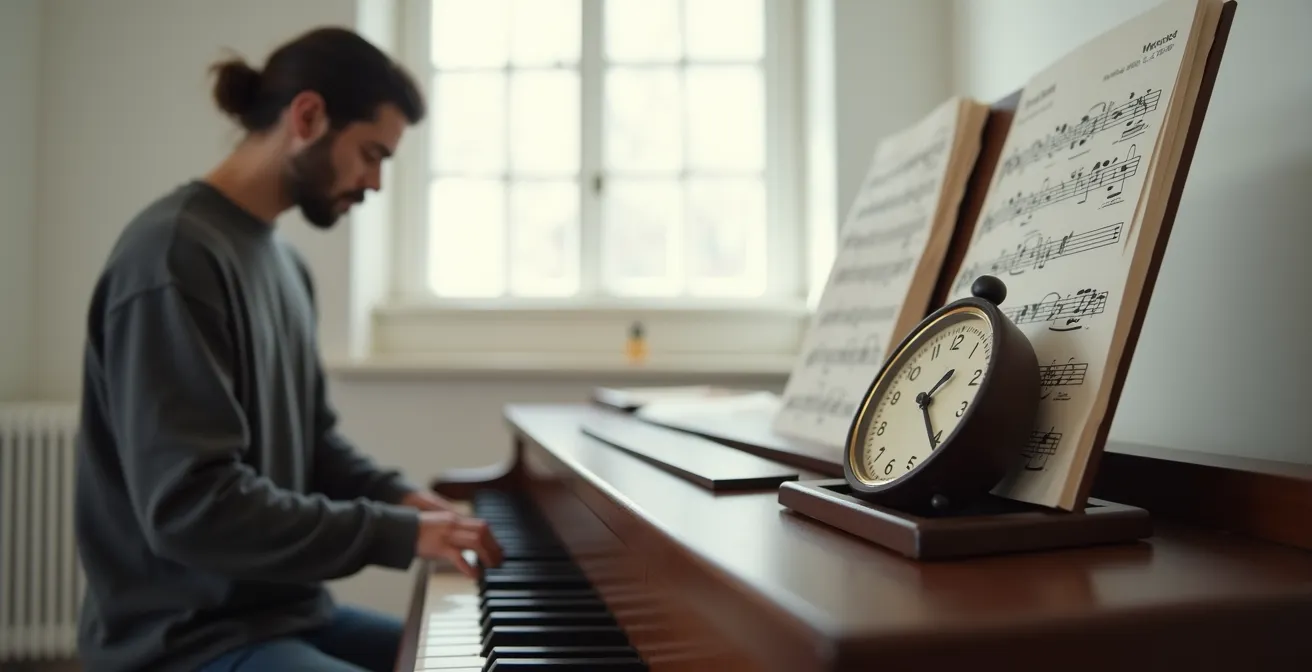
As the image suggests, the power lies in the intentionality of the time, not just its passage. This structure ensures that even on your busiest days, you are making tangible, compound progress. It respects your time while building a robust and resilient musical habit.
Apps or Teacher: Which Path Builds Better Technique Faster?
The modern learner faces a new choice: the affordability and flexibility of learning apps versus the personalized guidance of a traditional teacher. The question isn’t which is “better,” but which is better for *you* at your current stage. The answer lies in understanding what each provides and, more importantly, what it lacks. The “fastest” way to learn is to build a solid foundation, and this is where the distinction becomes critical.
Apps excel at gamification, motivation, and providing a vast library of songs to learn. They are excellent for getting started, learning basic chords, and maintaining a consistent practice schedule. However, their primary weakness is the lack of a crucial feedback loop for physical technique. An app cannot see that your wrist is bent at a bad angle, that you’re holding unnecessary tension in your shoulder, or that your posture is unsustainable. These are the small, foundational issues that, if left uncorrected, grow into major technical roadblocks later on.
A human teacher, while more expensive and less flexible, provides one irreplaceable service: real-time, personalized feedback. They can diagnose and correct those foundational physical issues before they become ingrained habits. A teacher’s role is not just to show you what to play, but to show you *how* to move your body to play it efficiently and without injury. This is an investment in your long-term progress.
The following table, based on an analysis of modern learning methods, breaks down the core differences:
| Aspect | Apps | Teachers |
|---|---|---|
| Cost | $5-20/month | $30-80/lesson |
| Flexibility | 24/7 availability | Scheduled sessions |
| Personalized Feedback | Limited AI feedback | Real-time corrections |
| Physical Technique | Cannot detect tension | Can correct posture |
| Motivation | Gamification | Personal accountability |
A hybrid approach is often the most effective. Use apps for daily practice, learning songs, and ear training, but check in with a teacher periodically (even once a month) for a “technical audit” to ensure you’re not developing bad habits.
The “Tablature Trap”: Why Relying on Tabs Stunts Your Musical Growth?
For guitarists and bassists, tablature (or “tabs”) seems like a magical shortcut. It’s a simple, visual map that tells you exactly which fret to press on which string. It allows you to play a recognizable version of a song almost immediately, providing a powerful hit of gratification. However, over-reliance on this tool is one of the most significant long-term traps for a developing musician. It teaches you imitation, not understanding.
The core problem is that tabs bypass the two most important skills in music: your ear and your brain. You are not learning to hear intervals, recognize chord changes, or understand why certain notes work together. You are simply following a set of mechanical instructions. This creates a fragile skill set; you can play the songs you have tabs for, but you are musically illiterate. You cannot improvise, write your own music, or figure out a song by ear because you haven’t developed the underlying auditory-kinesthetic feedback loop.
As one music education expert from the Equipboard Music Education Guide puts it, the distinction is fundamental to your artistic future. Their insight highlights the difference between replication and creation:
Tabs teach you how to replicate one specific song, while learning theory and reading music teaches you the principles to create your own art.
– Music Education Expert, Equipboard Music Education Guide
This does not mean you must abandon tabs entirely. They are a useful tool for checking your work or quickly learning a specific passage. The goal is to shift their role from a crutch to a reference. You must actively train your ear to be the primary tool. The following protocol helps you to start weaning yourself off of a total dependence on tabs.
Your Action Plan: The 3-Step Tab Weaning Protocol
- Listen First, Play Second: Before looking at any tab, listen to a very short phrase of a song (5-10 seconds) multiple times. Hum or sing the melody to internalize it.
- Attempt by Ear: With the sound in your head, try to find the notes on your instrument. Use your knowledge of scales and chords. This will be slow and frustrating at first, but it is the most important practice you can do.
- Verify with Tabs: Once you think you have it, or if you are completely stuck, use the tab to check your work. Don’t just read it; analyze it. Ask yourself, “Why did that note work here? What scale is this from?”
How to Set Up a Practice Corner That Triggers the Habit?
For the adult learner, the biggest battle isn’t finding the time to practice; it’s overcoming the “activation energy” required to start. After a long day, even small barriers—like taking your instrument out of its case, finding your tuner, and setting up your music stand—can feel monumental. The solution, borrowed from behavioral psychology, is to design an environment that makes starting your practice session ridiculously easy.
The goal is to apply the “2-Second Rule,” popularized by author James Clear. You should be able to go from thinking “I should practice” to actually playing a note in under two seconds. This involves creating a dedicated, permanent practice corner where your instrument is not just accessible, but is an invitation. An instrument on a stand is a visual cue that says “play me.” An instrument in a case under your bed is a chore waiting to happen. This isn’t about laziness; it’s about reducing friction to make the good habit the path of least resistance.
Your practice space should be a sanctuary, free from the distractions of daily life. It should be a place you associate with one thing and one thing only: making music. By curating this environment, you are not just setting up an instrument; you are setting up a powerful psychological trigger for your practice habit.
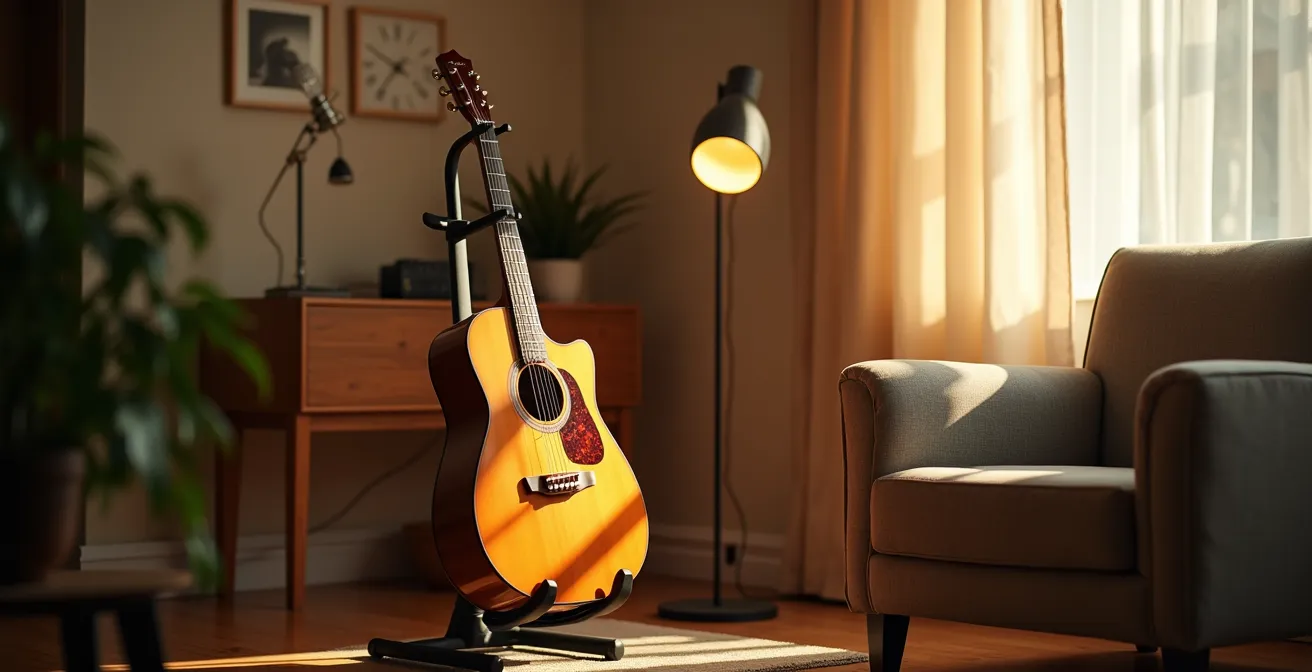
The image above captures the essence of a low-friction setup. It’s not just organized; it’s poised for action. Use the following checklist to audit your own space and eliminate every possible point of friction between you and your instrument.
- Keep your instrument on a stand, never in its case.
- Leave your music stand permanently open to the piece you are currently working on.
- Ensure your chair or stool is already positioned at the correct height.
- Place all necessary accessories (tuner, picks, metronome, capo) within arm’s reach.
- Use a dedicated practice light that you only turn on when you practice, creating a ritual.
- Remove all digital distractions. Your phone should be in another room or turned completely off.
How to Hold a Violin for 30 Minutes Without Neck Pain?
For instruments with demanding ergonomics like the violin, physical discomfort is a primary reason for quitting. Pain is a powerful demotivator. While the violin is notorious for causing neck and shoulder strain, this pain is almost always a symptom of a poor setup, not an inherent part of playing the instrument. Surviving the initial physical adaptation period requires a proactive approach to comfort and ergonomics.
The first and most critical step is getting your equipment professionally fitted. Using a generic, “out-of-the-box” chin rest and shoulder rest is like trying to run a marathon in shoes that are two sizes too big. Your unique jawline, neck length, and shoulder slope require a personalized combination of equipment. Investing in a fitting session with an experienced luthier or teacher is not a luxury; it’s a necessity for pain-free playing. The impact is significant; studies show a properly fitted chin rest and shoulder rest can reduce neck strain by up to 70%.
Even with a perfect setup, holding a new posture will tax muscles that are unaccustomed to the work. Just as an athlete stretches after a workout, a musician should perform counter-stretches to release tension built up during practice. This reactive care helps prevent acute tension from becoming chronic pain. Integrating a short, two-minute stretching routine after every practice session is a crucial habit for longevity.
Here is a simple and effective post-practice routine to counteract violin-related tension:
- Neck Rolls: Gently and slowly roll your head in a full circle, five times in each direction. Avoid any movements that cause sharp pain.
- Shoulder Shrugs: Inhale as you lift your shoulders up towards your ears, hold for five seconds, and exhale as you release them completely. Repeat 10 times.
- Upper Back Stretch: Clasp your hands behind your back, straighten your arms, and gently lift them away from your body. Hold the stretch for 20 seconds.
- Chin Tucks: Gently pull your chin straight back as if making a double chin, feeling a stretch in the back of your neck. Hold for a few seconds and release. Repeat 10 times.
Why Do 80% of Teachers Recommend Starting on Acoustic Guitar?
The recommendation to start on an acoustic guitar is a long-standing piece of musical pedagogy, but it’s often misunderstood. The advice isn’t arbitrary; it’s rooted in the principle of developing a solid technical foundation. An acoustic guitar is an unforgiving instrument. It provides raw, unadulterated auditory feedback. There are no effects, distortion, or volume knobs to hide behind. Every buzz from a poorly fretted note and every dull thud from a sloppy chord change is laid bare.
This “brutal honesty” is the acoustic guitar’s greatest teaching asset. It forces the beginner to develop clean technique from day one. As celebrated guitar educator Justin Sandercoe has often noted, this raw feedback is essential for building good habits. In his view, “An acoustic guitar provides raw, direct feedback. You can’t hide sloppy technique behind distortion or effects.” This forces you to address issues with finger pressure, hand position, and picking accuracy immediately, building a much stronger technical foundation.
However, this rule is not absolute. The single most important factor in learning an instrument is motivation. If your dream is to play blistering heavy metal solos, forcing yourself to start on an acoustic playing folk songs can kill your enthusiasm before you even begin. In some cases, the “best” instrument is the one that connects you to the music you love. This is supported by data on student retention; for instance, students wanting to play heavy metal show an 85% better retention rate when they are allowed to start on an electric guitar that inspires them.
The takeaway is nuanced. Starting on an acoustic is generally the best path for building pure technique. But if starting on an electric is the difference between practicing and quitting, the choice is clear. You can always refine your technique later, but you can’t recover lost motivation.
Key Takeaways
- The initial feeling of getting worse is a normal cognitive phase of motor learning, not a lack of talent.
- Short, highly structured 15-minute practice sessions are more effective for adults than long, unfocused ones.
- The best learning path often combines the motivation of apps with the essential technical feedback of a human teacher.
How to Memorize a 4-Page Score in Under a Week?
For a beginner, the idea of memorizing pages of music seems like a superpower. This feat, however, is less about having a “good memory” and more about employing a strategic, multi-layered memorization process. Most beginners rely on a single, fragile method: kinesthetic memory, or “muscle memory.” This is the memory of how the piece *feels* to play. While useful, it’s easily disrupted by nerves or a single mistake. True, robust memorization involves integrating two other crucial pillars.
The three pillars of musical memory are:
- Kinesthetic (Feeling): The muscle memory of your fingers moving across the instrument.
- Auditory (Hearing): The ability to hear the next phrase of the music in your head before you play it. This is your internal guide.
- Analytical (Understanding): The conscious knowledge of the music’s structure. This includes knowing the chord progression, the key signature, the form (e.g., verse-chorus-verse), and repeating patterns.
Rapid memorization happens when you actively engage all three pillars. Instead of just drilling passages repeatedly to build muscle memory, you must also listen intently and analyze the score’s architecture. Look for patterns, sequences, and harmonic relationships. Break the four-page piece down into its constituent parts. You’ll often find it’s not four pages of unique information, but perhaps one page of ideas that are repeated, transposed, and varied.

A powerful technique that leverages the analytical pillar is mental rehearsal, as it forces you to build a detailed cognitive map of the piece independent of your instrument.
Case Study: The Mental Mapping Method
Joel Snape, who began learning piano at age 40, documented his success using mental rehearsal to memorize complex pieces. By visualizing his hands on the keys and mentally ‘playing’ through the score during his daily commute—away from the piano—he was able to engage his analytical and auditory memory far more deeply. This method reduced his total memorization time by an estimated 50% compared to relying on physical practice alone. This demonstrates that a significant portion of memorization is a cognitive, not physical, task.
By consciously building all three types of memory, you transform a fragile, muscle-based skill into a robust, interconnected web of knowledge that is far more resilient and faster to recall.
Now that you understand the psychological hurdles and have a toolkit of strategies, the path forward becomes clearer. The journey of learning an instrument is a marathon, not a sprint, and surviving the initial phase is the most critical part. Your next step is to consciously apply these principles, starting with your very next practice session.