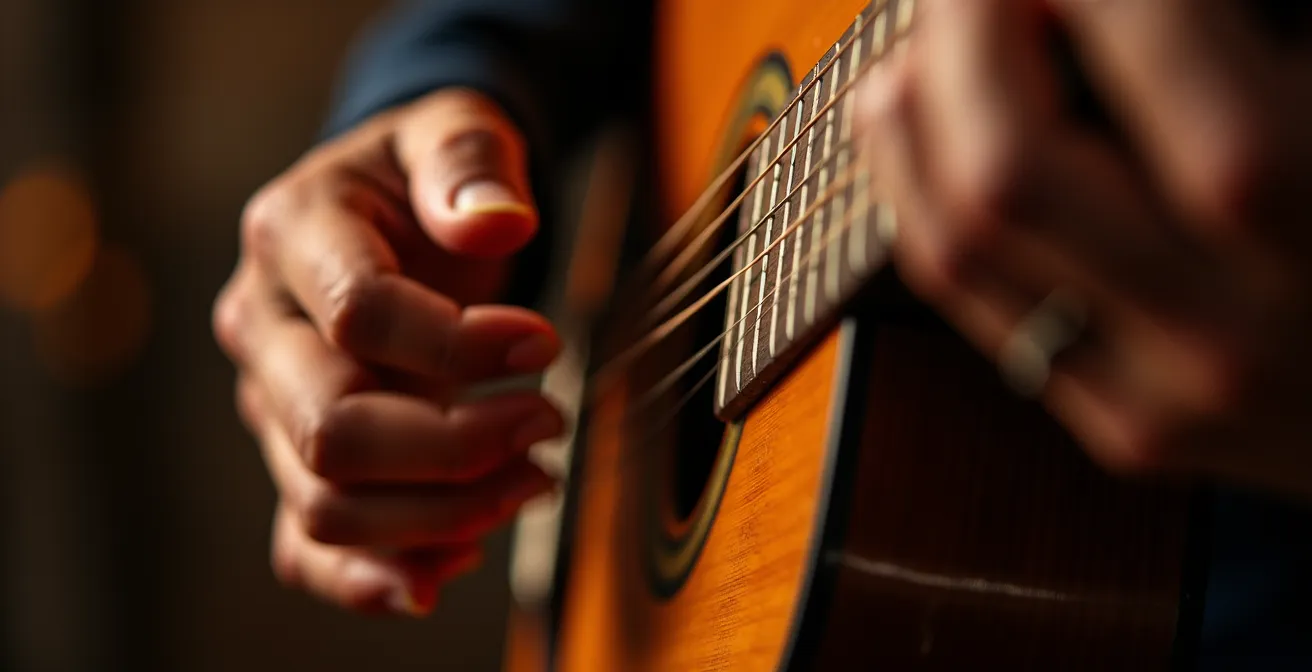
Stop trying to mechanically count Flamenco’s 12-beat compás. The secret isn’t in your head; it’s in your body. This guide reframes the compás not as a mathematical cycle, but as a passionate, rhythmic dialogue. You’ll learn to feel the ‘bodily gravity’ of the rhythm, understand the intention behind the accents, and finally internalize the pulse that separates a mere musician from a true flamencista.
There is a moment every musician new to Flamenco knows well. It’s a feeling of pure disorientation. You’re listening, you’re trying to follow, you’re counting—one, two, three, four, five, six…—and then, in a cascade of emotion from the singer or a flurry of steps from the dancer, you’re completely lost. The beat has vanished. The cycle, which seemed so logical on paper, has dissolved into a passionate chaos you can’t penetrate. You feel like an outsider looking in, baffled by a secret language.
The common advice is to “just feel it,” or to double down on the counting exercises. Many articles and teachers will present you with diagrams of the 12-beat cycle, breaking down the accents for Soleá, Alegrías, and Bulerías. They’ll tell you to clap, to use a metronome, to drill the patterns until they are second nature. And while this is a necessary foundation, it often misses the soul of the matter. It teaches the grammar, but not the poetry. It creates technicians, not artists.
But what if the very act of ‘counting’ is the wall blocking your understanding? What if the key to the 12-beat compás isn’t mathematical precision, but learning to participate in a conversation? This is the perspective we will explore. We will treat the compás not as a rigid container, but as a living, breathing pulse. It’s a dialogue of tension and release, of calling and responding, of weight and weightlessness. It is a language spoken with the entire body, not just the hands or the voice.
This guide is designed to shift your perception. We will break down why the accent placement transforms the entire mood of a piece, how performers communicate non-verbally, and why raw emotion, the famous ‘duende,’ is inseparable from rhythmic mastery. By the end, you’ll have a new framework for listening and a new path to practice—one that leads away from mechanical counting and towards an intuitive, bodily understanding of Flamenco’s heart.
To navigate this deep and passionate world, we’ll explore the fundamental questions that unlock the true feeling of the art form. This article will guide you through the core concepts, from rhythmic structure to emotional expression, providing a clear path to understanding.
Summary: The Rhythmic and Emotional Keys to Flamenco Mastery
- Why Does Moving the Accent Turn a Soleá into a Bulería?
- How to Develop the Nail Strength for Explosive Guitar Strums?
- Singer or Guitarist: Who Actually Leads the Tempo Changes?
- The “Soulless Robot” Mistake: Why Technique Without Pain Is Not Flamenco?
- How to Practice Zapateado Rhythm Without Destroying Your Knees?
- Why Do 80% of Teachers Recommend Starting on Acoustic Guitar?
- Lead or Follow: What Partner Dance Teaches About Musical Improvisation?
- How to Plan a Music Pilgrimage to New Orleans on a Budget?
Why Does Moving the Accent Turn a Soleá into a Bulería?
This is the first great mystery a student encounters. It seems like a simple shift of emphasis, but it completely changes the emotional landscape. The reason is that a Soleá and a Bulería don’t just have different accents; they have a different center of gravity. Think of the 12-beat cycle not as a circle, but as a physical space you walk through. A Soleá is profound, deep, and grounded. Its accents on 3, 6, 8, 10, and 12 create a feeling of reflection. The rhythmic weight resolves downwards, often feeling like it comes to rest on beat 3. It’s a rhythm that feels planted in the earth.
A Bulería, on the other hand, is a celebration, a jolt of energy, a forward-moving force. By shifting the main accentuation to start and resolve around beat 12 (counting 12, 1, 2, 3… with strong accents on 12, 3, 6, 8, 10), the cycle’s gravity is thrown forward. Each cycle feels like it’s launching into the next. It’s less about a reflective walk and more about a perpetual, joyful stumble forward. The famous song ‘America’ from West Side Story is a perfect example of the Bulería’s propulsive 12-count rhythm that is universally infectious.
Therefore, it’s not just a matter of moving accents. It’s about changing the entire rhythmic intention. The Soleá looks inward and downward; the Bulería looks outward and forward. Mastering this shift is about feeling where the music “lands” in your body, not just counting the beats in your head.
Your Action Plan: Feel the Soleá vs. Bulería Accent Shift
- Master the Basic 12-Beat Count: Start by counting 1-12 repeatedly with a metronome at 60 BPM, emphasizing beats 3, 6, 8, 10, 12 for Soleá.
- Practice the Soleá ‘Walking’ Pattern: Clap on 3, 6, 8, 10, 12 while feeling the resolution on beat 1 or 3 as your ‘rest point’.
- Shift to Bulería’s Forward Motion: Keep the same 12 beats but start your count from 12 (12, 1, 2, 3…), accenting 12, 3, 6, 8, 10.
- Feel the ‘Launching Point’: Practice resolving phrases on beat 12 instead of beat 3, creating perpetual forward momentum.
- Apply Harmonic Changes: Practice chord changes that resolve on beat 3 for Soleá, then shift them to resolve on beat 12 for Bulería.
Ultimately, one is a profound statement, the other a joyous exclamation. The accents are merely the punctuation that defines which it will be.
How to Develop the Nail Strength for Explosive Guitar Strums?
The explosive sound of a Flamenco guitarist’s rasgueado is iconic. It’s a percussive, cascading strum that seems to erupt from the instrument. Many aspiring players believe this comes from brute force, attacking the strings with aggression. This is a misunderstanding that leads to broken nails and a harsh, uncontrolled sound. The real secret is in developing a combination of nail resilience and hand independence, not raw power.
First, nail care is paramount. Your nails are your plectrums. They must be shaped, filed, and often reinforced. Many professional guitarists use layers of silk and superglue or professional acrylics not just for strength, but to achieve a specific tone—a bright, crisp attack. But beyond a hard surface, the technique lies in the wrist and fingers. An explosive strum is not a single, forceful movement of the arm. It is a rapid, controlled sequence of individual finger strokes, each one a small, precise flick. The power comes from the velocity of these flicks, not the force behind them.
The hand must be trained to be both tense and relaxed simultaneously. The fingers (e-a-m-i) must be strong and independent, yet the wrist must remain loose and fluid, acting as a shock absorber and a pivot for the entire motion. This allows for the machine-gun-like precision of a rasgueado without exhausting the muscles or creating a stiff, lifeless sound. It’s the art of creating an explosion through a series of controlled, tiny detonations.
This image captures the intense physical dialogue between flesh, nail, and string. It is a moment of controlled power, not brute force.
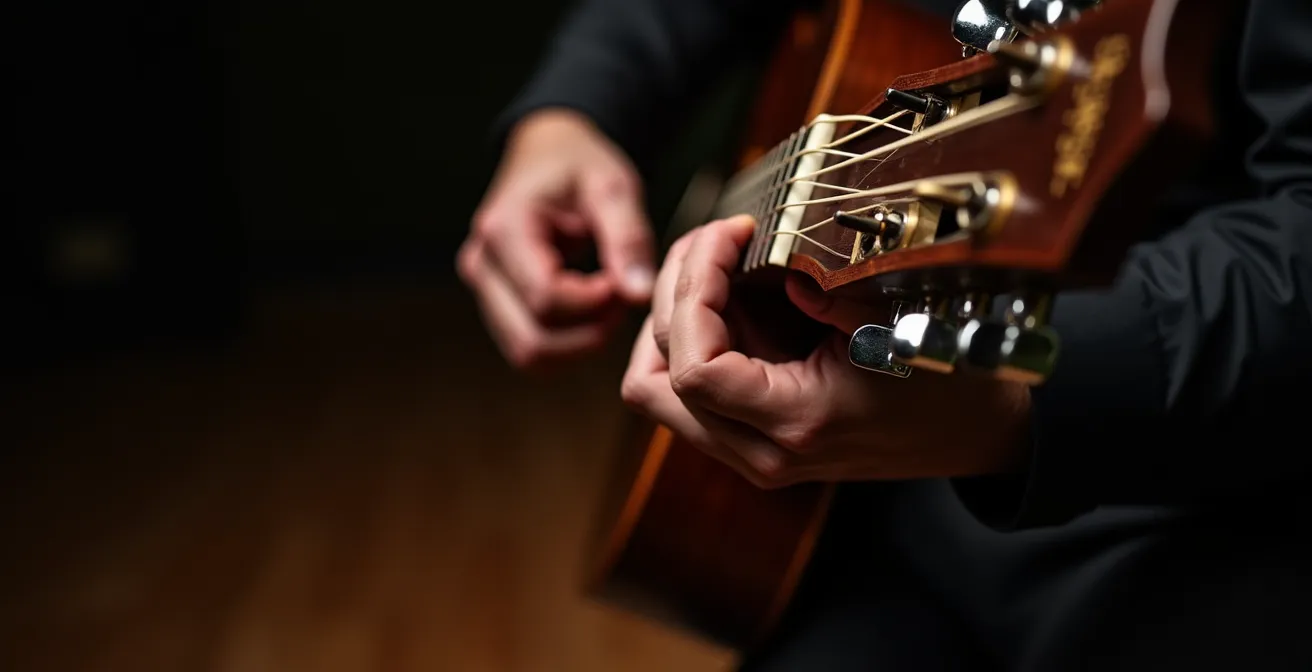
As you can see, the power of the rasgueado is born from a precise and intensely focused hand position. The strength is channeled through the fingers, but the expression remains in the subtle control of the entire hand, turning a simple strum into a rhythmic statement.
Forget about hitting the strings hard. Instead, focus on flicking them fast, with grace and precision. The volume and explosion will follow as a natural consequence of a well-honed technique.
Singer or Guitarist: Who Actually Leads the Tempo Changes?
For the uninitiated, a Flamenco performance can seem chaotic. The tempo swells and recedes, pauses hang in the air, and a furious passage can halt on a dime. This begs the question: who is in charge? The answer is a beautiful and complex “it depends.” Flamenco is not a dictatorship; it is a dynamic, three-way conversation between the singer (cantaor/a), the guitarist (tocaor/a), and the dancer (bailaor/a).
Traditionally, the singer holds the primary emotional and structural authority. The cante (song) is the soul of Flamenco. A singer can stretch out a single syllable, an “Ay,” over what feels like an eternity, and the guitarist must follow, breathing with them, supporting the emotion while never losing the underlying compás. This is the heart of the dialogue: the singer provides the emotional narrative, and the guitarist provides the rhythmic container for that narrative.
However, this hierarchy is not absolute. The guitarist can signal the end of a section with a sharp, decisive chordal passage called a remate. More dramatically, the dancer can seize control of the entire performance. With a powerful, stomped “call” known as a llamada, the dancer demands the full attention of the musicians. During an escobilla (a prolonged, intricate footwork section), the dancer becomes the primary percussionist, setting a new tempo with their feet that the guitarist and singer are obligated to follow. This constant, fluid exchange of leadership is what gives a live Flamenco performance its electrifying, unpredictable edge.
The following table breaks down some of the common non-verbal cues in this intricate dialogue, showing how performers listen with their eyes as much as their ears.
| Performer | Signal Type | Meaning | Response Required |
|---|---|---|---|
| Singer (Cantaor) | Elongated ‘Ay’ | Request to slow tempo | Guitarist follows with ralentando |
| Guitarist | Sharp remate | End of section | Return to base tempo |
| Dancer | Llamada (call step) | Attention command | All performers focus on dancer |
| Dancer | Escobilla start | Setting new tempo | Musicians must follow dancer’s rhythm |
So, who leads? Everyone and no one. The leader is the one who has the most compelling thing to say at any given moment. The responsibility of the others is to listen intently and respond with heart.
The “Soulless Robot” Mistake: Why Technique Without Pain Is Not Flamenco?
There comes a point in every dedicated musician’s journey where their technique becomes flawless. They can play the notes perfectly in time, their chords are clean, their rhythm is metronomically precise. And yet, when they play Flamenco, something is profoundly missing. The music is correct, but it is dead. This is the “soulless robot” mistake: mastering the science of Flamenco without embracing its spirit. The “pain” in the title is not about physical suffering; it is about pellizco—a Spanish term meaning “pinch,” which in Flamenco refers to a jolt of raw, authentic emotion.
Technique is the vehicle, but pellizco is the fuel. It is the micro-timing deviation that communicates emotion—playing a fraction of a second ahead of the beat (adelante) to convey urgency, or pulling back slightly (atrás) to express longing. It is the “dirty” note, the slight buzz of a string or the rasp in the singer’s voice that adds a layer of human imperfection and vulnerability. It’s the understanding that the space, the aire, between the notes is as important as the notes themselves. This emotional authenticity cannot be faked or simply added on top of perfect technique; it must be born from it.
As one guide notes, this is an elusive quality. A writer for HobbyLark’s Flamenco Dance Guide puts it aptly:
Unfortunately, it’s not something that can be taught, but the more you listen to flamenco music and become familiar with the compás, the better you’ll get at hearing the ‘sweet spot’.
– HobbyLark Flamenco Dance Guide, Flamenco Dance Technique: Mastering the Compás
While it can’t be taught like a formula, one can practice creating the conditions for it to appear. It requires breaking free from the fear of making a mistake and learning to play with the rhythm, to bend it without breaking it. This is the “pain” of Flamenco: the willingness to be vulnerable, to sacrifice robotic perfection for a moment of genuine, heart-stopping connection.
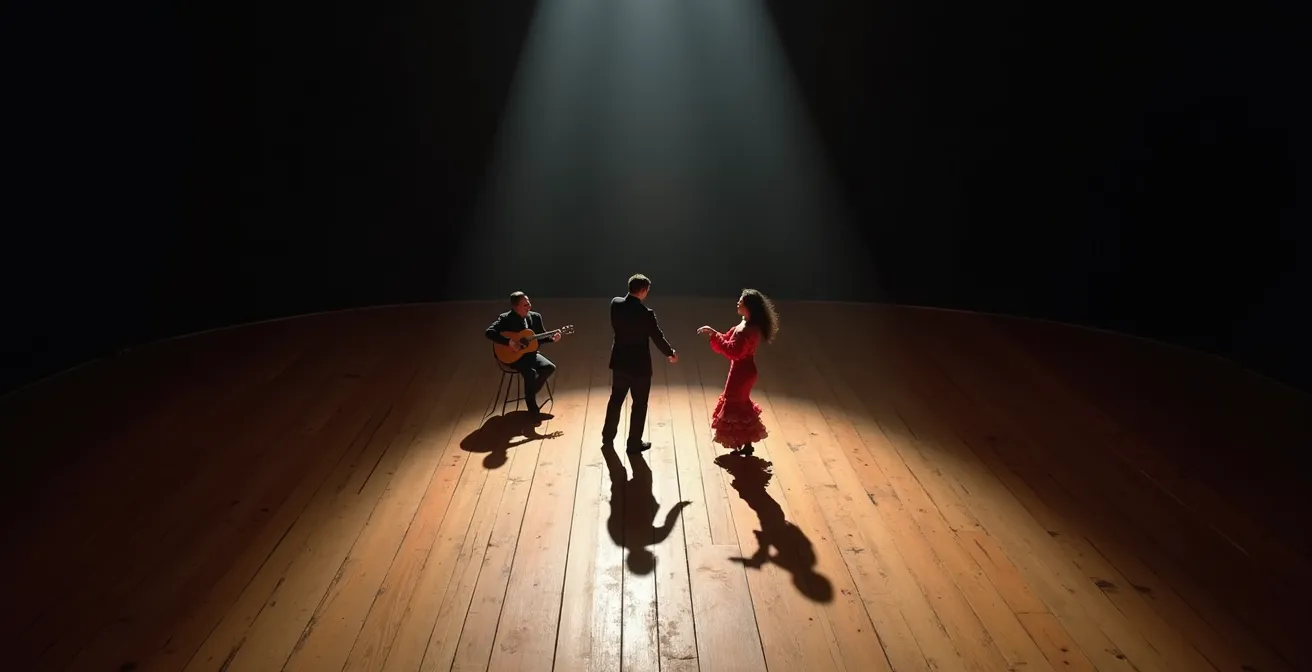
Without this emotional risk, you are merely playing notes. With it, you are telling a story. And that is the very essence of Flamenco.
How to Practice Zapateado Rhythm Without Destroying Your Knees?
The zapateado, the intricate footwork of Flamenco, is a thunderous and hypnotic part of the art form. For the spectator, it is pure percussive power. For the beginner, it can be a quick path to knee pain, shin splints, and frustration. The common mistake is to think of zapateado as “stomping” or generating sound from the brute force of the leg muscles. This approach is both unsustainable and musically limiting. The key to a healthy and expressive zapateado lies in a principle from martial arts and other somatic practices: generate power from the core and use gravity.
A true flamencista’s footwork is not powered by the quadriceps. Instead, the movement is initiated from the hips and the core. The leg is relaxed, and the sound is produced by letting the foot “fall” onto the floor with controlled weight. This is the concept of dejarse caer, or “letting yourself fall.” By using body weight and gravity, you can create a huge range of sounds—from a deep, resonant heel drop (tacón) to a sharp, crisp toe tap (punta)—without the repetitive, damaging impact that comes from muscular tension.
Furthermore, the upper body must remain calm and expressive. A tense upper body is a sign that you are forcing the movement from the wrong place. The goal is to create a separation: the lower body is a precise, powerful percussion instrument, while the torso, arms, and head remain fluid and emotionally expressive. Practice should begin slowly, on a sprung floor or a piece of wood placed on carpet, focusing on the quality of sound, not the volume. Master the rhythm with your hands (palmas) first, so the compás is in your soul before you ask your feet to speak it.
This progressive approach builds the necessary foundation safely:
- Month 1: Master the 12-beat compás through palmas only – build internal rhythm before any footwork.
- Month 2: Practice on soft surfaces (carpet with cardboard) focusing on sound clarity at low volume.
- Month 3: Hip-initiated movements – practice ‘dejarse caer’ (letting yourself fall) using body weight, not leg muscles.
- Month 4: Alternate between strong (tacón) and soft (planta) strikes to reduce repetitive impact.
- Month 5: Integrate palmas while doing simple footwork to maintain rhythmic precision without overthinking feet.
Remember, the goal is not to punish the floor. It is to make it sing in perfect time with your heart.
Why Do 80% of Teachers Recommend Starting on Acoustic Guitar?
For a beginner guitarist drawn to the fiery sound of Flamenco, picking up an electric guitar or a steel-string acoustic might seem like a logical first step. They are popular, versatile, and often perceived as easier to play. Yet, virtually every traditional Flamenco master will insist that a student begin on a nylon-string “classical” or Flamenco guitar. This isn’t just snobbery or a rigid adherence to tradition; it is a fundamental pedagogical principle designed to build a proper foundation from the ground up.
The reason is simple: nylon-string guitars are unforgiving in the best possible way. They have a wider neck, which forces the fretting hand to develop proper stretching and positioning. Their softer nylon strings have less sustain and a quieter, more delicate tone. This means the player cannot rely on amplification or the natural resonance of steel strings to create a powerful sound. All the rhythm, dynamics, and tone must be generated by the hands alone. This forces the student to develop a strong, precise, and nuanced right-hand technique from day one. You learn to make the guitar sing, shout, and whisper using only flesh and nail.
This requirement is so fundamental that professional instructors often make it a prerequisite. It’s a non-negotiable part of the curriculum, as 100% of traditional flamenco courses require nylon-string guitars for this very reason. Starting on an electric guitar teaches you to rely on volume knobs and effects pedals. Starting on a steel-string teaches you to rely on the bright, loud character of the strings themselves. Starting on a nylon-string guitar teaches you to rely on one thing: yourself. It builds the “engine” of your rhythmic expression directly into your hands.
It may feel more difficult at first, but this path builds the strength, control, and rhythmic sensibility that are the absolute bedrock of authentic Flamenco guitar playing.
Lead or Follow: What Partner Dance Teaches About Musical Improvisation?
Improvisation within the strict 12-beat framework of Flamenco can feel like a paradox. How can you be free and constrained at the same time? The answer can be found by looking at the dynamics of partner dancing. In a dance like salsa or tango, two people move as one, not because one is a mindless puppet, but because they share a common language of frame, rhythm, and intention. They are both leading and following simultaneously. This is the perfect metaphor for musical improvisation in Flamenco.
The compás is the “dance floor” and the “embrace.” It is the non-negotiable structure that all performers agree to inhabit. As the Flamenco Wiki states, it’s the absolute foundation: “The compás is fundamental to flamenco. It is the basic definition of the music and without it, there is no flamenco.” Within this shared space, musicians “dance” with each other. A guitarist doesn’t just play “at” a singer; they respond to the singer’s breath, the emotional weight of a word, the subtle lift of a phrase. This is the “follow” part of the dance.
The “lead” comes in how you choose to respond. Do you fill a moment of silence, or do you honor it by extending it, creating more tension? This is the concept of aire (air/space), which is as crucial as the notes themselves. Leaving intentional space is a powerful musical statement, a confident lead that invites the other performer to step in. A successful improvisation is not a series of monologues but a rich conversation, full of interruptions, affirmations, questions, and thoughtful pauses. It requires listening with your whole body—to the dancer’s weight shift, the singer’s intake of breath, the guitarist’s preparatory chord change.
- Listen with your whole body: Watch for singer’s breathing patterns and dancer’s weight shifts as musical cues.
- Create conversational pauses: Leave intentional silence after another performer’s phrase before responding.
- Maintain the ’embrace’: Stay connected to the compás even during silence, like dancers maintaining frame.
- Practice role reversal: Guitarists practice following recorded singing; singers practice following solo guitar.
- Master the art of ‘aire’: Know that leaving space is as important as filling it with sound.
Stop thinking about your solo. Start thinking about your next step in the dance. Listen for your partner’s invitation, and when you respond, do it with clarity and intention.
Key Takeaways
- The 12-beat compás is not a math problem but a rhythmic conversation felt in the body.
- Emotional expression (pellizco) is achieved through subtle, intentional manipulation of perfect rhythm, not just passion.
- Leadership in Flamenco is a fluid dialogue; performers constantly lead and follow based on listening.
How to Plan a Music Pilgrimage to New Orleans on a Budget?
At first glance, this question seems to have parachuted into the wrong conversation. We have been deep in the passionate, structured world of Andalusian Flamenco—what does a budget trip to the cradle of jazz have to do with it? Everything. By stepping outside our immediate subject, we can understand it more deeply. Both Flamenco’s compás and New Orleans’ “Second Line” groove are more than just rhythmic patterns; they are cultural philosophies of rhythm that grew from the ground up, in the streets, among the people.
Planning a music pilgrimage, whether to the tablaos of Seville or the jazz clubs of the French Quarter, is about immersing yourself in the city’s rhythmic soul. In New Orleans, this means understanding the loose, rolling, and inherently processional 4/4 syncopation that drives a Second Line parade. It’s a rhythm of collective joy and forward momentum. In Andalusia, it’s about finding a late-night juerga (a spontaneous flamenco gathering) and feeling the intricate, cyclical 12-beat compás that structures emotion into art. One is a joyous march, the other a complex, introspective dance.
Both teach a vital lesson: true rhythm is learned through immersion, not just instruction. A budget-conscious pilgrimage forces you away from the expensive, polished tourist shows and into the authentic heart of the music. In New Orleans, it means skipping the pricey club cover and instead finding a Sunday street parade. In Seville, it means forgoing the dinner-and-a-show for a crowded, standing-room-only bar in the Triana district where locals share their art for the love of it. An academic comparison highlights these deep cultural differences in their approach to rhythm.
This table contrasts the two rhythmic philosophies:
| Element | Flamenco Compás (Andalusia) | Second Line (New Orleans) |
|---|---|---|
| Basic Structure | 12-beat cyclical pattern | 4/4 rolling syncopation |
| Cultural Philosophy | Intricate formal structure | Loose processional groove |
| Learning Method | Formal study + juerga participation | Street immersion + jam sessions |
| Hand Percussion | Palmas (structured clapping) | Tambourine/cowbell patterns |
| Budget Learning | Free juergas in Triana, Seville | Street parades on Sundays |
Ultimately, both journeys lead to the same truth. To understand the rhythm, you must walk the streets where its heart beats. Stop counting the beats and start listening to the pulse of the city. That is where the real music lives.