Adding jazz chords to pop isn’t about complexity; it’s about strategically controlling emotion through harmonic storytelling.
- Familiar 4-chord structures should still form the foundation of your song (the 80/20 rule).
- Sophistication comes from subtle additions like 7ths, 9ths, and smooth voice leading, not from replacing entire progressions.
Recommendation: Start by introducing a single major 7th or minor 7th chord into a pre-chorus to feel its emotional effect before attempting more complex substitutions.
As a songwriter, you’ve felt it. That nagging sense of boredom with the same four chords, the I-V-vi-IV progression that seems to power the entire pop universe. You hear the rich, emotive harmonies in R&B, lo-fi, and even some forward-thinking pop, and you want a piece of that harmonic color. But then the fear creeps in: if you stray too far with complex jazz chords, will you leave the mainstream listener behind? Will your song become an academic exercise instead of an emotional experience?
The common advice is to “add some 7ths” or “try a ii-V-I,” but this often leads to clunky, out-of-place progressions that feel bolted-on rather than integrated. The real solution isn’t about memorizing a dictionary of jazz voicings. It’s about shifting your perspective. It’s about seeing chord progressions not as a set of rules, but as a form of harmonic storytelling. The goal is to learn how to guide the listener’s ear, to build tension with purpose, and to deliver a release that feels both surprising and deeply satisfying.
But what if the key wasn’t about replacing your pop toolkit, but upgrading it? What if the secret lies not in choosing between simple and complex, but in mastering the artful blend of both? This approach allows you to retain the magnetic pull of pop while introducing moments of breathtaking harmonic depth. It’s a way to make your music more interesting to you as a creator and more memorable for your audience.
This guide will deconstruct the principles that make this blend possible. We will explore how to use specific chord extensions to create mood, how to move between them with grace, and when to deploy a moment of harmonic surprise for maximum emotional impact. You will learn to think like a composer, using harmony to serve the song’s narrative.
To help you navigate these concepts, this article is structured to build your understanding from the ground up. The following sections will guide you through the essential techniques for weaving sophisticated harmony into a pop framework, ensuring your music gains depth without sacrificing its connection to the listener.
Summary: A Songwriter’s Roadmap to Jazzy Pop Harmony
- Why Are 7th and 9th Chords Essential for the Lo-Fi Hip Hop Sound?
- How to Move Between Complex Chords Without Jumping Around the Keyboard?
- Tension or Release: Which Moment Defines the Emotional Payoff?
- The “Muddy Cluster” Mistake: Why You Should Avoid Extensions in the Bass?
- When to Swap a V Chord for a Triton Substitution for Maximum Surprise?
- Why Do Simple Melodies Sound Better With Overdrive?
- How to Use LFOs to Add Life to Static Pad Sounds?
- Why Do the Same 4 Chords Appear in 80% of Billboard Top 100 Hits?
Why Are 7th and 9th Chords Essential for the Lo-Fi Hip Hop Sound?
Before diving into complex theory, let’s look at a genre that has masterfully woven jazz harmony into a mainstream, accessible format: lo-fi hip hop. The entire mood of this genre—nostalgic, mellow, and slightly melancholic—is built upon the foundation of 7th and 9th chords. These aren’t just random additions; they are the primary colors used to paint the genre’s signature emotional landscape. A simple minor triad feels sad, but a minor 7th chord feels like a memory. A major triad is happy, but a major 7th is dreamy and contemplative.
The 9th extension adds another layer of “harmonic surface area,” a term that describes the richness and complexity of a chord’s sound. It introduces a gentle, often beautiful dissonance that captures the ear’s attention without being jarring. This is a perfect entry point for pop songwriters because it demonstrates how an extension isn’t just “one more note”—it’s a tool for emotional specificity. The global success of channels like Lofi Girl, which has attracted nearly 2 billion views, is a testament to the fact that audiences are not only ready for these sounds, but actively seek them out for focus and relaxation.
To start incorporating this sound, you can follow a few simple principles. Begin your progressions with minor 7th chords to instantly create that nostalgic feeling. From there, experiment with adding the 9th. Notice how it changes the emotional weight of the chord. Another key technique is parallelism, where you move the same chord shape up or down by semitones. This creates a smooth, flowing transition that is a hallmark of the lo-fi sound. Finally, keep the movement between the notes of each chord minimal; often, only one or two notes need to change to get to the next chord, creating a seamless and hypnotic effect.
By studying lo-fi, you learn the first rule of sophisticated pop: extended chords are most effective when used to consistently support a specific, desired emotion.
How to Move Between Complex Chords Without Jumping Around the Keyboard?
One of the biggest giveaways of a songwriter awkwardly forcing jazz chords into pop is clunky, disjointed transitions. The music suddenly lurches from a simple triad to a dense 9th chord, and the listener is jolted out of the experience. The solution to this is a fundamental concept in jazz harmony: voice leading. Think of it as the art of creating a smooth, melodic path for each individual note within a chord progression. Instead of your whole hand jumping from one shape to another, you aim for minimal movement.
The secret to great voice leading lies in prioritizing the most important notes that define a chord’s character: the 3rd and the 7th. These are known as guide tones. When you move from one chord to the next, your primary goal is to connect these guide tones as smoothly as possible, often by moving them only a step or a semitone. The root note, which pop musicians often fixate on, is actually the least important for the right hand to play; it can be handled by the bassline or the left hand on a piano. This “split brain” approach—where the bass provides the foundation and the right hand handles the colorful harmony—is what allows jazz progressions to flow so elegantly.

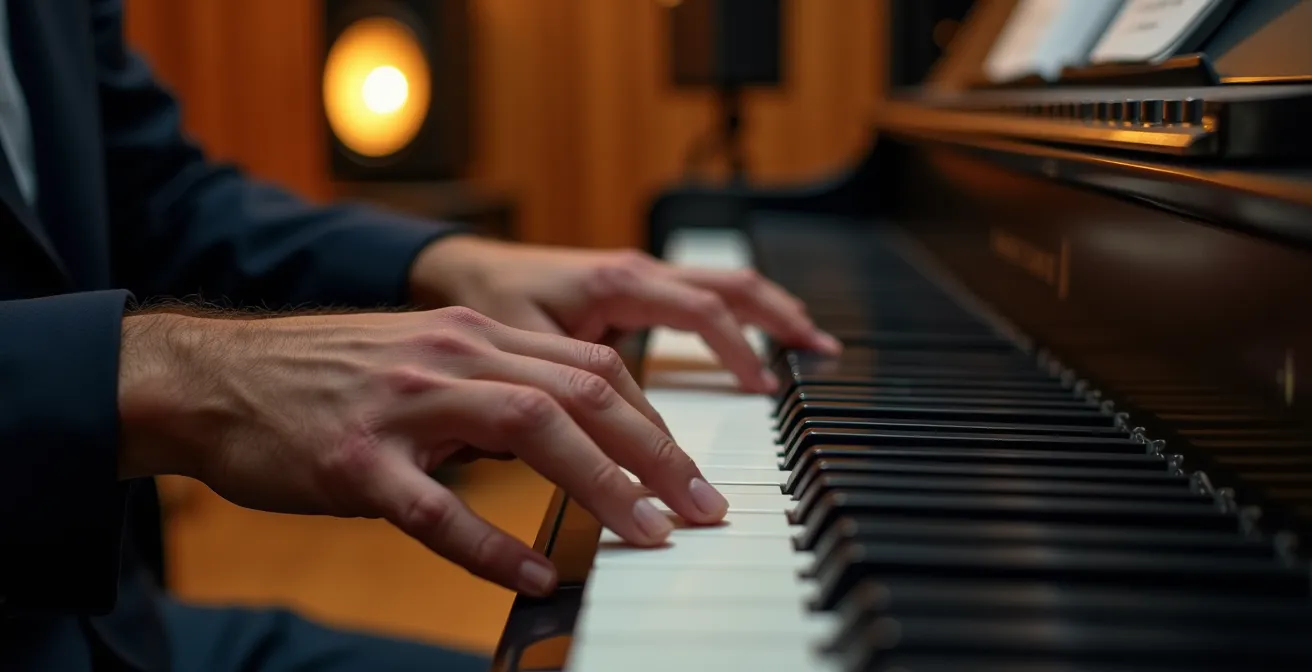
As the image above suggests, this creates smooth, almost invisible lines between chords. A powerful technique is to identify “common tones”—notes that are shared between two consecutive chords—and keep them in the same position. This acts as an anchor, further enhancing the feeling of a seamless transition. By focusing on guide tones and common tones, you create a sense of harmonic gravity, pulling the listener effortlessly through even the most complex changes.
To better understand this, consider the different approaches to chord movement.
| Aspect | Traditional Approach | Jazz Voice Leading |
|---|---|---|
| Movement Style | Often large jumps between chords | Minimal movement, 1-2 notes maximum |
| Focus Notes | Root and fifth emphasized | 3rd and 7th (Guide Tones) prioritized |
| Hand Distribution | Both hands move together | Split Brain: Left handles roots, right stays clustered |
| Common Tones | Sometimes maintained | Always anchor common tones between chords |
| Complexity Level | Simple triads sufficient | Extended harmonies (9ths, 11ths) preferred |
This isn’t just a technical exercise; it’s an aesthetic choice. Smooth voice leading is what makes sophisticated harmony sound expensive and elegant, rather than clumsy and academic.
Tension or Release: Which Moment Defines the Emotional Payoff?
At its core, all music is a dance between tension and release. Pop music typically creates this with simple, powerful resolutions, most commonly the V chord resolving to the I chord (G to C in the key of C). Jazz harmony takes this fundamental principle and elevates it into a more nuanced form of harmonic storytelling. The emotional payoff isn’t just in the final release; it’s in the journey of building and resolving tension along the way. The most powerful and common vehicle for this journey in jazz is the ii-V-I progression.
This progression is so foundational that a deep analysis of jazz standards confirms the most common chord progression in all of jazz standards is called the ii-V-I. In the key of C major, this would be Dmin7 (ii) – G7 (V) – Cmaj7 (I). The magic lies in the voice leading between these chords. As the Musiversal Music Production Team explains in their guide to jazz chord progressions, “The third in the opening ii chord becomes the seventh of the dominant7, then the 7th becomes the third in the tonic.” This chain reaction of guide tones creates a powerful sense of forward motion and an incredibly strong, satisfying resolution.
The beauty of the ii-V-I is that it’s a modular storytelling device. You can insert it almost anywhere in a pop song to create a moment of sophisticated resolution, often leading into a chorus or a new section. It feels familiar enough to the ear (due to the strong V-I cadence) but adds a layer of harmonic preparation with the ii chord. This isn’t a niche concept anymore. From R&B stars like SZA and H.E.R. to pop icons like Dua Lipa and Harry Styles, artists are increasingly using these moments of jazz-inflected tension and release to make their music stand out. They understand that a well-placed harmonic journey is the key to creating a memorable emotional payoff.
The lesson is clear: don’t just think about what chords you’re playing, but about the emotional story you are telling with the tension you build and the release you provide.
The “Muddy Cluster” Mistake: Why You Should Avoid Extensions in the Bass?
As songwriters get excited about adding 9ths, 11ths, and 13ths, they often make a critical mistake: they put them everywhere, including in the low-end. This leads to what’s known as the “muddy cluster”—a thick, dissonant sound in the bass register that clouds the entire mix. The low frequencies of a song are its harmonic foundation. This foundation needs to be clear, stable, and unambiguous. The human ear has a harder time distinguishing between closely-spaced notes in lower registers, so adding complex extensions below middle C is a recipe for sonic confusion.
The principle to follow is “Register-Specific Voicing.” Let the bass handle the fundamental work: outlining the root of the chord, or simple root-fifth intervals. This provides a solid anchor for the listener. Meanwhile, the upper-register instruments (piano, guitar, synths) are free to provide the harmonic color with 7ths, 9ths, and other extensions. This separation of duties ensures that the final sound is both rich and clear. The bass provides the stability, while the other instruments provide the sparkle.

For a solo piano context, a common technique to avoid this “mud” is to use Shell Voicings in the left hand. Instead of playing a full, dense chord, you play only the most essential notes that define the harmony: the root, the 3rd, and the 7th. This simple three-note “shell” provides all the necessary harmonic information without cluttering the low end, leaving the right hand free to explore melodies and more colorful extensions in the upper register. Adhering to these rules for clean bass voicing is one of the quickest ways to make your arrangements sound professional and intentional.
To maintain clarity in your arrangements, follow these essential guidelines:
- Rule 1: Keep the bass register simple – use only root notes or root-fifth intervals below middle C.
- Rule 2: Apply the ‘Register-Specific Voicing’ principle – bass handles foundation while upper instruments provide color.
- Rule 3: For solo piano, use Shell Voicing – play only Root, 3rd, and 7th in left hand to avoid mud.
Remember, harmony is like a painting: you need a solid canvas (the bass) before you can start adding vibrant colors (the extensions).
When to Swap a V Chord for a Triton Substitution for Maximum Surprise?
Once you’ve mastered the ii-V-I and the principles of voice leading, you can start introducing one of jazz’s most powerful tools for harmonic storytelling: the tritone substitution. This is the “plot twist” in your song’s narrative. In simple terms, it involves replacing the V chord in a progression with a dominant 7th chord that is a tritone away. A tritone is an interval of three whole tones (six semitones), and it’s known for its dissonant, unstable sound that desperately wants to resolve.
The magic of the tritone substitution is that the substitute chord shares the exact same guide tones (the 3rd and 7th) as the original V chord, just inverted. For example, in a ii-V-I in C (Dm7 – G7 – Cmaj7), the guide tones of G7 are B (the 3rd) and F (the 7th). The tritone substitute for G7 is Db7. The guide tones of Db7 are F (the 3rd) and Cb (which is enharmonically B, the 7th). Because they share these crucial notes, the substitution still resolves beautifully to the I chord, but it gets there via a completely unexpected path, creating a moment of maximum surprise.
So, when should you use it? The key is to be strategic. Don’t throw it in everywhere. Use it in a place where the listener has already heard the standard progression once or twice. A perfect spot is in the second or final chorus, or in the bridge, where you want to elevate the emotional intensity. By swapping the familiar V chord for its tritone substitute, you defy the listener’s expectations. This creates a sophisticated, “inside-out” feeling that pulls the ear in and makes the final resolution to the I chord feel even more earned and satisfying. It’s a single chord change that can transform a predictable progression into a memorable and defining moment of your song.
Used sparingly and with intent, the tritone substitution is one of the most effective ways to add a jolt of pure jazz sophistication to a pop framework.
Why Do Simple Melodies Sound Better With Overdrive?
As you begin to build these richer, jazz-inflected chord beds, a new problem can emerge: your simple, clean melody can get lost. The harmonic density of 7th and 9th chords can easily swallow a pure sine-wave lead or an untreated vocal. The solution often lies not in making the melody more complex, but in giving it more character and presence through saturation and overdrive. These effects do more than just add distortion; they add new harmonic content to a sound.
When you apply saturation, you are generating new overtones (harmonics) that weren’t present in the original signal. Tube saturation, for example, tends to add even-order harmonics, which the human ear perceives as warmth and richness. Tape saturation and overdrive add a mix of even and odd-order harmonics, resulting in more bite and aggression. This added harmonic content is what helps a simple melody “cut through” a dense mix. It acts as a sonic spotlight, drawing the listener’s ear to the melodic line amidst the complex chords underneath.
The process can be quite nuanced. A great technique is to use parallel processing, where you blend the original “dry” signal with the “wet” saturated signal. This gives you precise control over how much character you add, allowing you to find the sweet spot between warmth and unintelligible distortion. Furthermore, by focusing the saturation on specific frequency ranges—particularly the upper-mids between 2-5kHz—you can dramatically enhance the presence and intelligibility of a vocal or lead instrument without making the whole sound harsh. The goal is to give the melody enough harmonic edge to ride on top of the jazz chords, creating a clear and compelling focal point for the listener.
In this context, overdrive isn’t about aggression; it’s about clarity. It’s the tool that ensures your melodic story is heard loud and clear over your rich harmonic background.
How to Use LFOs to Add Life to Static Pad Sounds?
Complex jazz chords, when played as static pads on a synth or electric piano, can sometimes sound lifeless and sterile. They contain a wealth of harmonic information, but without movement, they can feel like a beautiful photograph instead of a moving film. This is where the Low-Frequency Oscillator (LFO) becomes an essential tool. An LFO is a slow-moving, inaudible signal that can be assigned to control almost any parameter of a synth, adding subtle (or drastic) movement and life to static sounds.
By modulating different parameters, you can achieve a wide range of effects that complement your jazz harmonies. For instance, assigning a very slow LFO to the filter cutoff can gently open and close the filter over several seconds. This has the effect of “smearing” some of the harsher dissonances that might appear in 11th or 13th chords, making the overall pad sound smoother and more organic. To emulate the classic wobble of a vintage Rhodes or Wurlitzer electric piano, you can assign a slightly faster LFO to the fine pitch, creating a gentle vibrato.
LFOs can also add rhythmic and spatial interest. By assigning an LFO to the volume and syncing it to your song’s tempo, you can create a pulsing tremolo effect that gives the chord pad its own internal rhythm. Assigning a slow, random LFO to the pan position will cause the sound to drift gently from left to right in the stereo field, adding a sense of space and preventing the sound from feeling stuck in the center of the mix. These techniques transform a static chord into a living, breathing element of your arrangement, adding a layer of dynamic interest that keeps the listener engaged.
The right LFO application can completely change the character of a pad sound, making it an ideal partner for your sophisticated chord choices.
| LFO Type | Target Parameter | Effect on Jazz Chords | Best Speed Setting |
|---|---|---|---|
| Slow LFO | Filter Cutoff | Smears harsh dissonances of 11th/13th chords | 0.1-0.5 Hz |
| Pitch LFO | Fine Pitch (Vibrato) | Emulates vintage Rhodes/Wurlitzer wobble | 4-6 Hz |
| Rhythmic LFO | Volume (Tremolo) | Creates harmonic pulse synced to tempo | 1/8 or 1/16 note sync |
| Random LFO | Pan Position | Adds spatial movement to static chords | 0.2-1 Hz |
Movement is the final polish. It ensures your rich harmonies don’t just sit there, but actively participate in the groove and feel of your song.
Key takeaways
- True sophistication lies in strategic additions, not wholesale replacement of pop structures.
- Smooth voice leading is the non-negotiable technique that makes complex chords sound elegant and intentional.
- Harmony is storytelling: use tension (ii-V) and surprise (tritone subs) to guide the listener’s emotional journey.
Why Do the Same 4 Chords Appear in 80% of Billboard Top 100 Hits?
This brings us back to the central dilemma. If all these sophisticated harmonic tools are available, why does popular music seem to rely on an incredibly small palette of chords? An extensive analysis of the Billboard 100, which has built a database of over 1300 entries, confirms this trend. The answer is simple: familiarity and predictability are powerful tools for creating an instant connection with a massive audience. These common progressions are the musical equivalent of a simple, universal story archetype. They work because they are deeply ingrained in our collective musical consciousness.
However, this doesn’t mean hit songwriting is creatively bankrupt. On the contrary, the modern pop landscape values subtle, intricate changes. The key to a hit that sounds both fresh and familiar is not to abandon the four-chord structure, but to tweak it. As the editorial team at How to Write Better Songs notes, “This small alteration is like adding a secret ingredient to a well-loved recipe, making it stand out from the crowd.” That “secret ingredient” is often a carefully placed jazz chord—a major 7th swapped for a standard major, or a ii-V-I leading into the chorus.
The reason these ‘new’ chord progressons work is because they are very similar to the Axis Chord Progression but they are a little bit different. And that can be the perfect recipe for a hit.
– How to Write Better Songs Editorial Team, What Chord Progressions Work Well in 2024
This is where the 80/20 rule for pop harmony comes into play. You build 80% of your song on the solid, familiar foundation of a common progression. This anchors the song for the mainstream listener. You then reserve the other 20% for your moments of harmonic sophistication. This could be a passing chord, an extended chord in the pre-chorus, or a substitution in the bridge. This approach gives you the best of both worlds: the undeniable accessibility of pop and the emotional depth of more complex harmony. It resolves the songwriter’s dilemma by reframing it: the goal is not to choose between pop and jazz, but to find the perfect, strategic blend of both.
Your Action Plan: The 80/20 Rule for Pop Harmony
- Use familiar 4-chord progressions for 80% of your song’s structure (verse, chorus).
- Reserve jazz chord substitutions and more complex movements for the remaining 20%—typically the pre-chorus or bridge sections.
- Start by adding a single 7th extension to one chord per section (e.g., changing the final G major to a G7) for subtle sophistication.
- Think of jazzier chords as “passing chords” that create a smoother transition between the main “pillar” chords of your progression.
- Save your most adventurous substitution (like a tritone sub) for a single, high-impact “surprise moment” in the song.
By embracing this philosophy, you can finally stop worrying about alienating your audience and start writing music that is as intelligent as it is infectious.