Instruments and Equipment
Every musician’s journey is shaped not just by talent and practice, but by the tools they choose to work with. Whether you’re holding your first violin, setting up a bedroom studio, or deciding between an acoustic piano and its digital counterpart, the world of musical instruments and equipment presents a landscape filled with critical decisions. The right choices can accelerate your learning and inspire creativity, while common pitfalls can drain your budget and frustrate your progress.
This comprehensive resource addresses the fundamental questions that musicians face when building their instrumental toolkit. From understanding why certain beginner instruments are worth the investment to navigating the technical complexities of recording equipment, we’ll explore the practical considerations that separate smart purchases from costly mistakes. Whether you’re concerned about maintaining wooden instruments through seasonal changes or demystifying the signal path of your first synthesizer, the principles outlined here will help you make informed decisions aligned with your musical goals.
Choosing Your First Instrument: Quality Versus Price
The instrument selection process represents one of the most consequential decisions in a musician’s development, yet it’s frequently rushed or based on incomplete information. The tension between budget constraints and quality requirements creates confusion, particularly when marketing materials promise professional results from entry-level gear.
The Hidden Cost of “Bargain” Instruments
Music stores and online marketplaces overflow with instruments at suspiciously low prices. For string instruments, this phenomenon has spawned the term VSO—Violin Shaped Objects—instruments that look superficially correct but fail to produce acceptable tone or maintain proper tuning. These items often feature poorly fitted bridges, substandard wood that won’t resonate, and construction shortcuts that make proper technique impossible to develop.
The false economy becomes apparent within weeks. A guitar with a neck that won’t stay straight forces beginners to fight the instrument rather than learn from it. A digital piano without weighted keys develops muscle memory that doesn’t transfer to acoustic instruments. The frustration these instruments create often exceeds the money saved, leading students to abandon their musical pursuits entirely.
The Rental Versus Purchase Decision
For students and adult beginners uncertain about their long-term commitment, rental programs offer a strategic middle path. This approach provides several distinct advantages:
- Trial period flexibility that allows you to confirm your interest before significant financial commitment
- Access to properly maintained, quality instruments that won’t impede your learning
- Upgrade options as your skill level advances and your needs become more specific
- Professional setup and adjustments typically included in rental agreements
The mathematics of renting become particularly favorable when you consider that many rental fees apply toward eventual purchase. A six-month rental period that costs roughly 15-20% of the instrument’s value provides invaluable information about whether this particular instrument suits your playing style, physical comfort, and musical direction.
Building a Home Studio Without Breaking the Bank
The dream of recording your own music has never been more accessible, yet the path to a functional home studio is littered with expensive detours. Understanding the correct sequence of investments and their relative priorities prevents the common pattern of accumulating gear that doesn’t work together coherently.
The Fundamental Equipment Sequence
Your first studio purchases should follow a deliberate order based on signal flow and necessity. Before chasing vintage microphone preamps or software synthesizers, establish this foundation:
- Audio interface with clean preamps and reliable drivers—your gateway between instruments and computer
- Studio monitors or reference headphones that reveal accurate frequency response
- Room treatment addressing first reflections and bass buildup
- Essential microphones appropriate to your recording needs
- Cables and stands that maintain signal integrity
This sequence prioritizes the signal chain elements that cannot be fixed later through software. An audio interface with noisy preamps will compromise every recording you make, while inadequate room treatment will mislead your mixing decisions regardless of how expensive your monitors might be.
The Room Treatment Versus Plugin Fallacy
Aspiring producers frequently fall into the trap of believing that software plugins can compensate for poor recording environments. They invest hundreds in virtual gear while recording in untreated rooms with parallel walls creating standing waves and flutter echoes. Think of it like photographing in terrible lighting while planning to “fix it in Photoshop”—you’re working against yourself from the start.
Basic acoustic treatment—strategically placed absorption panels, bass traps in corners, and diffusion for rear walls—costs less than many single plugin bundles yet improves every aspect of recording and mixing. The improvement is immediate and applies to every project you’ll ever work on, making it perhaps the highest return on investment available in studio setup.
Vintage Gear: Romance Versus Reality
The mythology surrounding vintage equipment creates a powerful temptation, particularly for beginners seeking a shortcut to professional sound. The reality is more nuanced. That 1970s analog synthesizer may possess unique character, but it likely also requires specialized maintenance, lacks the reliability needed for consistent practice, and demands technical knowledge to keep operational. For developing musicians, modern equipment typically offers better value through reliability, warranty support, and features designed for contemporary workflows.
Acoustic Instruments: Maintenance and Environmental Care
Wooden instruments are living, breathing entities that respond to their environment. The same hygroscopic properties that allow spruce and maple to vibrate sympathetically with strings also make these materials vulnerable to humidity fluctuations and temperature extremes.
Understanding Humidity’s Impact on Wooden Instruments
Wood expands when it absorbs moisture and contracts when dry. For stringed instruments, this movement manifests as several common problems. Fret buzz during winter months typically signals that the fingerboard has contracted, lowering string action beyond playable tolerances. Conversely, summer swelling can raise action to uncomfortable heights while putting stress on glued joints.
The ideal relative humidity range for most wooden instruments falls between 40-60%. Maintaining this range requires active monitoring and intervention in many climates. During heating season, when indoor air becomes desert-dry, instruments can lose moisture so rapidly that tops crack and seams separate. A hygrometer placed near your instrument storage area provides essential data for prevention.
Practical Humidification Strategies
Several approaches address humidity management, each with specific applications:
- Soundhole humidifiers for acoustic guitars, releasing moisture directly into the instrument body
- Case humidifiers that maintain stable conditions in the microenvironment where instruments spend most time
- Room humidifiers for larger collections or dedicated music spaces
- Two-way humidity control packs that both add and remove moisture to maintain specific levels
The methodology involves consistent monitoring rather than reactive intervention. Check humidity levels weekly, refill humidifiers before they’re completely dry, and avoid placing instruments near heat sources or air conditioning vents that create localized extremes.
Temperature Considerations and String Longevity
Rapid temperature changes present distinct risks beyond humidity concerns. Bringing a cold instrument into a warm room causes condensation to form on and potentially inside the instrument. This moisture can damage finish, promote mold in hidden areas, and stress structural joints. Allow instruments to acclimate gradually, keeping them in their cases for 30-60 minutes after moving between temperature zones.
String life correlates directly with playing frequency, hand chemistry, and post-playing maintenance. The simple practice of wiping strings after each session removes the corrosive combination of oils, sweat, and environmental contaminants that degrade windings and dull tone. This habit can effectively double string lifespan while maintaining the bright, clear sound that fresh strings provide.
Recording Acoustic Instruments: Capturing Authentic Character
The technical process of recording acoustic instruments demands a fundamentally different approach than electronic instruments or vocals. You’re capturing not just the direct sound from strings or soundboard, but the complex interaction between the instrument and its acoustic environment—the resonances, overtones, and subtle dynamic shadings that define musical expression.
Microphone Selection and Placement Fundamentals
Microphone placement for acoustic instruments involves finding the position where the instrument sounds most balanced and natural. This location rarely matches where players hear their own instruments—a guitarist’s ear sits far from where a microphone should be positioned for recording. Begin by listening to the instrument from various positions in the room, identifying where tone, clarity, and resonance achieve optimal balance.
For acoustic guitars, starting positions include 12-15 inches from the 12th fret, angled slightly toward the soundhole. This captures both the string attack and body resonance without the boomy low-end that results from placing microphones directly over the soundhole. Small adjustments of just a few inches can dramatically alter the tonal balance, making patient experimentation essential.
Preparation and Session Timing
Professional results begin before the microphone is placed. Instruments should be freshly tuned with stable strings—ideally strings that have been played for a few days rather than brand new strings that haven’t settled. Playing technique should be warmed up and consistent, as dynamic variations that seem expressive during performance can create mixing difficulties later.
Timing recording sessions around the instrument’s resonance patterns might seem esoteric, but wooden instruments genuinely respond differently based on temperature and how recently they’ve been played. An acoustic guitar that’s been played for 20-30 minutes typically opens up sonically, with the wood vibrating more freely. This phenomenon makes warm-up playing before serious recording a practical consideration rather than superstition.
The Compression Trap
Over-compression ranks among the most common errors in acoustic instrument recording. The dynamic range and natural breath of acoustic instruments—the way notes swell and decay, the difference between delicate fingerpicking and aggressive strumming—constitute much of their musical appeal. Aggressive compression in pursuit of loudness or consistency crushes these qualities into lifeless uniformity.
Light compression addressing only the most extreme peaks preserves the organic quality that makes acoustic instruments compelling. Think of compression as a safety net catching only what would otherwise be problematic, not as a tool to reshape the fundamental character of the performance.
Digital Instruments: Pianos, Synthesizers, and Modern Alternatives
The digital revolution in musical instruments has created entirely new categories of creative tools while offering practical alternatives to traditional acoustic instruments. Understanding where digital instruments excel and where they compromise helps musicians make choices aligned with their specific needs and constraints.
Digital Pianos: The Weighted Key Non-Negotiable
Among digital piano features, weighted keys represent the single specification that separates legitimate practice instruments from expensive toys. Piano technique depends fundamentally on the relationship between finger pressure, key resistance, and dynamic output. Unweighted keys develop muscle memory and touch sensitivity that simply don’t transfer to acoustic pianos, creating a frustrating disconnect if you ever play on traditional instruments.
Modern digital pianos employ several weighting technologies. Hammer action mechanisms most closely replicate acoustic piano feel, with heavier resistance in lower registers and lighter touch in upper octaves. This graduated resistance matches how acoustic piano actions actually function, making technical development on digital instruments directly applicable to their acoustic counterparts.
Two additional specifications deserve attention during selection: polyphony limits and sound engine quality. Polyphony—the number of simultaneous notes the instrument can produce—becomes critical in complex passages with sustain pedal. Instruments with only 32-note polyphony can cut off notes unpredictably during dense chord progressions, while 128-note or higher polyphony handles even the most demanding repertoire.
Synthesizers: Demystifying Sound Design
Synthesizers intimidate many musicians accustomed to acoustic instruments where sound production is relatively straightforward. The conceptual shift from “playing an instrument that makes its own sound” to “designing sounds then playing them” requires understanding signal flow and sound shaping principles.
Subtractive synthesis—the most common synthesis type—begins with harmonically rich waveforms then uses filters to sculpt away frequencies, creating desired timbres. The signal path follows a logical sequence: oscillators generate raw waveforms, filters remove frequency content, envelopes shape how sounds evolve over time, and modulation sources like LFOs add movement and variation. Understanding this chain demystifies the overwhelming array of knobs and parameters by revealing their functional relationships.
The methodology for reverse-engineering sounds you admire involves listening analytically. Is the sound bright or dark? That’s primarily filter settings. Does it have a sharp attack or slow swell? That’s the amplitude envelope. Is there vibrato or rhythmic pulsing? That’s LFO modulation. Breaking complex sounds into these components makes recreation systematic rather than mysterious.
Common Equipment Mistakes and How to Avoid Them
Certain purchasing and usage patterns recur with such frequency that they deserve explicit attention. Recognizing these common pitfalls helps musicians allocate resources more effectively and avoid frustration.
Gear Acquisition Syndrome—the compulsive belief that the next purchase will unlock creative breakthrough—affects musicians at all levels. The psychology is understandable: new equipment provides novelty and inspiration. But when acquisition replaces practice and skill development, it becomes a financial drain that doesn’t improve musical outcomes. The antidote involves distinguishing between gear that addresses specific creative limitations versus purchases made from vague dissatisfaction or marketing pressure.
The vintage gear trap, mentioned earlier for studio equipment, extends to instruments as well. A 1960s guitar might carry historical cachet, but unless you possess the knowledge to evaluate its structural integrity and the budget for potential restoration, modern instruments typically offer better value and reliability. Vintage instruments make sense for collectors and advanced players who understand exactly what they’re acquiring; they rarely represent wise choices for developing musicians.
Cable and signal flow optimization seems mundane compared to glamorous gear, yet poor cable management creates noise, unreliability, and workflow frustration that undermine expensive equipment. Balanced cables for longer runs, proper strain relief, and logical routing that separates power cables from audio signals prevent problems before they occur. These fundamentals cost little but preserve the signal integrity that everything else depends upon.
Listening Equipment: The Foundation of Musical Judgment
The equipment you use for critical listening—whether monitoring your own recordings or studying music that inspires you—shapes your musical development as profoundly as your instrument choice. Accurate monitoring reveals details that guide improvement, while flawed playback systems can mislead your musical decisions for years.
Speaker placement fundamentals apply whether you’re setting up studio monitors or a vinyl listening system. The equilateral triangle principle—positioning speakers and listening position as three equal points—provides the starting geometry for stereo imaging. Speakers should be pulled away from walls to minimize boundary reinforcement of bass frequencies, while angle and height adjustments optimize the frequency response at your listening position.
The ongoing debate between lossless and compressed audio formats matters more for critical listening than casual enjoyment. Compressed formats like MP3 achieve small file sizes by removing audio information that algorithms deem psychoacoustically irrelevant. For casual listening, modern compression at reasonable bitrates sounds acceptable. But for studying arrangement details, identifying mixing techniques, or training your ear to hear subtle production choices, lossless formats preserve the information that compressed versions discard.
The vinyl resurgence speaks to more than nostalgia. Vinyl playback enforces a ritual of dedicated attention—you must be present to flip sides, and you cannot easily skip or shuffle. This focused listening develops musical awareness in ways that distracted background streaming cannot match. Whether you choose vinyl, high-resolution digital files, or streaming services, the practice of attentive listening remains essential for musical growth.
Building your collection of instruments and equipment should be guided by musical necessity rather than marketing or trend chasing. Each purchase represents an investment in your creative toolkit, with implications for your practice environment, recording capabilities, and artistic development. By understanding the principles behind instrument selection, maintenance requirements, recording fundamentals, and the strategic sequence of studio building, you create a foundation that supports sustained musical growth. The equipment decisions you make today will influence your musical journey for years to come—choose thoughtfully, maintain carefully, and remember that the most important instrument is always your developing musical ear.
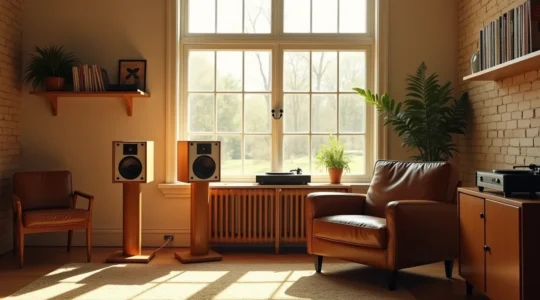
How to Set Up a Hi-Fi Listening Room for Under $1,000?
The most significant upgrades to your Hi-Fi system are free; they are your setup, your attention, and your listening skills, not more expensive gear. Perfect stereo imaging comes from precise speaker placement (the “equilateral triangle”), which costs nothing to implement….
Read more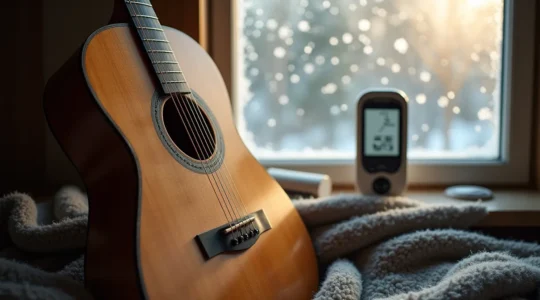
How to Prevent Your Acoustic Guitar from Cracking in Winter?
In summary: Maintain a stable environment of 45-55% relative humidity using a two-way case humidifier. Learn to spot early warning signs like sharp fret ends (“fret sprout”) and a sunken top before cracks appear. Never leave your guitar in a…
Read more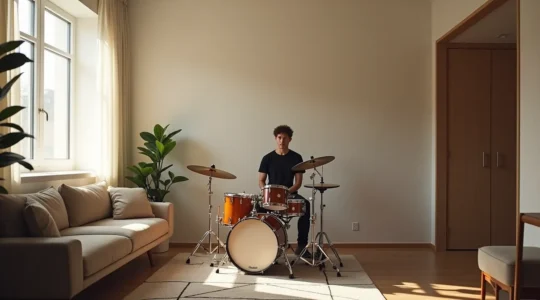
How to Practice Drums in an Apartment Without Getting Evicted?
Forget everything you’ve heard about soundproof foam—the real secret to drumming in an apartment is killing vibration at the source. Low-frequency sounds and structural vibrations from your kick drum are the main culprits that travel through floors and walls, which…
Read more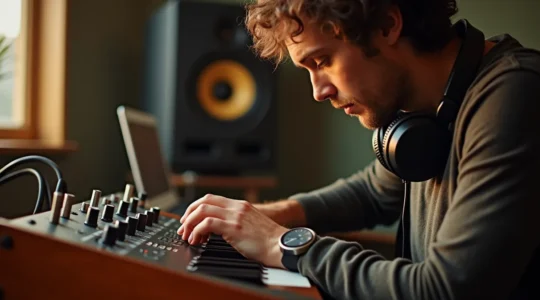
How to Create Your Own Synth Patches and Stop Browsing Presets
In summary: Stop thinking about parameters and start thinking about musical intent and sonic sculpture. Master the core components—filter, envelope, and LFOs—to shape the character and life of your sound. Build your sound dry, without reverb or delay, to ensure…
Read more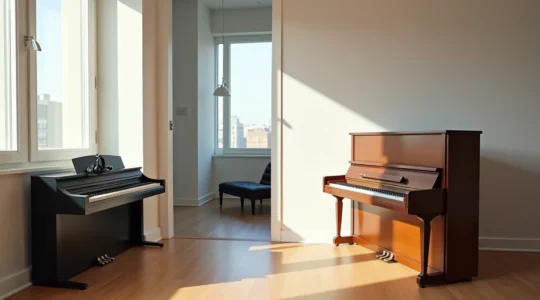
Digital Piano vs Acoustic Upright: Which Is Best for Apartment Living?
The right piano for your apartment is less about a headphone jack and more about the physics of touch, sound transmission, and environmental stability. An acoustic piano’s greatest challenge isn’t volume—it’s the structural vibration that travels through floors and its…
Read more
Acoustic vs. Electric: Which Guitar Path Should You Choose First?
Choosing your first guitar isn’t about picking acoustic *or* electric; it’s about building a foundational skillset that will serve both. Most teachers recommend acoustic first to build a “rhythmic foundation” and clean technique, which can drastically reduce the chance of…
Read more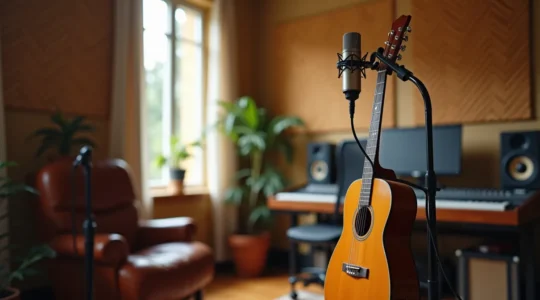
How to Record Acoustic Instruments at Home Without Room Boxiness?
In summary: Room acoustics are more critical than microphone choice; invest in effective broadband absorption first. Stereo miking offers realism, but only if phase coherence is meticulously managed to avoid cancellation. Instrument preparation—from new, stretched strings to stable humidity—is a…
Read more
Why Is Learning Violin After 30 Considered the Ultimate Musical Challenge?
Mastering the violin as an adult is less about musical talent and more about systematically dismantling the physical and psychological roadblocks your own body has built over decades. Physical progress requires “unlearning” years of postural habits before new muscle memory…
Read more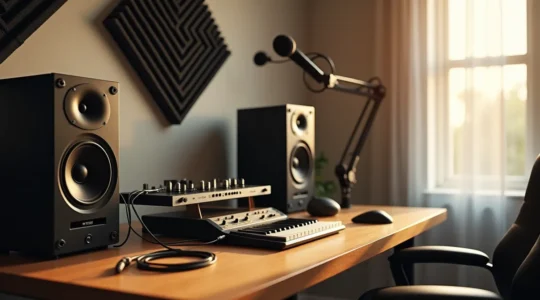
Home Studio Budget: How to Allocate $1,000 for Maximum Quality?
Building a high-quality $1,000 studio is not about a shopping list; it’s about ruthlessly prioritizing what can’t be faked with software. The biggest impact comes from your monitoring (headphones/speakers) and basic acoustic treatment, not expensive microphones or interfaces. Modern, budget-friendly…
Read more