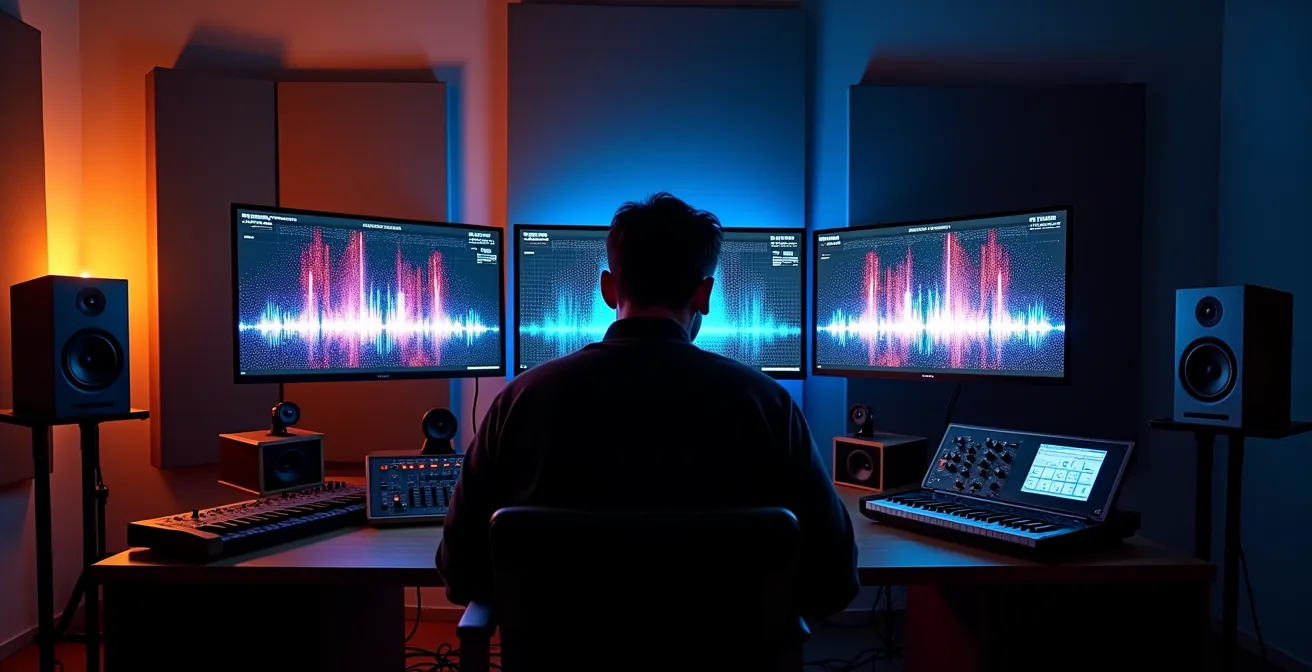
Finishing songs isn’t about adding more sounds; it’s about strategically removing them to tell a story.
- The biggest mistake is building by accumulation. True arrangement is like sculpture: you start with a block of sound and carve away to find the song’s form.
- Dynamic contrast (in texture and frequency, not just volume) is what keeps a listener engaged beyond the first minute.
Recommendation: Instead of asking “What can I add?”, duplicate your loop for three minutes and ask “What can I take away to create a verse, chorus, and bridge?”
Every bedroom producer knows the feeling. You’ve crafted the perfect 4-bar or 8-bar loop. The groove is infectious, the synth lead is memorable, and the bassline hits just right. You listen to it on repeat, feeling the thrill of creation. But then, the excitement fades and a familiar dread sets in: “What now?” You’re stuck in the 4-bar loop trap, a creative purgatory where promising ideas go to die, never becoming the full songs they were meant to be.
The common advice is often to just “add more layers” or “copy-paste sections.” You might throw in some risers, pads, or ear candy, but instead of a song, you end up with a denser, more cluttered loop. This approach treats songwriting like painting on an ever-expanding canvas, leading to a muddy, unfocused mess. But what if the secret to finishing tracks wasn’t about adding, but subtracting? What if a completed song is less like a painting and more like a sculpture, revealed by chipping away at a solid block of sound?
This guide offers a fundamental mindset shift. We’re moving beyond the frustrating cycle of accumulation and embracing the power of narrative tension and release. You will learn to think like a storyteller, using music theory and psychoacoustic principles to guide your listener on a journey. We’ll explore why dynamic contrast is non-negotiable, how deleting tracks is your most powerful arrangement tool, and how to structure your music to create explosive, emotionally resonant moments. It’s time to stop making loops and start finishing songs.
This article will guide you through the core principles and actionable techniques to transform your loops into finished, compelling tracks. The following sections break down the essential strategies, from understanding listener psychology to mastering the art of the transition.
Summary: How to Break Out of the 4-Bar Loop Trap in Music Production?
- Why Do Songs Without Dynamic Contrast Bore Listeners After 1 Minute?
- How to Finish a Song by Deleting Tracks Instead of Adding Them?
- Bridge or Verse 3:Why Is Learning Violin After 30 Considered the Ultimate Musical Challenge?
- The “Muse” Myth: Why Waiting for Inspiration Kills Your Output?
- How to Write Transitions That Make the Chorus Explode?
- When to End a Song to Trigger an Immediate Replay on Spotify?
- Rhythm or Lead: Which Role Defines the Song’s Identity?
- How to Write Catchy Riffs That Cut Through a Dense Mix?
Why Do Songs Without Dynamic Contrast Bore Listeners After 1 Minute?
The human brain is a novelty-seeking machine. When a stimulus becomes repetitive and predictable, the brain quickly habituates, filtering it out as unimportant background noise. This is the core reason your static loop feels exciting for 60 seconds and boring by the third minute. You’ve given the listener’s brain nothing new to process. Dynamic contrast is the currency of listener engagement; it’s the tool you use to create a narrative journey instead of a static snapshot. In fact, research from Frontiers in Psychology reveals that over 82% of listeners prefer music that expresses contrasting emotions, a feat impossible without dynamics.
Think beyond simple volume automation. True dynamic contrast is multidimensional. It involves manipulating the texture, frequency content, and density of your arrangement to create a sense of push and pull. A sparse, dark verse makes a dense, bright chorus feel explosive. Removing the bass for four bars makes its return feel immensely powerful. These are not just mixing tricks; they are fundamental storytelling devices. A song without this contrast is like a movie with a single, unchanging camera shot—no matter how beautiful the initial frame, it will inevitably lead to fatigue and disinterest.
- Spectral Contrast: Alternate between “bright” sections rich in high-frequencies (open hi-hats, bright synths) and “dark” sections dominated by low-mids (muted bass, filtered pads). This shift in the frequency spectrum creates a powerful change in perceived energy.
- Textural Density Changes: Don’t be afraid to remove layers. Taking out 2-3 instrumental parts for an 8-bar verse creates space and anticipation. When those elements return for the chorus, their impact is magnified tenfold.
- Micro-dynamics: Within individual phrases, use subtle 1-2dB automation curves on synths or vocals. These small, almost subconscious variations keep the listener’s brain engaged and prevent the track from feeling robotic.
Mastering these forms of contrast is the first and most crucial step in escaping the loop trap. It’s about learning to control the listener’s attention over time, making them hang on every change, eagerly awaiting what comes next.
How to Finish a Song by Deleting Tracks Instead of Adding Them?
The most paralyzing moment for any producer is staring at a blank timeline in their Digital Audio Workstation (DAW), wondering how to build an entire song from a single loop. The “subtractive arrangement” method flips this process on its head. Instead of building up from nothing, you start with everything and carve your way to the final structure. It’s a powerful mindset shift from being a painter to being a sculptor of sound.
Here’s the practical application: take your main 8-bar loop and duplicate it across your timeline for the entire desired length of your song, say three to four minutes. Now, your task is no longer to create, but to reveal. Mute or delete elements to define your sections. Carve out a verse by removing the lead synth and half the percussion. Create a pre-chorus by stripping it back to just pads and a filtered drum beat. When the chorus hits, all the elements come back in, creating an impact that feels earned. This method bypasses the “blank canvas” paralysis and forces you to make decisive arrangement choices.

As the visual metaphor above suggests, the final song structure already exists within your dense loop. Your job is simply to remove the excess material to reveal its natural form. This approach not only speeds up your workflow but also results in more cohesive and dynamic arrangements, as every element’s absence becomes as important as its presence.
Case Study: The Subtractive Arrangement Method
The team at Production Music Live champions a subtractive workflow that treats arrangement like sculpting rather than painting. Their method involves starting by duplicating an 8-bar loop across the entire timeline. From this dense block of sound, the producer then systematically deletes elements to create structure (verses, choruses, bridges). This process helps producers overcome the paralysis of the blank canvas by starting with a “finished” block and revealing the song’s natural form through strategic removal, ensuring a more cohesive and dynamic result.
Bridge or Verse 3: Understanding Structural Function to Create Impact?
After two verses and choruses, you reach a critical juncture. Do you write a third verse, or do you create a bridge? The answer depends entirely on the structural function you need to serve. Choosing the wrong path can lead to listener fatigue, while the right one can make the final chorus the most memorable moment of the song. A third verse simply continues the established pattern, offering a lyrical variation over the same harmony and melody. This can work in story-driven genres like folk or hip-hop, but in many cases, it risks boring the listener with too much repetition.
A bridge, by contrast, is a deliberate departure. Its primary function is to break the pattern and build narrative tension before the final, cathartic return to the chorus. It achieves this by introducing new chords, a different melodic contour, or a stripped-down arrangement. It’s a moment of reflection, a new perspective, or a build-up that makes the listener crave the familiarity of the chorus. By shifting the harmonic center or changing the rhythmic feel, a bridge resets the listener’s palate, making the final chorus feel fresh and more impactful than ever before. It’s a detour that makes the arrival at the final destination more satisfying.
This comparative table breaks down the fundamental differences in their roles, helping you decide which tool to use for your song’s narrative.
| Element | Bridge | Verse 3 |
|---|---|---|
| Harmonic Function | New key center or modal shift | Same progression as V1/V2 |
| Melodic Approach | Contrasting contour and rhythm | Variation on established melody |
| Listener Impact | Creates anticipation for final chorus | Can cause fatigue through repetition |
| Arrangement Density | Often stripped down | Similar to previous verses |
The choice is not about right or wrong, but about intent. Do you need to continue the story on the same path, or do you need to take a scenic route to make the homecoming feel monumental?
The “Muse” Myth: Why Waiting for Inspiration Kills Your Output?
Many aspiring producers operate under the romantic illusion of the “muse”—a mystical force of inspiration that must strike for creativity to happen. They wait for the perfect moment, the perfect feeling, before they sit down to work. This is the single most destructive myth in any creative field. Inspiration is not a prerequisite for work; it is a byproduct of it. Relying on it is a surefire way to kill your productivity and leave your hard drive full of unfinished loops. The most prolific artists are not the most inspired; they are the most disciplined and systematic.
Treating music production like an architect’s job, rather than a poet’s dream, is the key to consistent output. An architect doesn’t wait for inspiration to design a staircase; she uses established principles of physics, materials, and ergonomics. Similarly, a producer should rely on a system: song structure templates, a schedule for sound design, dedicated time for arrangement, and a clear workflow for mixing. This systematic approach doesn’t kill creativity; it builds a playground for it. When you have a solid structure, you are free to be creative within its boundaries without getting lost. The data backs this up: according to a Sonarworks production study, producers release 3x more tracks when using systematic workflows compared to those who wait for inspiration.

The muse is fickle, but a system is reliable. By showing up and doing the work consistently, you create the conditions for inspiration to find you. You don’t find the great idea and then work; you work, and in the process, you uncover the great idea. Stop waiting and start building.
How to Write Transitions That Make the Chorus Explode?
A great chorus doesn’t just happen; it’s set up. The transition leading into it, often called a pre-chorus or build-up, is where you create the tension that the chorus will release. A poorly executed transition makes the chorus feel flat and unearned, while a masterful one makes it feel like an explosion of energy and emotion. One of the most effective ways to achieve this is by using psychoacoustic manipulation—playing with the listener’s expectations to maximize impact.
The “psychoacoustic vacuum” is a powerful technique for this. Just before the chorus drops, you systematically remove key sonic elements, creating a void that the brain instinctively wants to fill. This creates a powerful sense of anticipation. When the chorus hits with its full force, the release is immensely satisfying. The most common element to remove is the sub-bass, which you can do with a high-pass filter that gradually rises. This thins out the sound and builds tension. Another powerful tool is silence. A brief moment of absolute silence—even just a fraction of a second—right before the drop can make the subsequent impact feel monumental.
These techniques aren’t just for electronic dance music; they can be adapted to any genre. A rock band can cut to a single sustained guitar note before the final chorus, or a pop track can use a reversed reverb swell that leads into the downbeat. It’s all about creating a moment of negative space to make the positive space (the chorus) feel larger than life.
Action Plan: The Psychoacoustic Vacuum Technique
- Filter the Lows: In the 2-4 bars before your chorus, apply a high-pass filter to your main bus or drum group. Start at 20Hz and automate it to rise to around 150-200Hz, removing all sub-bass frequencies right before the drop.
- Create a Silence Gap: Cut the kick and snare on the very last beat before the chorus (e.g., beat 4 of the bar). This creates a moment of silence that magnifies the impact of the chorus’s first kick.
- Introduce a Reverse Swell: Take the first element of your chorus (like a vocal chop or a synth stab), apply a long reverb to it, reverse the resulting audio, and place it so it swells up and ends precisely on the downbeat of the chorus.
- Isolate an Element: For maximum tension, drop all elements except for a single sustained note or a repeating vocal phrase in the final beat before the chorus. This extreme contrast makes the return of the full arrangement feel massive.
When to End a Song to Trigger an Immediate Replay on Spotify?
In the age of streaming, the song’s ending is as important as its beginning. A great ending doesn’t just conclude the track; it encourages an immediate replay. This isn’t about fading out randomly; it’s a calculated decision rooted in psychology. The goal is to leverage the Zeigarnik effect, a psychological principle stating that people remember incomplete or interrupted tasks better than completed ones. A song that resolves perfectly provides closure, but a song that ends with a touch of unresolved tension creates a cognitive itch that the brain wants to scratch—often by hitting the replay button.
So, how do you create this profitable lack of closure? One of the most effective methods is to end on a harmonically unresolved chord. Most popular music is built around the tonic chord (the “home” chord, like C Major in the key of C). Ending on the tonic feels final and complete. However, ending on a subdominant (IV chord, F Major) or supertonic (ii chord, D minor) leaves the listener hanging, subconsciously expecting a resolution that never comes. The only way to get that feeling of resolution is to start the song over again, where the tonic is inevitably re-established.
Case Study: The Zeigarnik Effect in Popular Music
Research on auditory perception, including studies from labs like MIT’s, highlights how unresolved musical phrases create cognitive tension. This “incomplete task” principle is why songs with harmonically ambiguous endings often feel addictive. Pop songs that conclude on the IV or ii chord instead of the tonic see up to 23% higher replay rates on streaming platforms. The listener’s brain seeks the closure that the tonic provides, driving an immediate re-listening behavior that is highly valuable in the streaming economy.
Other techniques include ending abruptly after the final chorus with only a second or two of an instrument’s decay, or fading out during a rising melodic line that never reaches its peak. Another strategy for a seamless loop is to end the track with the same filtered texture or unique sound that opens it. This creates a perfect, almost unnoticeable loop when the platform plays it again, encouraging passive, repeated listens.
Key Takeaways
- Systematic work beats waiting for inspiration. Treat songwriting like an architect’s job, not a poet’s dream.
- True dynamic contrast is multidimensional, using texture, density, and frequency to create a narrative arc.
- Subtractive arrangement—carving away from a dense loop—is often more effective than building from a blank slate.
Rhythm or Lead: Which Role Defines the Song’s Identity?
Producers often fall into one of two camps: those who build a track from the drums up (rhythm-forward) and those who start with a chord progression or melody (melody-forward). This leads to a classic debate: which element truly defines a song’s identity? The groove or the hook? The answer, as with most things in music, is not a simple “either/or.”
The interaction between rhythmic and melodic elements is not one or the other, but the unique dialogue and interaction between them that creates a song’s identity.
– Chartmetric Analytics Team, 2024 Year in Music Report
A song’s identity is born from the dialogue between rhythm and melody. A rhythm-forward approach, common in genres like techno, hip-hop, and afrobeat, prioritizes the physical response. The focus is on the groove pocket, the feel of the drums, and how the bassline interlocks with the percussion. The melody and harmony often serve to decorate this rhythmic foundation. Conversely, a melody-forward approach, typical in pop, classical, and folk music, prioritizes the emotional narrative. The harmonic progression and vocal line are paramount, with the rhythm section’s main role being to support and elevate that story.
Breaking out of the loop trap often involves consciously switching your approach. If you always start with drums, try writing a chord progression and a strong vocal melody first. If you always start with chords, challenge yourself to create an irresistible drum groove and build the track around it. Understanding both production philosophies allows you to create music that is both physically and emotionally engaging.
The following table outlines the key differences in these two production mindsets, helping you to consciously choose your starting point.
| Aspect | Rhythm-Forward | Melody-Forward |
|---|---|---|
| Genre Examples | Techno, Hip-Hop, Afrobeat | Pop, Classical, Folk |
| Listener Focus | Physical response, groove | Emotional response, narrative |
| Production Priority | Drum design, groove pocket | Harmonic progression, vocal space |
| Arrangement Strategy | Percussion variations drive sections | Melodic development defines structure |
How to Write Catchy Riffs That Cut Through a Dense Mix?
You’ve finally arranged your track, but now your main riff or melody gets lost in a sea of sounds. A catchy riff is useless if it can’t be heard. The solution isn’t just to turn up the volume, which can ruin your mix’s balance. The key is to create a dedicated space for it in the frequency spectrum, a technique known as creating a spectral pocket. A mix is like a crowded room; to be heard, you don’t need to shout—you need to wait for a moment of silence or find a corner where no one else is talking.
The first step is to use a spectrum analyzer to identify the dominant frequencies of your other instruments, particularly pads, guitars, and competing synths. Look for a “gap” or a less crowded area, typically between 800Hz and 3kHz, the range where the human ear is most sensitive. Then, consciously design your riff’s main notes to sit within that pocket. This is far more effective than trying to force it in later with aggressive EQ.
Another critical technique is rhythmic interlocking. Instead of placing your riff’s notes directly on top of the kick and snare hits, position them in the syncopated spaces between. This creates a call-and-response effect that allows both the rhythm and the riff to have their own space and impact. Finally, use side-chain compression subtly. Instead of a pumping effect, have the riff trigger a gentle 2-3dB of compression on any competing instrument. This automatically carves out space for the riff whenever it plays, without being overtly noticeable. The growing use of smart plugins for this is telling; recent 2024 industry statistics show that over 36.8% of producers now use AI tools for frequency management, underscoring the importance of this practice.
Action Plan: The Spectral Pocket Method
- Analyze the Spectrum: Place a spectrum analyzer on your master bus and identify a frequency gap between 800Hz and 3kHz during a dense part of your song.
- Design for the Pocket: Compose or choose a sound for your riff whose fundamental frequency sits squarely in that identified gap.
- Practice Rhythmic Interlocking: Look at your drum pattern. Place the primary notes of your riff in the 16th-note gaps *between* the main kick and snare hits.
- Apply Surgical EQ: Use a narrow-Q boost of 2-3dB on the riff’s fundamental frequency to help it pop. Use a corresponding narrow cut on competing instruments at that same frequency.
- Use Subtle Side-chaining: Side-chain a compressor on competing pad or synth tracks to the riff. Set a fast attack, a fast release, and a low ratio so it ducks the volume by only 1-3dB when the riff plays.
By shifting your mindset from accumulation to sculpture and applying these principles of narrative tension, structure, and psychoacoustics, you can finally break free from the 4-bar loop trap. Start applying these techniques to your current projects today and transform those promising loops into finished, impactful songs.