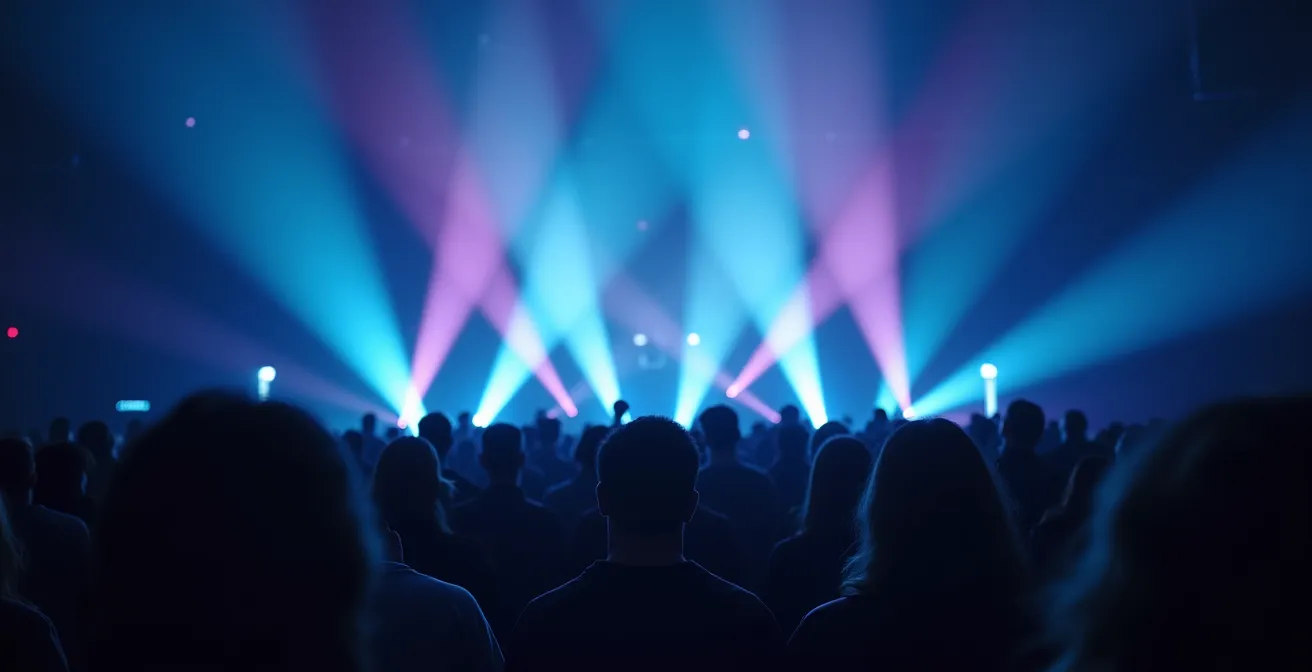
The intense euphoria of a live concert is not just in your head; it is a full-body neurobiological event that recorded music cannot replicate.
- Your body doesn’t just hear bass; it physically detects it through specialized mechanoreceptors in your skin and organs, a sensation headphones can’t reproduce.
- The collective energy of the crowd triggers “emotional contagion” via mirror neurons, synchronizing your emotional state with thousands of others and amplifying the experience.
Recommendation: Understanding the science behind the live music experience allows you to consciously enhance it, from choosing your spot in a venue to managing the post-show crash and protecting your long-term hearing.
There’s a universal, almost primal, feeling that every concert-goer recognizes: the moment the house lights dim and a wave of sound pressure hits your chest. It’s an experience that transcends mere listening. You’ve spent a significant amount of money on a ticket for an event that, in theory, you could replicate with a good pair of headphones and a streaming subscription. Yet, you know it’s not the same. The emotional high, the sense of connection, the sheer physical impact—it’s a fundamentally different phenomenon. While many attribute this to “crowd energy” or simply the volume, these are superficial explanations for a much deeper process.
The truth lies not in psychology alone, but in physiology and neuroscience. The human body is a complex sensory instrument, designed to interpret a rich tapestry of environmental cues. Recorded music, even in high fidelity, delivers only a fraction of this information, primarily targeting the auditory system. A live performance, by contrast, is a multi-modal assault on the senses. It engages your auditory cortex, your visual system, your vestibular system (balance), and, most crucially, your somatosensory system—the network of nerves that processes touch, pressure, and vibration.
The powerful dopamine response you feel isn’t just a reaction to a favorite song; it’s the culmination of a unique neurobiological cascade. It’s a synthesis of full-body vibration, synchronized collective emotion, and the brain’s integration of sight and sound. This article dissects the biological mechanisms at play, explaining why spending money on that ticket is a valid investment in an experience that simply cannot be reproduced. We will explore the science behind feeling the music, the power of the crowd, the real risks involved, and how to harness this knowledge to deepen your connection to the art form.
This exploration will break down the distinct biological events that make live music a peak human experience. The following sections will guide you through the science of sound, from its physical impact on your body to its emotional resonance within a crowd.
Summary: The Neurobiology of the Live Music Experience
- Why Do You Feel Sub-Bass in Your Chest and Not Just Your Ears?
- How to Position Yourself in a Venue for the Best Sonic Experience?
- Crowd Energy or Isolation: Which Context Deepens Emotional Connection?
- The “Ringing” Mistake: Why Not Wearing Earplugs at One Show Causes Permanent Damage?
- How to Manage the “Post-Concert Depression” After a Major Tour Event?
- Mono or Stereo: Which Mic Setup Captures the Most Realism?
- Where to Position the Control Tower for the Best Crowd Experience?
- How to Set Up a Hi-Fi Listening Room for Under $1,000?
Why Do You Feel Sub-Bass in Your Chest and Not Just Your Ears?
The profound physical sensation of live music, particularly the chest-thumping impact of sub-bass, is not an auditory illusion. It is a direct result of your body’s secondary system for “hearing”: mechanoreception. While your ears are exquisitely designed to process airborne sound waves, your body is covered in and filled with pressure-sensitive nerve endings that detect physical vibration. The primary structures responsible for this are the Pacinian corpuscles, onion-like mechanoreceptors located deep in your skin, joints, and even internal organs.
These receptors are tuned to detect high-frequency vibrations transmitted through solid and liquid mediums—what scientists call substrate vibrations. Recent research demonstrates that the core of these structures contains specialized cells that potentiate their sensitivity, allowing them to detect microscopic vibrations. At a concert, the powerful sound system doesn’t just move air; it vibrates the floor, the structure of the venue, and ultimately, you. These low-frequency waves travel through your skeleton and body tissue, directly stimulating Pacinian corpuscles. This is a form of sensory input headphones simply cannot deliver. In fact, research shows that Pacinian corpuscles are tuned to detect vibrations in the 100 to 2000 Hz range, which perfectly overlaps with the impactful frequencies of bass and percussion instruments.

This full-body haptic feedback is interpreted by the brain as a more immersive and “real” event, contributing significantly to the release of adrenaline and dopamine. You are not just hearing the kick drum; your entire nervous system is feeling it as a physical event. This is why a massive sound system in an open field can feel less impactful than a smaller, perfectly tuned system in an enclosed club—the transmission of substrate vibration is key.
How to Position Yourself in a Venue for the Best Sonic Experience?
Achieving the optimal sonic experience in a live venue is an exercise in applied physics and biology. The “best” spot is not merely about being close to the stage; it’s about finding the location where the sound is most balanced and your brain can most effectively process the information. The single most important landmark for this is the Front of House (FOH) mixing desk. This is where the audio engineer stands, and the entire sound mix is calibrated to sound perfect from this one position. By positioning yourself near the FOH, you are hearing the show exactly as the artist and engineer intend.
Beyond this primary rule, several psychoacoustic principles can guide your positioning to maximize clarity and impact:
- Avoid Sonic Traps: Stay away from corners and flat back walls. These areas are prone to creating “standing waves,” where bass frequencies can either build up into a muddy mess or cancel each other out, leaving you with a thin, lifeless sound.
- Engage the McGurk Effect: Your brain integrates visual and auditory information to enhance perception. Having a clear line of sight to the performers’ faces and hands allows your brain to use visual cues (like mouth shape or hand movements on an instrument) to improve the perceived clarity of the sound.
- Choose Your Distance for Intent: For analytical listening and appreciating the full stereo image, a position about two-thirds of the way back from the stage is often ideal. For a more visceral, socially energized experience driven by proximity and oxytocin release, moving closer is more effective.
- Mitigate High-Frequency Harshness: Being directly in the “line of fire” of a speaker array can result in overly harsh and fatiguing high frequencies. Moving slightly off-axis can smooth out the sound while maintaining a powerful bass response.
Ultimately, finding your perfect spot involves a trade-off between social energy, visual engagement, and technical sound fidelity. Understanding these variables allows you to make a conscious choice based on what you want to get out of the performance.
Crowd Energy or Isolation: Which Context Deepens Emotional Connection?
The debate between the immersive energy of a crowd and the focused clarity of isolation (like headphone listening) centers on a powerful neurobiological phenomenon: emotional contagion. While isolated listening allows for analytical appreciation of musical detail, the collective experience of a concert crowd provides a feedback loop that dramatically amplifies emotional response. This is not a metaphysical concept; it is driven by a specific neural mechanism known as the mirror neuron system.
Mirror neurons are brain cells that fire both when we perform an action and when we observe someone else performing that same action. This system is the foundation of empathy, learning, and social bonding. At a concert, you are surrounded by thousands of people who are physically and emotionally reacting to the same stimulus. When you see someone next to you raise their hands in euphoria, a part of your brain simulates that action and its associated emotion. When you hear the collective roar of the crowd, your brain’s auditory centers process it as a massive, unified emotional signal. This creates a powerful, self-reinforcing loop where the collective joy of the group heightens your own, and your expression of joy contributes back to the group.
This biological synchronization is something headphones can never replicate. As neuroscientist Thomas Arizmendi explains in Psychology Today, this process is fundamental to our social nature:
What we have learned is that by observing another’s actions or even hearing them (audiovisual mirror neurons), the same area of the brain becomes activated that would if we were performing that action ourselves
– Thomas Arizmendi, Psychology Today – Dynamics of Emotional Contagion
This shared experience triggers the release of social bonding hormones like oxytocin, which deepens feelings of connection and well-being, further enhancing the dopamine rush from the music itself. Therefore, while isolation allows for focus, the crowd context provides an unparalleled pathway to a deepened, shared emotional peak.
The “Ringing” Mistake: Why Not Wearing Earplugs at One Show Causes Permanent Damage?
The immense power of a live concert comes with a significant and often underestimated biological risk: permanent hearing damage. The temporary ringing in your ears after a show, known as tinnitus, is not a harmless side effect; it is a direct distress signal from your auditory system indicating that irreversible damage has occurred. This damage happens at a microscopic level inside your cochlea, the spiral-shaped organ in your inner ear responsible for converting sound vibrations into neural signals.
Inside the cochlea are thousands of tiny “hair cells,” or stereocilia, which bend in response to sound waves. Loud noises cause these delicate structures to bend too far, leading to damage or death. Unlike other cells in the body, these hair cells do not regenerate. Once they are gone, they are gone forever, leading to permanent hearing loss and chronic tinnitus. The danger is a function of both volume (measured in decibels, dB) and duration. Concerts regularly operate at 100-110 dB, a level at which permanent damage can occur with frightening speed. According to hearing safety guidelines, maximum safe exposure is only 15 minutes at 100 dB. A full two-hour set exposes you to eight times the safe limit.

The “just one show won’t hurt” mentality is a dangerous fallacy. Each exposure to unsafe volume levels causes cumulative, irreparable damage. The solution is simple and non-negotiable for anyone who values their hearing: high-fidelity earplugs. These are not the foam plugs that muffle sound, but rather sophisticated filters that reduce the overall decibel level evenly across all frequencies, preserving the clarity of the music while protecting your hearing. Investing in a pair is as essential as the ticket itself.
How to Manage the “Post-Concert Depression” After a Major Tour Event?
The feeling of emptiness or melancholy that can follow a major concert, often dubbed “post-concert depression,” is a genuine neurochemical phenomenon. It is the brain’s response to the sudden withdrawal of an intensely stimulating, multi-sensory experience. During a concert, your brain is flooded with a powerful cocktail of neurotransmitters: dopamine from the rewarding music and anticipation, adrenaline from the excitement, and oxytocin from the social bonding. This creates a state of heightened euphoria.
Once the event is over, your brain faces a steep “comedown.” Neurotransmitter levels plummet as the system attempts to rebalance, leading to feelings of lethargy, sadness, and a lack of motivation. The experience is neurologically similar to the withdrawal felt after other intensely rewarding activities. The brain’s reward centers, particularly the caudate and nucleus accumbens, which were highly active during the show, become comparatively quiet. In fact, neuroscience research reveals dopamine shows distinct patterns of activity in these regions during periods of peak musical pleasure, explaining the intensity of both the high and the subsequent low.
Managing this is not about fighting the feeling, but about supporting your brain’s natural recovery process. It requires gently re-engaging reward pathways without seeking another extreme high. A structured approach can help ease the transition and allow your neurochemistry to recalibrate smoothly.
Action Plan: A Neuro-Informed Recovery Protocol
- Engage in gentle dopamine-releasing activities like sunlight exposure and light exercise within 24 hours to support natural mood elevation.
- Consume foods rich in tyrosine (almonds, avocados, bananas), an amino acid that serves as a precursor for dopamine production, to help replenish your brain’s supply.
- Re-engage with positive concert memories by looking at photos, listening to the artist’s music at a moderate volume, or discussing the show with friends to gently reactivate reward pathways.
- Practice journaling or create a playlist from the concert to help your brain process and integrate the intense sensory and emotional experience.
- Allow a 48-72 hour “rest period” for your neurotransmitter levels to naturally rebalance, avoiding other forms of overstimulation like intense movies or video games.
Mono or Stereo: Which Mic Setup Captures the Most Realism?
The quest to capture musical “realism” in a recording is a technical and philosophical challenge, and the distinction between mono and stereo recording lies at its heart. Neither format truly replicates the live experience, but understanding their limitations reveals why. A live performance is an infinitely complex sound field; a recording is a deliberate, simplified representation of it. Mono recording captures sound from a single point, creating a focused, centered image. Stereo recording uses two or more points to create an illusion of width and spatial positioning between speakers or in headphones.
However, even advanced stereo cannot capture the verticality, depth, and full-body vibrations of a live event. Your brain processes live sound using a host of cues—interaural time differences (when sound hits each ear), interaural level differences (how loud it is in each ear), and the reflections from the room’s surfaces—to construct a three-dimensional mental map. Stereo recording guides and limits this perception, while live sound provides a rich data stream for your brain to interpret freely.
This comparison highlights the inherent trade-offs in capturing reality. While stereo offers a more immersive soundstage than mono, it’s still a carefully constructed illusion that pales in comparison to the real thing.
| Aspect | Mono Recording | Stereo Recording |
|---|---|---|
| Spatial Information | Single point source | Width and positioning |
| Brain Processing | Forces spatial imagination | Guides perception |
| Live Realism | Natural for vocals/bass | Better for ambience |
| Headphone Playback | Center-focused | Immersive soundstage |
| Best Use | Intimate recordings | Complex arrangements |
The pinnacle of recording realism for headphone listening is binaural audio, which uses a dummy head with microphones in its ears to capture sound exactly as a human would hear it. As the Audio Engineering Society notes, this technique is superior for creating a 3D effect because it preserves the subtle time and level cues between the ears. Yet even this advanced method fails to reproduce the critical element of substrate vibration—the feeling of the music in your body.
Where to Position the Control Tower for the Best Crowd Experience?
From a concert-goer’s perspective, the “control tower”—or Front of House (FOH) mixing position—is the single most important location in the entire venue. It is the sonic ground zero, the reference point from which the audio engineer orchestrates the entire show. The engineer’s primary goal is to create a powerful, clear, and emotionally impactful mix that translates well to the entire audience, and they do so from this very spot. Therefore, their experience *is* the intended experience.
The positioning of the FOH desk is not arbitrary. It is strategically placed at a distance from the stage where the sound waves from the various speakers (mains, subs, fills) converge and integrate into a coherent whole. Too close, and the sound is a disjointed collection of individual sources. Too far, and the sound loses its direct energy and becomes dominated by room reverberation. The FOH position represents the optimal balance between direct sound from the stage and the ambient sound of the venue.
When the engineer makes a decision—to turn up a guitar solo, add reverb to a vocal, or boost the kick drum—they are making it based on what they hear in that exact location. They are your ears. By standing near the FOH, you are effectively plugging directly into the engineer’s brain, hearing the most balanced and meticulously crafted version of the performance. While other spots in the venue might offer more physical bass impact or a more intense social crush, the FOH area is the undisputed location for the highest fidelity audio.
Key Takeaways
- The intense feeling of live music is a full-body event, driven by Pacinian corpuscles in your skin detecting bass vibrations that headphones cannot produce.
- “Crowd energy” is a real neurobiological phenomenon called emotional contagion, where your mirror neuron system syncs your emotions with those around you, amplifying the experience.
- The ringing in your ears after a concert is a sign of permanent, irreversible damage to the hair cells in your cochlea; high-fidelity earplugs are essential.
How to Set Up a Hi-Fi Listening Room for Under $1,000?
While nothing can fully replicate the live experience, you can bring your home listening environment significantly closer by focusing on the same principles: physical impact and an immersive sound field. The biggest mistake is spending the entire budget on electronics. In reality, the room itself is the most important component in your audio system. Indeed, acoustic research indicates room treatment can account for up to 80% of perceived sound quality.
With a budget of $1,000, the priority should be to manage how sound behaves in your space and to ensure you can *feel* the music, not just hear it. A strategic allocation of funds can yield results that outperform systems costing many times more.
- Prioritize Room Acoustics (approx. $300): Your first and most impactful investment should be in acoustic treatment. Hard, flat surfaces like walls and windows create reflections that smear the sound. You can build highly effective DIY acoustic panels using wooden frames, mineral wool insulation, and fabric. Placing these at first-reflection points (the spots on the side walls between you and the speakers) will bring immediate and dramatic improvements in clarity and imaging. Thick rugs and heavy curtains are also affordable and effective tools.
- Invest in a Subwoofer (approx. $300): To recreate the physical sensation of live music, a dedicated subwoofer is not a luxury; it is essential. Its job is to reproduce the low-frequency information that triggers the same Pacinian corpuscles we discussed earlier. A modest, well-integrated subwoofer will do more for emotional impact than a pair of “full-range” speakers alone.
- Choose Speakers for Character (approx. $250): With a limited budget, don’t chase perfect neutrality. Instead, choose speakers that have a pleasing character and engage you emotionally. Listen to a few options and pick the ones that make you want to tap your feet.
- Optimize Speaker Placement (Free): The most powerful tool you have is positioning. Place your speakers and listening chair in an equilateral triangle. This “rule” is the foundation of a proper stereo image, allowing your brain to construct a believable soundstage.
By focusing on taming the room and reproducing physical bass, you are directly addressing the two biggest factors that separate live music from a typical home listening setup. This approach maximizes the emotional and neurobiological impact of your music collection.
Now that you understand the complex interplay of physiology, physics, and neuroscience that makes live music so powerful, you can approach every concert not just as a listener, but as an active participant in a profound biological event. This knowledge empowers you to enhance your experience, protect your hearing for a lifetime of enjoyment, and justify every dollar spent on that irreplaceable feeling.