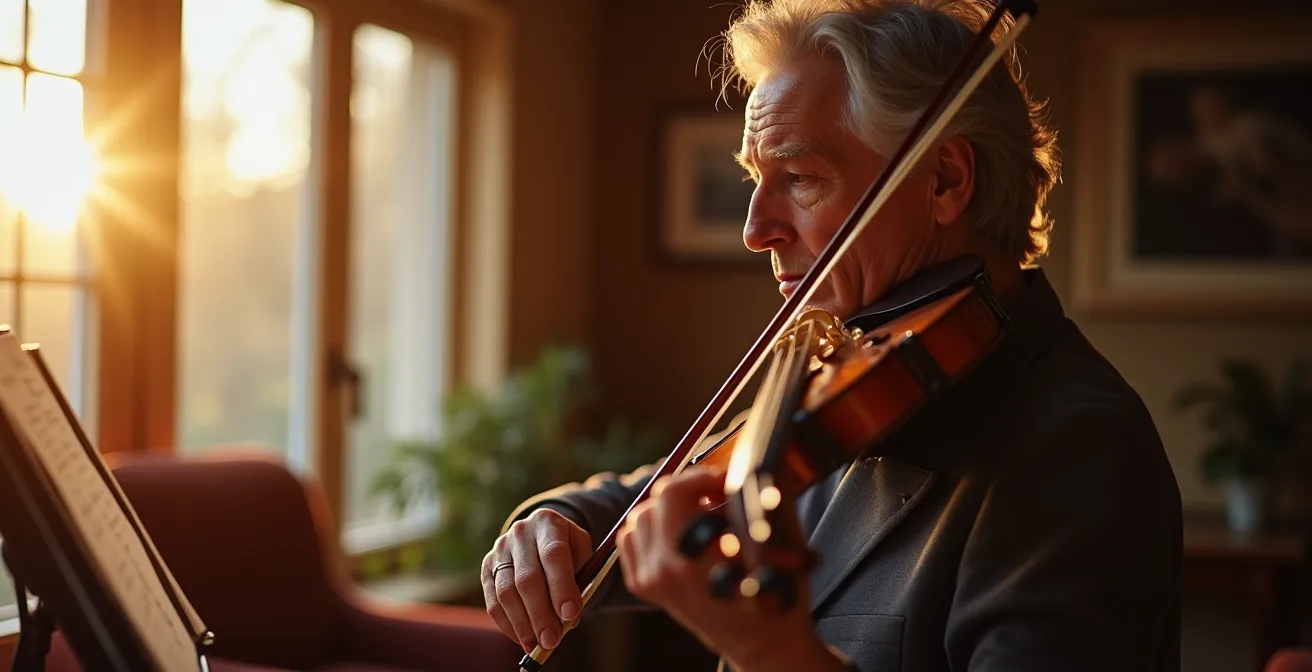
Mastering the violin as an adult is less about musical talent and more about systematically dismantling the physical and psychological roadblocks your own body has built over decades.
- Physical progress requires “unlearning” years of postural habits before new muscle memory can form.
- Equipment choice is critical; a cheap instrument creates a negative feedback loop that actively prevents learning.
- The biggest hurdles are mental: navigating the frustrating “progress dip” and separating your analytical “practitioner brain” from your expressive “performer brain.”
Recommendation: Approach the violin not as a hobby to be “picked up,” but as a strategic project of self-re-engineering. Focus first on ergonomics and quality tools.
Let’s be brutally honest. Anyone who tells you “it’s never too late to learn the violin” is only telling you half the story. The encouraging sentiment is true, but it glosses over the monumental challenge that awaits an adult learner. Unlike a child, whose body and brain are like sponges, you arrive at this instrument with decades of established postural habits, a fully-formed analytical mind prone to self-criticism, and a physical stiffness you might not even be aware of. The battle isn’t with the violin; it’s with yourself.
The common advice—practice daily, find a good teacher, be patient—is not wrong, but it is profoundly incomplete. It doesn’t explain the *why* behind the frustration. It doesn’t give you a framework for understanding why it often feels like you’re getting worse before you get better, or why the sounds you make are so demoralizingly scratchy for months on end. This isn’t just about learning notes and scales. It’s about a fundamental process of physical and psychological unlearning before the real learning can even begin.
But if it’s such a struggle, why bother? Because the reward is proportionate to the challenge. For an adult, learning the violin isn’t just about making music; it’s a powerful tool for cognitive enhancement, a deep exercise in mindfulness, and a source of immense personal satisfaction. This guide is your new playbook. We will dissect the most common and discouraging hurdles specific to adult learners and provide a brutally honest, strategic roadmap to overcome them. We will move beyond platitudes and into the mechanics of success.
This article provides a strategic breakdown of the key challenges you’ll face and, more importantly, the concrete methods to overcome them. Follow this guide to turn frustration into focused progress.
Summary: A Strategic Guide to Conquering the Violin as an Adult
- How to Hold a Violin for 30 Minutes Without Neck Pain?
- Rent or Buy: Which Option Makes Sense for the First Year of Violin?
- How to Eliminate Bow Screeching in Your First 3 Months?
- The $100 Violin Trap: Why Cheap Instruments Hinder Progress?
- How to Use Drone Tracks to Fix Your Intonation Faster?
- Why Does It Feel Like You Are Getting Worse Before You Get Better?
- Why Does Obsessing Over Mistakes Kill the Vibe of a Performance?
- How to Survive the First 6 Months of Learning an Instrument Without Quitting?
How to Hold a Violin for 30 Minutes Without Neck Pain?
The first and most significant battle for an adult learner is with their own body. For decades, you’ve held your head, neck, and shoulders in a certain way while typing, driving, or reading. Now, you must ask them to do something completely unnatural. The goal is not to “muscle through” the discomfort but to engage in a process of physical unlearning. The pain you feel is a signal that you’re fighting your old habits, not that you’re weak. The violin should feel like an extension of your body, supported by your skeleton, not held up by tense muscles.
This requires a high-quality, professionally fitted shoulder rest and chin rest. These are not accessories; they are essential ergonomic tools. An adult’s body is not one-size-fits-all, and your setup must be customized to your specific neck height, jaw shape, and shoulder slope. A good teacher or luthier is non-negotiable here. They will help you find a neutral, balanced posture where gravity does most of the work. The sensation you’re aiming for is one of release, not tension.
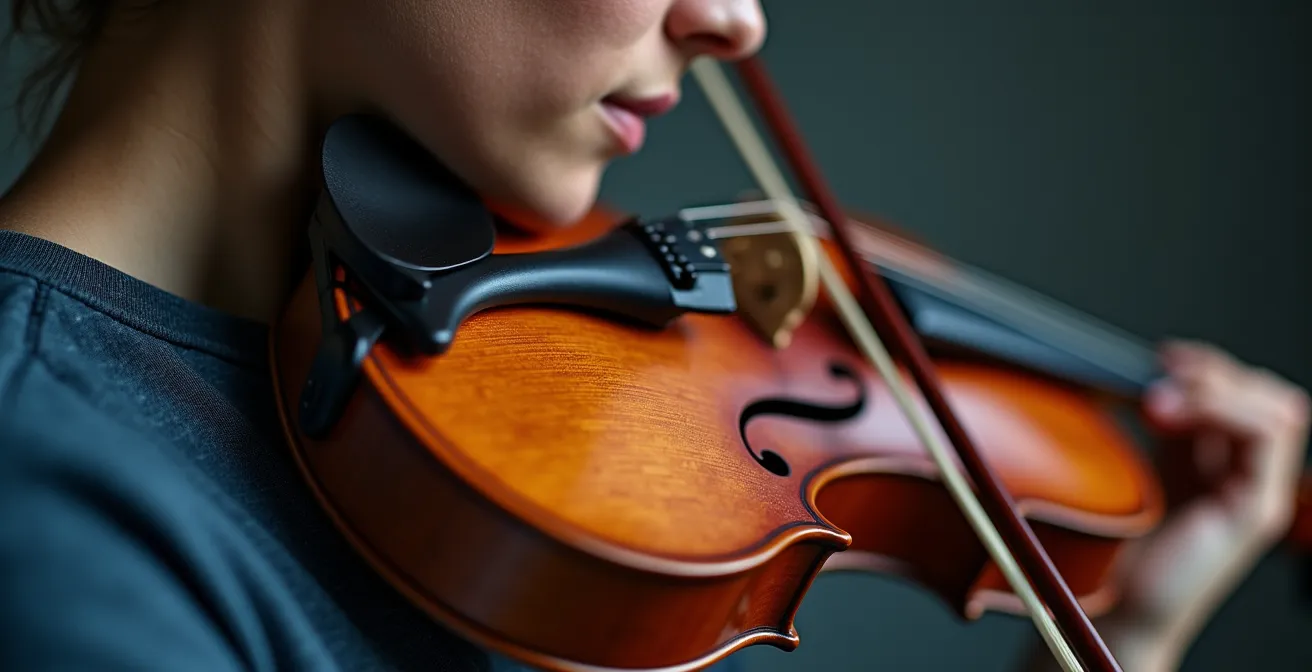
As the image above illustrates, the contact points are precise. The instrument rests on the collarbone, balanced by the gentle weight of the head in the chin rest and the counter-pressure of the bow arm. Any tension in the jaw, neck, or left hand is a red flag. Before you even think about making a beautiful sound, you must be able to hold the instrument in silence, comfortably, for extended periods. This foundational work prevents chronic pain and frees up your entire system for the complex task of playing.
Your Pre-Practice Posture Audit
- Identify Existing Tension: Before picking up the instrument, stand and notice your body. Are your shoulders already creeping towards your ears? Is your jaw tight? Acknowledge these daily tension patterns.
- Check Shoulder Height: As you place the violin, consciously drop your shoulders. They should remain level and relaxed, not raised to meet the instrument.
- Assess Jaw Tension: Rest your head’s weight in the chin rest. You should be able to gently move your jaw side-to-side without clamping down.
- Notice Spine Alignment: Your spine should be long and aligned, neither slouching forward nor artificially rigid. Think of a string pulling you up from the crown of your head.
- Scan for Pain Signals: As you practice, constantly check for new tension. According to experts in body mechanics, it is crucial to identify habits of posture and playing that cause pain, as they directly interfere with the quality of your music-making.
Rent or Buy: Which Option Makes Sense for the First Year of Violin?
Your second strategic decision is about your primary tool: the instrument itself. For an adult beginner, the “rent versus buy” debate isn’t just financial; it’s about quality control and flexibility. A common mistake is buying a cheap “starter” violin online, a decision that can actively sabotage your progress (more on that in a moment). Renting from a reputable violin shop or luthier is almost always the superior choice for the first year.
Why? Three reasons. First, setup quality. Rental instruments from proper shops are set up by a professional luthier. The bridge is carved correctly, the soundpost is in the right place, and the strings are at a playable height. A poorly set up instrument is exponentially harder to play. Second, maintenance is included. When a string breaks or the bow needs rehairing, the shop takes care of it. These costs add up quickly when you own the instrument. Third, flexibility. If you decide after six months that the violin isn’t for you, you can simply return it. You are not stuck trying to resell an instrument with low market value.
While buying seems like an investment, the math often favors renting initially. A decent beginner outfit costs $400-$600, while renting is typically $25-$35 per month. The breakeven point where buying becomes cheaper is often well past the one-year mark, especially when factoring in maintenance. Furthermore, many shops offer a rental credit program, where a large portion of your rental fees can be applied toward purchasing a higher-quality instrument later. This is the smartest path: rent a well-maintained, properly set up instrument, confirm your commitment, and then use your rental credit to upgrade to an even better violin you’ll own for years.
The following table breaks down the typical costs and benefits during your crucial first year, based on an analysis of common rental programs and beginner packages.
| Factor | Renting ($20-30/month) | Buying ($300-500 beginner) |
|---|---|---|
| First Year Total Cost | $300 (at $25/month average) | $400 one-time |
| Maintenance Included | Yes – shops provide bow rehairs and string replacement | No – $90-135/year extra |
| Rental Credit Toward Purchase | $240 typical after fees | N/A – Already owned |
| Setup Quality | Professional luthier setup | Often needs additional setup ($75-150) |
| Flexibility to Quit | High – return anytime | Low – must resell |
How to Eliminate Bow Screeching in Your First 3 Months?
Nothing is more discouraging than the sound of a screeching, scraping bow. It’s the sound that makes family members flee and pets hide. For the first few months, this is the default sound for most adult beginners. The key is to understand that screeching is not random; it is a symptom of a specific imbalance between the three pillars of tone production: bow speed, pressure, and contact point (placement of the bow between the bridge and the fingerboard).
As an adult, your instinct is to control things with force. You press down hard, trying to “make” a sound. This is the primary cause of screeching. A good tone comes from releasing the natural weight of your arm into the string, not from muscular pressure. Your bow should feel like it’s sinking into the string, drawing the sound out, not scraping it off the surface. Think of it like a figure skater’s blade: too little pressure and it skitters, too much and it chatters. You’re looking for that perfect glide.
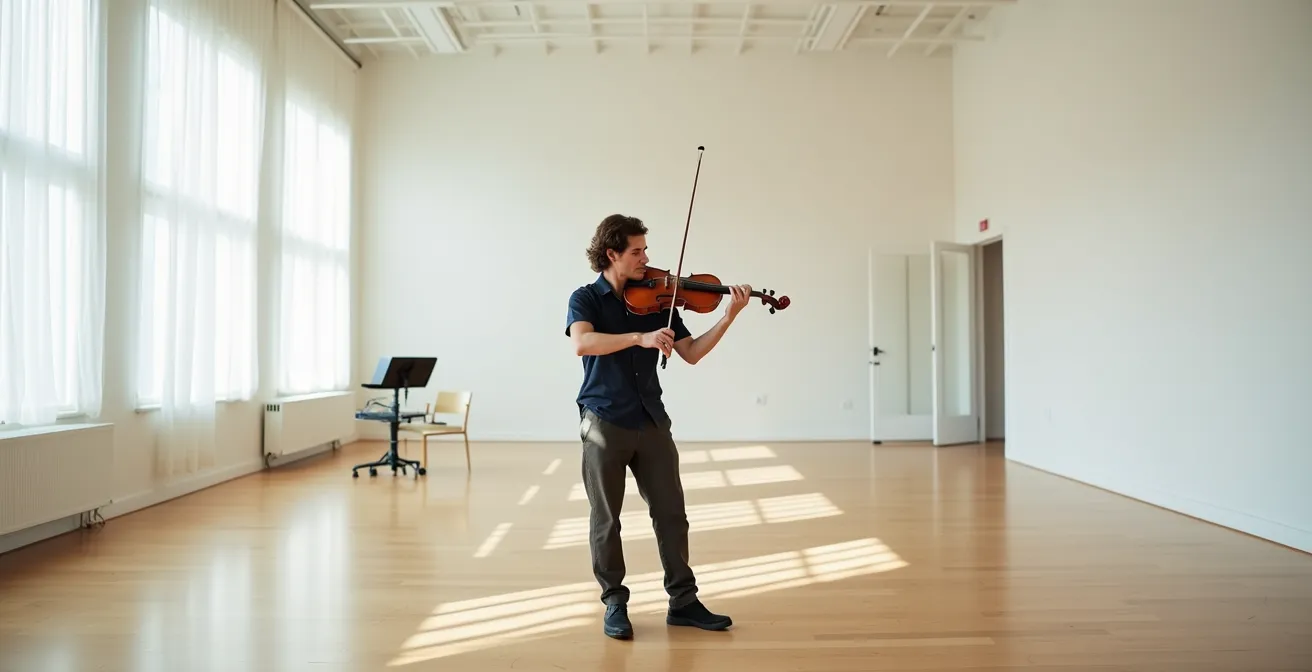
The solution is systematic, diagnostic practice. Instead of just playing, become a scientist of your own sound. Isolate the variables. Play long, slow, open strings focusing only on maintaining a consistent arm weight. Then, vary your bow speed while keeping the weight constant. Finally, change the contact point. You’ll quickly discover the “sweet spot” for each string. Screeching is just feedback. It’s the violin telling you, “You’re either too fast, too slow, too heavy, too light, or in the wrong place.” Listen to that feedback without judgment and make one small adjustment at a time. This analytical approach turns a frustrating noise into valuable data.
- If screeching happens at the start of the bow stroke: You are likely “biting” the string with too much pressure from a dead stop. Try starting the bow motion a millisecond before it touches the string to create a softer landing.
- If screeching happens in the middle of the stroke: Your bow speed and pressure are out of sync. You are likely moving the bow too fast for the amount of weight you’re using, causing it to “skate” over the string’s surface.
- If screeching happens when you change bow direction: You are not maintaining consistent arm weight through the change. The goal is a seamless transition, not a stop-and-start jerk.
The $100 Violin Trap: Why Cheap Instruments Hinder Progress?
Let’s address the elephant in the room: the ultra-cheap, “complete” violin outfit you can buy online for $100. As a teacher, this is my biggest point of frustration. These are not instruments; they are what luthiers call VSOs (Violin-Shaped Objects). Buying one is the single fastest way to guarantee you will quit within three months. This isn’t snobbery; it’s about a critical concept for adult learners: the feedback loop.
Learning an instrument is about training your brain to connect a physical action to a specific sound. When you place your finger on the string, you hear a pitch. Your brain registers the result. With a proper instrument, this loop is reliable: correct action equals correct sound. A VSO breaks this loop. Because of its poor construction—a thick bridge that won’t vibrate, a plastic fingerboard that buzzes, pegs that slip constantly—even a *correct* action can produce a *bad* sound. Your brain receives faulty data. You try to “fix” the bad sound by making an incorrect physical adjustment, which then becomes ingrained as bad muscle memory. You are actively teaching yourself the wrong way to play.
Case Study: Feedback Loop Failure in VSO Instruments
An adult learner’s brain relies on clear, consistent feedback to build new neural pathways. As experts in adult music education note, working with quality instruments is essential for developing proper technique precisely because adults often have pre-existing physical challenges. A VSO forces the player to make unnatural compensatory movements to produce any sound at all. For example, to stop a string from buzzing on a poorly shaped fingerboard, a student might press far too hard. This tension becomes a deeply ingrained habit, requiring months or even years of remedial work with a teacher to unlearn once they finally upgrade to a real violin.
A VSO is a false economy. The $100 you “save” will cost you hundreds more in frustration, wasted time, and the potential need for physical therapy to undo the damage of bad posture. A quality rental instrument, by contrast, provides a clean, reliable feedback loop, allowing your brain to build the correct connections from day one. You must be able to trust that the sound you’re making is a true reflection of your actions.
How to Use Drone Tracks to Fix Your Intonation Faster?
After producing a decent tone, the next great mountain to climb is intonation—playing in tune. Unlike a piano, the violin has no frets. A millimeter’s difference in finger placement can be the difference between a beautiful note and a cringe-worthy one. For adults, whose auditory processing is less malleable than a child’s, developing a reliable sense of pitch can be a slow, frustrating process. Your most powerful tool in this fight is the drone.
A drone is a continuously sounding note that serves as your auditory benchmark. By playing a scale or a simple melody against a drone of the scale’s root note (e.g., playing a G major scale against a constant G drone), your ear is forced to recognize the relationship between each note and the harmonic center. When a note is out of tune, it creates a dissonant “beating” or “wobble” against the drone. When it’s perfectly in tune, it “locks in” and creates a smooth, ringing resonance. This is instant, objective feedback that is far more effective than staring at a digital tuner.
Practicing with drones trains your ear and your muscle memory simultaneously. It bypasses your analytical brain and builds a subconscious, physical understanding of where the notes live on the fingerboard. This method is so effective that studies show it can dramatically accelerate progress. Indeed, one analysis found that students using drone practice show 40% faster intonation improvement compared to those relying solely on other methods. This isn’t just about hitting the right notes; it’s about hearing the *relationships between* them, which is the very essence of music.
Start simply. Use a cello drone track on YouTube or a drone app. Play a single long note against the drone and adjust your finger until the “wobble” disappears and the sound becomes pure. Then move to two notes, then three, and then entire scales. Ten minutes of focused drone practice is more valuable than an hour of mindless, out-of-tune playing. It is the fastest way to build the foundational skill of a strong ear.
Why Does It Feel Like You Are Getting Worse Before You Get Better?
There is a terrifying moment in every adult learner’s journey, usually around month three or four, known as “the dip.” It’s a period where, despite practicing diligently, you suddenly feel like you are regressing. Your intonation seems to be getting worse, your bow feels clumsy again, and your motivation plummets. This is not a sign of failure. On the contrary, it is the most critical sign of progress. You are transitioning from one stage of learning to another.
This phenomenon is best explained by the Four Stages of Competence model, a cornerstone of adult learning theory. When you start, you are in a state of “Unconscious Incompetence”—you are bad, but you don’t even know *how* bad you are. You can’t hear your own intonation errors clearly. “The dip” is the painful but necessary shift into “Conscious Incompetence.” You don’t sound worse; you have simply developed a more discerning ear. Your brain and ears have improved enough to recognize your own flaws in excruciating detail. This is a victory, even if it feels like a defeat.
Feeling worse is the shift from ‘Unconscious Incompetence’ to ‘Conscious Incompetence’—your ear and knowledge have improved enough to recognize your own flaws.
– Adult Learning Theory Applied to Music, Four Stages of Competence Model
Neurologically, this is a period of intense brain rewiring. You are dismantling old, inefficient neural pathways and building new, more precise ones. This process is not linear. It involves trial, error, and consolidation. Research into the neuroplasticity of adult musicians confirms that students report temporary performance decreases during these periods of technical adjustment. However, those who understand this process and persist through the dip show the most significant long-term improvements in both technique and musicality. So when you hit this wall, don’t despair. Recognize it for what it is: the messy, uncomfortable, and essential work of genuine learning.
Why Does Obsessing Over Mistakes Kill the Vibe of a Performance?
You’ve practiced for weeks. In the practice room, the piece sounds pretty good. Then you try to play it for a friend, your teacher, or even just a recording device, and it all falls apart. You hit a wrong note, and your brain instantly short-circuits. You fixate on the error, your body tenses up, and the rest of the performance is a joyless, mechanical exercise. This is the curse of the adult analytical mind. To overcome it, you must learn to consciously switch between two distinct mental modes: the Practitioner Brain and the Performer Brain.
The Practitioner Brain is your analytical, problem-solving self. Its job is to dissect, diagnose, and fix technical problems. It listens for intonation errors, analyzes bow angles, and focuses on the “how.” This mode is essential for effective practice. The Performer Brain, however, has a completely different job. Its role is to communicate the emotional arc of the music. It focuses on phrasing, character, and storytelling. It must trust the work the Practitioner Brain has already done and let go of moment-to-moment analysis.
The mistake adults make is trying to use their Practitioner Brain during a performance. When you obsess over a mistake, you’ve dragged your analytical mind back onto the stage. The music stops being a story and becomes a test you are failing. The solution is to create a clear ritual to transition between these modes. Before you play for someone, take a deep breath and give yourself permission to shift gears. Your goal is no longer technical perfection; it is emotional communication. If a mistake happens, your job as a performer is to keep the story going, to incorporate it into the narrative and move on gracefully. As one teacher wisely notes, a habitual focus on failure can make a violinist become resigned to a lower level of artistry, forever stuck in the technical weeds.
This mental separation is a skill, and it must be practiced just like a scale. Record yourself and practice playing through mistakes without stopping. The more you do it, the more you will build the resilience of your Performer Brain and learn to share the joy of the music, flaws and all.
Key Takeaways
- Learning violin as an adult is a strategic process of overcoming your body’s ingrained habits and your brain’s analytical tendencies.
- Invest in ergonomics and quality tools from the start. A proper setup and a good rental instrument are non-negotiable.
- Embrace the frustrating “dip” in progress as a sign of true learning—your ear is getting better, not your playing getting worse.
How to Survive the First 6 Months of Learning an Instrument Without Quitting?
The first six months on the violin are a trial by fire. This is where most adult beginners give up, defeated by the screeching sounds, neck pain, and a perceived lack of progress. Surviving this period requires a strategic framework built on realistic expectations, consistent effort, and a focus on small, measurable wins. Your goal is not to sound like a professional in six months; your goal is to build a sustainable practice habit that will carry you for years.
The most important factor is consistency over duration. The adult brain builds new skills more effectively through short, frequent reinforcement than through long, sporadic cram sessions. Practicing for 15-20 minutes every day is infinitely more powerful than a single two-hour practice on the weekend. This daily engagement keeps the new neural pathways active and turns practice from a chore into a non-negotiable part of your routine, like brushing your teeth.
Next, you must redefine “progress.” You will not be playing concertos in six months. Set small, achievable “micro-goals.” Examples could include:
- Playing one open string with a clear, steady tone for a full bow.
- Playing a one-octave G major scale in tune with a drone.
- Memorizing the first four bars of “Twinkle, Twinkle, Little Star.”
Each time you achieve one of these tiny goals, you get a small dopamine hit of accomplishment, which provides the fuel to keep going. This structured, goal-oriented approach is how adult learners can make astounding progress. One case study documented an adult violinist who, by applying an analytical mindset and a dedication to structured practice, went from knowing nothing to successfully auditioning for university music programs with scholarships in under three years. It is possible, but it requires a methodical, project-manager’s approach.
Embracing the violin after 30 is one of the most demanding yet rewarding projects you can undertake. By approaching it with strategy instead of just hope, you transform the immense challenge into a clear path toward profound personal and artistic growth. Start today by assessing your posture and finding a reputable shop for your first rental instrument.